
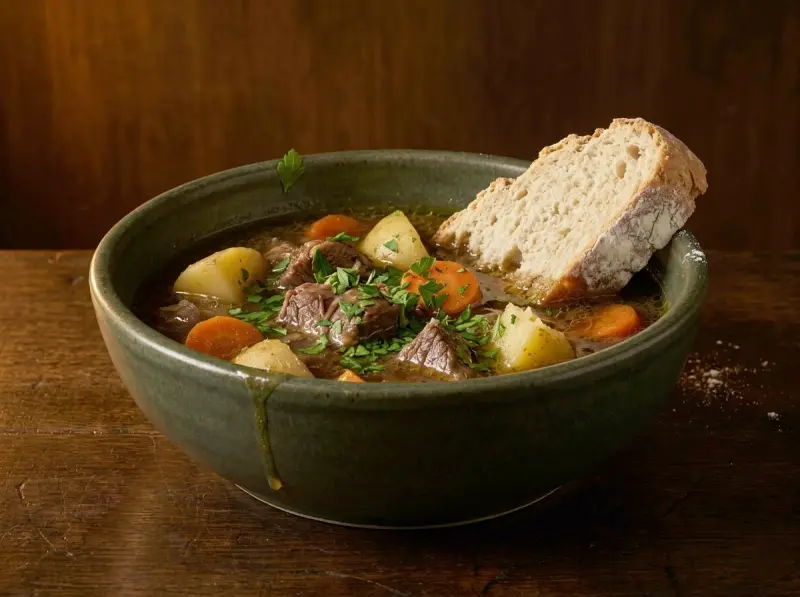
Ragoût Irlandais
Épaule d'agneau dorée jusqu'à une couleur sombre, puis braisée lentement avec des pommes de terre, des carottes et des oignons dans un bouillon à la Guinness. Le plat national d'Irlande.
Ingrédients
- 700 gépaule d'agneau
- 600 gpommes de terre
- 3 carottes
- 2 oignons
- 330 mlbière brune Guinness
- 400 mlbouillon de bœuf
- 2 c.à.s.farine
- 3 thym
- 2 feuilles de laurier
- 1 persil
- 1 c.à.c.sel
- 0.5 c.à.c.poivre noir
- 2 c.à.s.huile végétale pour saisir
Préparation
- Coupez l'épaule en morceaux de 4 cm. Séchez complètement avec du papier absorbant. Assaisonnez avec sel et poivre puis farinez.
- Chauffez l'huile dans une cocotte à feu vif. Faites dorer l'agneau en 2–3 fois, 3–4 minutes par face jusqu'à une couleur sombre profonde. Ne précipitez pas — c'est là que se construit la saveur. Réservez.
- Baissez le feu à moyen. Dans la même cocotte, faites revenir l'oignon 5 minutes en grattant le fond. Versez la Guinness et laissez bouillonner 2 minutes. Ajoutez le bouillon.
- Remettez l'agneau dans la cocotte. Ajoutez thym, laurier et tiges de persil (gardez les feuilles pour servir). Amenez à un frémissement léger. Couvrez et cuisez au minimum 60 minutes.
- Ajoutez les carottes en gros morceaux et les pommes de terre en quartiers. Couvrez et cuisez encore 35–40 minutes jusqu'à ce que tout soit tendre.
- Retirez thym, laurier et tiges de persil. Rectifiez le sel. Si le bouillon est trop liquide, cuisez à découvert 10 minutes. Servez dans des assiettes creuses avec du persil haché et du pain soda.
Questions
Ce sont des plats différents. Le ragoût irlandais est le traditionnel : agneau avec pommes de terre, carottes et oignons dans un bouillon clair, d'origine paysanne. Le ragoût à la Guinness est un plat de pub moderne avec du bœuf braisé dans la stout, avec une sauce sombre et intense. La confusion vient du fait que les deux sont irlandais. Cette recette utilise l'agneau traditionnel avec l'ajout de Guinness pour la profondeur. Pour la version strictement classique, omettez la bière.
Seulement épaule ou cou — ils ont beaucoup de collagène qui se transforme en gélatine avec la cuisson lente. La gigot et les côtelettes ne sont pas adaptés. Minimum 90 minutes à frémissement très doux. L'ébullition vive contracte les fibres. La bonne température : quelques bulles paresseuses en surface. Prêt quand il se défait sans résistance avec une fourchette.
Oui. La recette traditionnelle ne contenait pas de bière. Remplacez la Guinness par 330 ml supplémentaires de bouillon pour la version classique. Pour la profondeur sans alcool : 1 c.à.s. de Worcestershire + 1 c.à.c. de concentré de tomate donnent umami et couleur similaires. La bière brune sans alcool fonctionne aussi. Ajoutez-la au même moment que le bouillon.
La turbidité vient de deux choses. D'abord : viande humide — si vous ne séchez pas l'agneau avant de le faire dorer, il libère de l'eau au lieu de former une croûte et trouble le bouillon. Toujours sécher. Ensuite : ébullition trop forte — brise les protéines en particules suspendues. Maintenir le feu minimum. Pour plus de clarté : écumer avec une louche dans les 10–15 premières minutes après l'ajout du liquide.
Le ragoût irlandais se sert seul dans une assiette creuse — la pomme de terre est déjà dedans. Le pain soda est indispensable pour tremper dans le bouillon. Le pain n'est pas une garniture ; c'est l'outil pour finir le bouillon au fond de l'assiette. On le sert parfois avec du colcannon (purée de pomme de terre avec chou et oignon nouveau) à la place de la pomme de terre dans le ragoût. Parsemez de persil frais haché avant de servir.
Notez
Des recettes par e-mail
Une lettre par semaine : une recette choisie selon vos goûts et les nouveautés du site. Vous pouvez la désactiver en un clic.
En cadeau : le livre de recettes de Sergei (e-book).
En cliquant sur le bouton, vous acceptez la politique de confidentialité.
Dites-nous ce que vous aimez cuisiner (30 secondes) →Continuez à parcourir
D’autres plats des archives — choisis pour leur proximité avec ce que vous êtes en train de cuisiner.

Rejoignez la discussion
Commentaires (1)
Rest the beef for at least 5 minutes after cooking irish stew. Cutting immediately lets all those precious juices run onto the board. A loose foil tent keeps it warm without steaming the crust.