


Beef Stroganoff
Beef stroganoff is a Russian dish of thin beef strips in a sour cream sauce, named after Count Alexander Stroganov. Here tenderloin or sirloin is seared hot in batches, then warmed through in an onion and mushroom sauce finished with sour cream that never boils. Partly freezing the beef for 20 minutes makes thin slicing easy.
Ingredients
- 500 gbeef tenderloin or sirloin, sliced into thin strips
- 2 mediumonions
- 300 gmushrooms
- 200 mlsour cream
- 2 tbspflour
- 1 tspmustard
- 2 tbspvegetable oil
- 100-200 mlbroth or water
- 2 tbspdill or parsley
- to tastesalt and ground black pepper
Method
- Freeze the beef for 20 minutes to firm it up, then slice it across the grain into strips about 5 mm thick.
- Heat the vegetable oil in a frying pan over high heat. Fry the meat in small batches for 2–3 minutes per batch, until browned on each side but still juicy inside. Set aside on a plate.
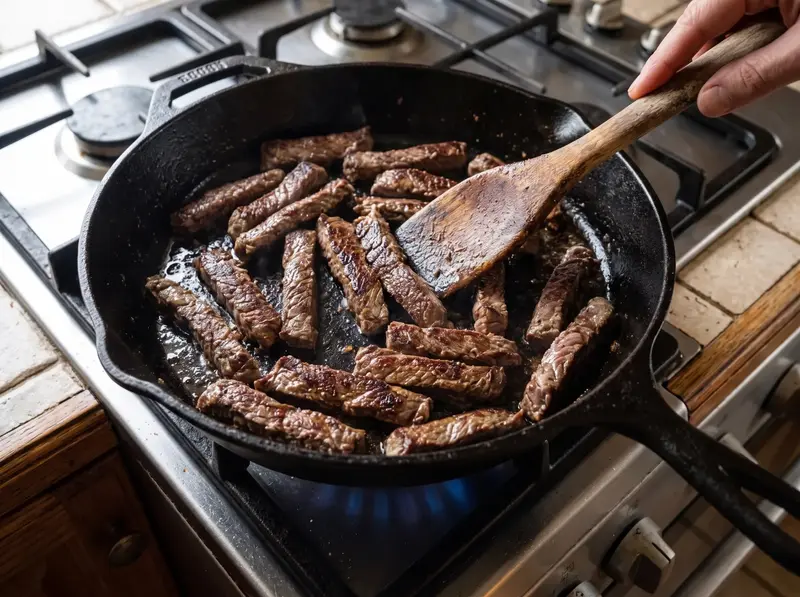
- In the same pan, fry the finely chopped onion until golden, then add the sliced mushrooms and fry for 8–10 minutes, until their liquid has evaporated and they start to brown.
- Lower the heat. Sprinkle the onions and mushrooms with the flour and stir for a minute, then add the mustard and about 100 ml of the broth or water and simmer for 2 minutes until it thickens, adding more liquid if the sauce is too thick. Take the pan off the heat for a minute, stir in the sour cream, then return the beef and its juices. Season with salt and pepper.
- Warm through over low heat for 3 to 5 minutes, stirring, without letting the sauce boil. Serve hot, sprinkled with fresh herbs, traditionally with mashed potatoes, porridge or boiled pasta.
Cooked it? Rate the recipe
FAQ
The most common cause is overcooking thin beef strips. Stroganoff uses quick-fry cuts like sirloin or tenderloin sliced 5–7 mm thick — they need only 1–2 minutes per side in a very hot pan. If you cook them longer or add them to a simmering sauce before searing, the proteins tighten and the meat becomes chewy. Always sear the beef in small batches in a smoking-hot pan with a thin layer of oil; overcrowding drops the temperature and causes steaming instead of browning. Remove the seared beef from the pan, make the sauce separately, and add the meat back only for the final 3–5 minutes of gentle warming — never boil it in the sauce.
Sour cream curdles when added to a very hot pan or allowed to boil. To prevent this: first reduce the heat to low before adding sour cream, and let the sauce cool slightly (about 70°C). Stir a tablespoon of the warm sauce into the sour cream first to temper it, then pour the mixture back into the pan. Never let it boil after adding sour cream — just warm through gently for 3–5 minutes. Full-fat sour cream (20–25%) is much more stable than low-fat versions. If the sauce does curdle, blend it with an immersion blender — it won't fully recover texture but will become smooth again.
Yes, but the technique must change. Shoulder (chuck) is tougher and needs time to break down — it cannot be quick-fried like sirloin. Slice it thin (4–5 mm), pound lightly to break the fibers, and marinate for 30–60 minutes in a small amount of oil and mustard. Sear quickly in batches, then return to the sauce and simmer covered on very low heat for 25–30 minutes until tender. The result will be slightly less elegant than with sirloin but equally flavorful — many home cooks prefer shoulder for its richer beefy taste. Avoid any braising cuts from the leg or shank — they require hours and won't work for stroganoff.
Cut the beef across the grain into strips 5–7 mm thick and 4–5 cm long — cutting with the grain produces long, chewy strands. The grain direction is visible as parallel lines running through the muscle; your knife should cut perpendicular to those lines. For sirloin and tenderloin, pounding is not necessary if the slices are thin enough. For tougher cuts like shoulder, a brief pound (a few taps with a meat mallet) breaks surface fibers and speeds up cooking. Partially freezing the meat for 20–30 minutes makes slicing much easier and ensures even, thin strips.
Classic accompaniments are egg noodles, mashed potatoes, or boiled rice — all absorb the sauce well. In Russia, fried straw potatoes (julienne-cut and deep-fried) are traditional. For a lighter option, serve over steamed buckwheat. Heavy cream (33%) can replace sour cream: use the same quantity, add a teaspoon of lemon juice or a splash of white wine vinegar to replicate the slight tanginess, and stir in a teaspoon of Dijon mustard. The sauce will be richer and silkier but less tangy. Crème fraîche is the best substitute — it has a similar fat content and acidity to sour cream and is very heat-stable.
Keep browsing
More dishes from the Russian archive — picked by overlap with what you're cooking now.





Recipes by email
One letter a week: a recipe picked for your taste, plus whatever is new on the site. You can stop the letters in one click.
Welcome gift: Sergei's cookbook (e-book).
By signing up for the newsletter you agree to the privacy policy.
Tell us what you like to cook (30 seconds) →
Join the conversation
Comments
No comments yet — be the first!