
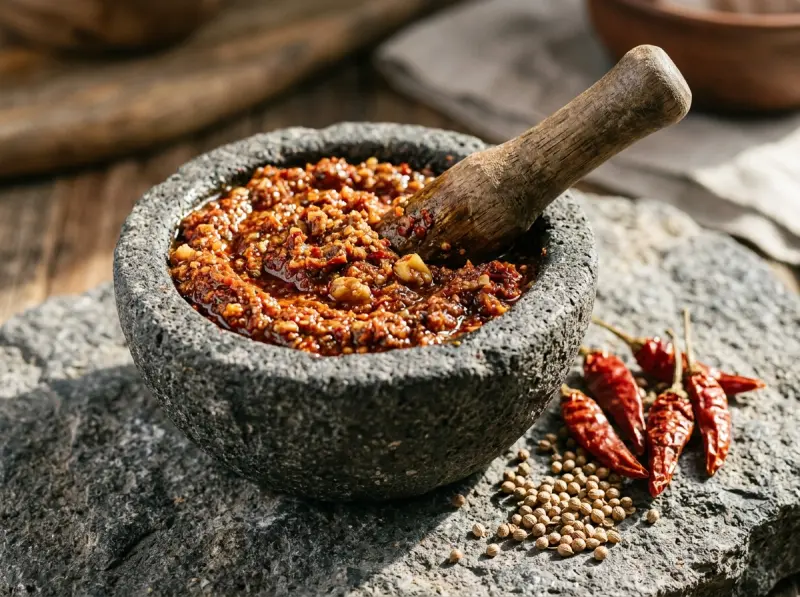
Adjika
A fiery Georgian-Abkhazian spice paste of hot red peppers, garlic, salt, walnuts, and Caucasian spices like blue fenugreek and coriander. Authentic adjika has no tomatoes; it is ground raw into a red pesto-like paste and used as a rub or condiment. It needs a day or two in the fridge before the flavors come together. Makes about 750 g; a serving is 1 tablespoon.
Ingredients
- 250 gdried hot red peppers
- 60 ggarlic
- 50 gwalnuts
- 2 tbspground coriander
- 1 tbspblue fenugreek
- 1 tspdried marigold
- 1 tbspred wine vinegar (optional)
- 25 gsalt
Method
- Wearing gloves, stem the dried hot red peppers, then cover them with just-boiled water and let soak for 15–20 minutes until soft; drain well and pat dry with paper towels, then remove the seeds and inner ribs for moderate heat, or leave them in for a fiery paste.
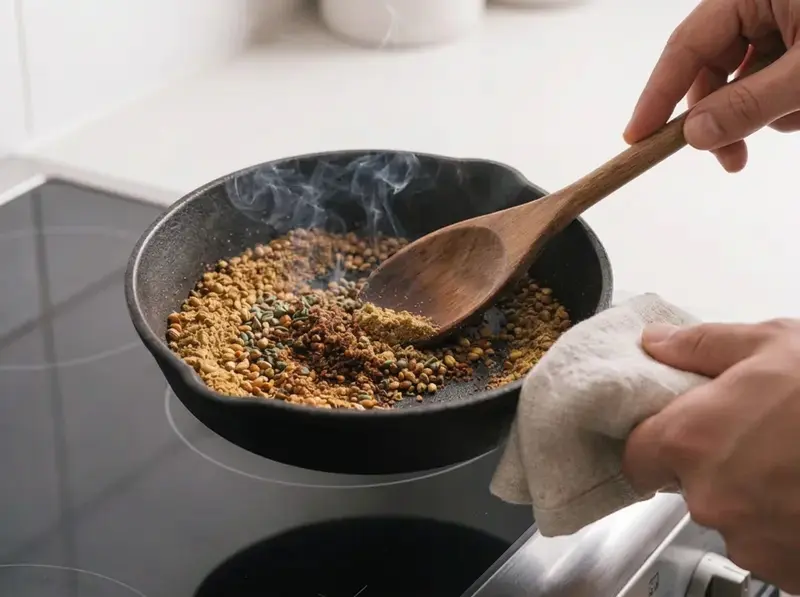
- Lightly toast the ground coriander and blue fenugreek in a dry pan over low heat, stirring, until fragrant, about 30 seconds; do not let them burn.
- Pulse the walnuts in a food processor just to a coarse crumb and set aside, so they do not turn oily and bitter.
- Add the soaked peppers and garlic to the processor and grind to a thick paste, scraping down the sides; if the blades stall, add cooled boiled water a tablespoon at a time.
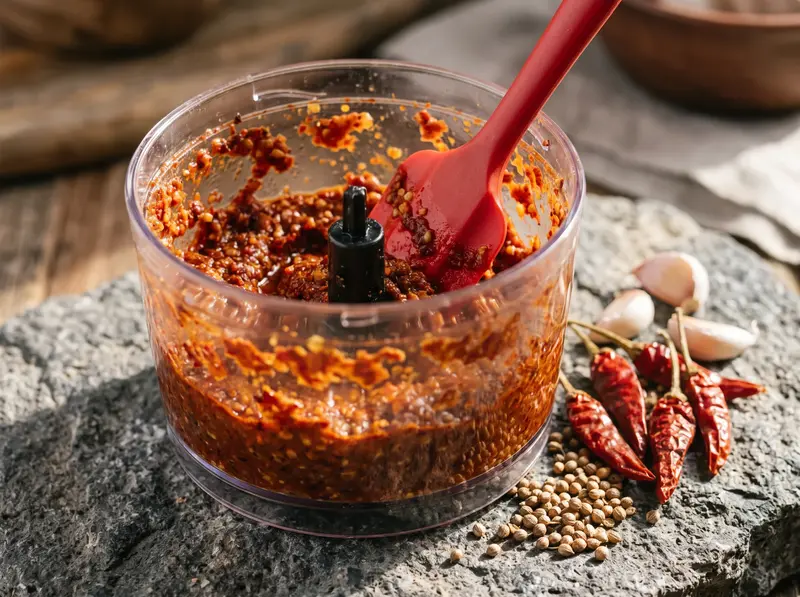
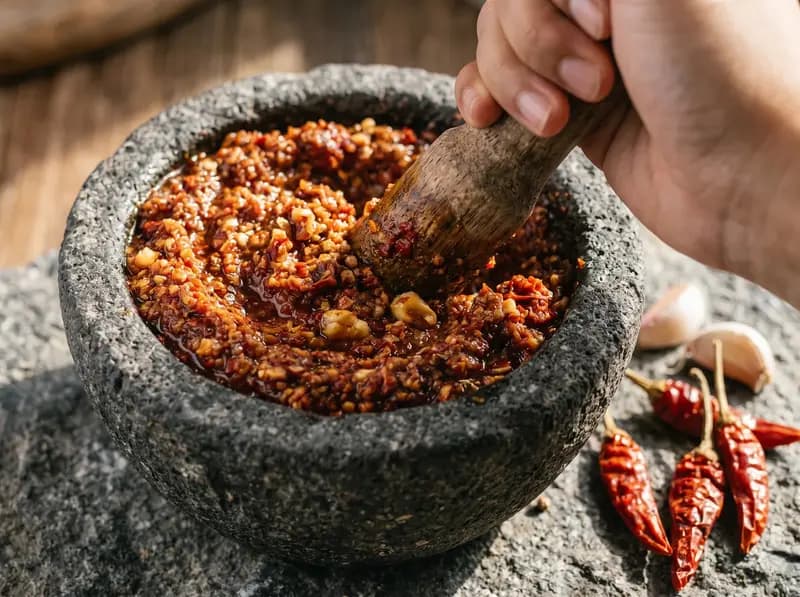
- Add the toasted spices, dried marigold, walnuts, salt, and vinegar, if using, to the processor and pulse until it has the texture of a red pesto. A stone mortar and pestle is the traditional tool and works just as well: pound everything together to the same texture.
- Cover the bowl and let the paste rest in the fridge for 1 to 2 days so the spices open up.
- Pack into clean jars and keep in the fridge for up to 2 weeks; for longer, freeze it in tablespoon portions. With this little salt the paste is not shelf-stable, so do not keep it at room temperature. Discard it if you see surface mold or it smells sour instead of sharply of garlic and chile. Use it as a rub for meat and fish, stirred into soups and stews, or as a spread.
FAQ
Traditional Georgian-Abkhazian adjika is a paste of hot peppers, garlic, salt, walnuts, and spices; tomatoes are not part of it. The tomato-and-carrot version often sold as "adjika" in Russia and Ukraine is a later adaptation, closer to a tomato sauce such as satsebeli. Traditional Abkhazian and Mingrelian adjika stays a thick ground paste of chile, garlic, salt, and spices.
Utskho suneli (blue fenugreek) is a signature Caucasian spice with a grassy, nutty note that shapes adjika's aroma. Swap in regular fenugreek if you can't find it, using less since it's sharper, or use a ready-made khmeli suneli blend, which already contains it.
Adjika is meant to be very hot, built from a full 250 g of dried chiles ground with garlic and spices. Most of the capsaicin sits in the seeds and inner ribs, so removing them before grinding gives a noticeably milder paste, while leaving them in keeps it fiery. Handle the chiles only with gloves — capsaicin soaks into skin and can sting your eyes for hours if you touch your face afterward.
Traditional adjika is ground raw and never simmered. In this recipe the only heat is the just-boiled water that softens the dried peppers and half a minute of toasting for the spices. The cooked sauces sold under the same name are the tomato-based Russian and Ukrainian versions, a different thing.
Pack the finished paste into clean jars and keep it in the fridge for up to 2 weeks; for longer, freeze it in tablespoon portions. With this little salt it is not shelf-stable, so do not keep it at room temperature. Use it as a rub for grilled meat and fish, stir a spoonful into soups, stews and sauces such as satsebeli, or spread it thinly on bread. Throw it out if you see surface mold or notice a sour smell instead of its normal sharp, garlicky aroma.
Keep browsing
More dishes from the Georgian archive — picked by overlap with what you're cooking now.
Recipes by email
One letter a week: a recipe picked for your taste, plus whatever is new on the site. Unsubscribe in one click.
Welcome gift: Sergei's cookbook (e-book).
By subscribing you agree to the privacy policy.
Tell us what you like to cook (30 seconds) →
Join the conversation
Comments
No comments yet — be the first!