
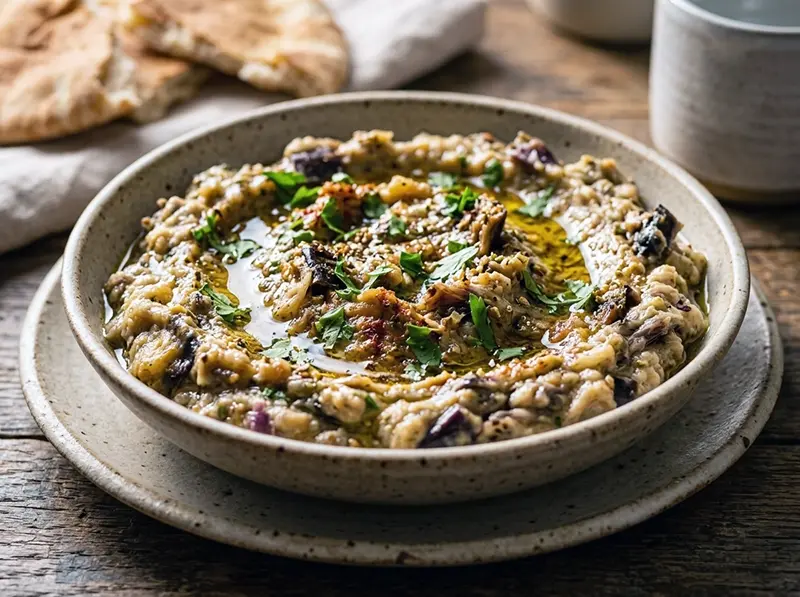
Baba Ganoush
Smoky roasted eggplant mashed with tahini, lemon juice, and raw garlic into a rough, creamy dip that's simultaneously rich and light. The entire point of baba ganoush is the char — the eggplant needs direct contact with flame or the highest heat your oven can deliver, so the skin blackens completely and the flesh underneath turns silky and smoky. I char mine directly on the gas stovetop, which takes about fifteen minutes of turning and gets the best possible flavor.
Ingredients
- 2 largeeggplants
- 3 tbsptahini
- 2 tbsplemon juice
- 2 clovesgarlic
- 2 tbspextra virgin olive oil
- to tastesalt
- 1 tbspfresh parsley
Method
- Char the eggplants: place them directly on gas burner grates over a medium-high flame. Turn every 3–4 minutes using tongs until the entire skin is blackened and blistered and the eggplant is completely soft when pressed — it should collapse under its own weight. This takes 12–15 minutes per eggplant. Alternatively, halve the eggplants, place cut-side down under the broiler at maximum heat for 20–25 minutes.
- Transfer the charred eggplants to a colander set over a bowl. Let them steam and cool for 10 minutes, then slit them open lengthwise and scoop out the flesh with a spoon, leaving the blackened skin behind. Let the flesh drain in the colander for another 5 minutes — excess liquid makes the dip watery.
- Chop the eggplant flesh roughly with a knife on a cutting board — do not use a food processor, which turns it into a smoothie and kills the texture. You want uneven, chunky pieces.
- In a bowl, combine the chopped eggplant, tahini, lemon juice, minced garlic, and salt. Stir with a fork until everything is mixed but still has visible texture. Taste and adjust — it might need more lemon or salt.
- Spread onto a plate, drizzle with olive oil, and scatter fresh parsley on top. Serve at room temperature with warm pita bread. Baba ganoush tastes even better the next day after the flavors have melded in the fridge overnight.
FAQ
The broiler is your best oven alternative. Halve the eggplants and place them cut-side down directly on the oven rack (put a tray below to catch drips) under maximum broiler heat, about 8 cm from the element. Broil for 20–25 minutes until the skin is blistered and blackened and the flesh is completely soft. Some people add a tiny drop of liquid smoke, but use it very sparingly — a quarter teaspoon maximum — or it tastes artificial.
They're related but not identical. Baba ganoush (as made in the Levant) uses charred eggplant, tahini, lemon, and garlic — it's rustic and chunky. Mutabbal (sometimes spelled mutabal) is a smoother version that often includes yogurt and sometimes pomegranate molasses, giving it a tangier, creamier profile. In many restaurants outside the Middle East the names are used interchangeably, but at home the distinction is whether you add yogurt and how smooth you make it.
Two common problems: the eggplant wasn't drained after roasting (the flesh holds a lot of liquid — let it sit in a colander for at least 10 minutes), and the eggplant wasn't charred enough (pale roasted eggplant tastes mild and flat). For the best flavor, the skin must be completely black and the flesh inside should be custard-soft. Also, don't use a food processor — it breaks the cell walls and releases more liquid. Chop by hand for better texture and less wateriness.
Yes, baba ganoush actually improves overnight. The tahini, lemon, and garlic meld with the smoky eggplant and the flavors deepen. Make it the day before, cover and refrigerate. Take it out 30 minutes before serving so it comes to room temperature — cold baba ganoush tastes muted. Add the olive oil drizzle and fresh parsley just before serving. It keeps well in the fridge for 3–4 days.
Tahini is a paste made from ground sesame seeds — hulled and lightly roasted for the best flavor. It should have a pourable, honey-like consistency and a nutty taste. If you can't find tahini, the closest substitute is a blend of 2 tablespoons of creamy peanut butter (unsweetened) with 1 tablespoon of sesame oil — it won't taste the same but captures the richness and nuttiness. Greek yogurt also works as a different-but-good substitute, giving the dip creaminess without the sesame flavor.
Rate this
Recipes by email
One letter a week: a recipe picked for your taste, plus whatever is new on the site. Unsubscribe in one click.
Welcome gift: Sergei's cookbook (e-book).
By subscribing you agree to the privacy policy.
Tell us what you like to cook (30 seconds) →Keep browsing
More dishes from the Israeli archive — picked by overlap with what you're cooking now.
Join the conversation
Comments (1)
The consistency of this baba ganoush is the difference between good and great. Too thick and it doesn't spread; too thin and it slides off. I add the liquid a tablespoon at a time until it coats the back of a spoon.