
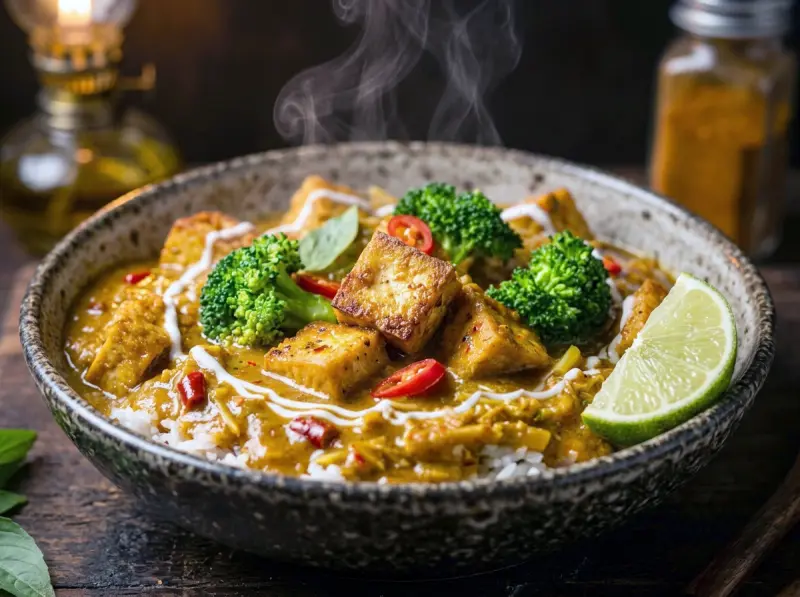
Vegan Coconut Curry
Crispy-edged tofu and vegetables simmered in a fragrant coconut-and-curry-paste sauce, finished with lime juice and fresh herbs. The kind of dish that makes your kitchen smell extraordinary and tastes like it took much longer than it did. The curry paste does most of the flavor work — frying it in oil first releases the aromatics fully before the coconut milk goes in, which is the step that transforms a flat-tasting sauce into something layered and complex. Serve over jasmine rice with extra lime and a scatter of Thai basil.
Ingredients
- 400 gextra-firm tofu, pressed dry 20+ min, cut into 2 cm cubes
- 2 tbspred or yellow Thai curry paste
- 400 mlfull-fat canned coconut milk
- 200 mlvegetable stock
- 1 large onion
- 3 garlic cloves
- 1 tbspfresh ginger
- 1 red bell pepper
- 200 gbroccoli or cauliflower florets
- 100 gbaby spinach or kale
- 2 tbspsoy sauce or tamari
- 1 tspcoconut sugar or light brown sugar
- 1 lime
- 2 tbspneutral oil
- 1 small bunchfresh Thai basil or coriander
Method
- Crisp the tofu. Heat 1 tablespoon of oil in a large wok or deep frying pan over medium-high heat. Add the pressed tofu cubes in a single layer — do not crowd. Cook without moving for 3 to 4 minutes until a golden crust forms on the base, then turn and repeat on each side. The tofu should be firm, golden, and slightly crispy on the outside. Transfer to a plate and set aside. The crust matters: it prevents the tofu from turning soft and mushy once it goes into the sauce.
- Fry the curry paste. Add the remaining oil to the same pan over medium heat. Add the curry paste and fry, stirring constantly, for 60 to 90 seconds until it darkens slightly and smells intensely fragrant — you'll know it's ready when the whole kitchen smells of it. Add the sliced onion and cook for 3 minutes. Add garlic and ginger and cook for another 60 seconds.
- Build the sauce. Add the sliced red pepper and broccoli florets. Stir to coat in the paste. Pour in the vegetable stock and two-thirds of the coconut milk. Stir to combine and bring to a gentle simmer — not a full boil. Add the soy sauce and sugar. Simmer for 8 to 10 minutes until the vegetables are just tender and the sauce has thickened slightly. The sauce should coat the back of a spoon.
- Add tofu and finish. Return the crisped tofu to the pan and stir gently. Add the remaining coconut milk — adding it at the end preserves its creaminess and gives the sauce a final richness. Reduce to low heat. Stir in the spinach or kale and let it wilt for 60 seconds. Taste the sauce: it should be savory, creamy, faintly sweet, and bright. Squeeze in the lime juice and add the zest. Adjust with more soy sauce if flat, more sugar if too sharp.
- Serve. Divide over jasmine rice and scatter with fresh Thai basil or coriander. Serve with extra lime wedges. The curry is best eaten immediately but keeps well for 4 to 5 days in the fridge — the flavor improves significantly overnight as the spices continue to develop in the sauce.
FAQ
Coconut curry is one of the most versatile sauces for vegetables. Best choices: aubergine (absorbs the sauce and becomes silky), butternut squash or sweet potato (add sweetness and structure), broccoli and cauliflower (hold shape and take on flavor), red bell pepper (sweetness and color), peas and baby spinach (add at the very end, just to warm through). Good additions: chickpeas, carrots, courgette, mushrooms. Timing matters: add dense vegetables (squash, potato) early, medium-firm vegetables (pepper, broccoli) in the middle, delicate ones (spinach, peas) in the final 2 to 3 minutes. Avoid: cucumber, salad leaves, avocado — they break down in hot sauce. White cabbage goes gray and loses texture.
Yes, though the result will be simpler. Thai curry paste contains fresh lemongrass, galangal, chilli, garlic, shallots, and coriander root — elements that are hard to replicate individually at home. Substitute for 2 tablespoons of red curry paste: 1 teaspoon each of ground coriander and cumin, ½ teaspoon each of chilli powder and turmeric, 1 tablespoon tomato paste, and a generous amount of fresh garlic and ginger. This produces more of an Indian-style coconut curry than a Thai one, but it's good. For a Thai flavor profile, curry paste is genuinely irreplaceable. If using dry spices, add them to the hot oil for 60 seconds — the blooming step is still important.
Full-fat is always better for curry. It provides the thickness, richness, and creaminess that makes a curry sauce satisfying, and the coconut flavor itself is almost undetectable once the spices are in. Light coconut milk works but produces a thinner, less rich sauce that benefits from longer simmering to concentrate. Carton coconut milk (the shelf-stable drinking variety) is too thin and should not be used. Acceptable substitutes in order of quality: canned coconut cream (richer than full-fat milk), cashew cream (neutral, silky), full-fat plant cream (20%+ fat content). A useful technique: add two-thirds of the coconut milk when building the sauce, then stir in the remaining third off the heat at the end — this gives a final boost of creaminess.
Coconut curry keeps for 4 to 5 days in the fridge and up to 3 months in the freezer. Splitting and separation on cooling is completely normal: coconut milk fat separates from the water fraction when cold. To reheat: pour into a pan and warm gently over low heat while stirring — the sauce will re-emulsify. Adding a splash of water or stock helps. Do not boil aggressively when reheating: it worsens separation and can make the texture grainy. For freezing: cool completely, then portion into airtight containers or freezer bags without rice. Freeze rice separately or cook fresh. The curry's flavor improves after 24 hours as the spices continue developing in the sauce.
Spice level depends entirely on the curry paste and quantity used. Green paste is typically the hottest, red is medium, yellow is mildest. For a family with children, start with 1 tablespoon of yellow or red curry paste rather than 2 to 3 — you can always add more but not take it out. Coconut milk significantly tempers heat. Best time to taste and adjust: after frying the paste and before adding the coconut milk, when the flavor is most concentrated. Final adjustment: add more sugar or maple syrup if too spicy, lime juice to balance sweetness. At the table, serve chilli sauce separately so those who want more heat can add it themselves.
Rate this
Recipes by email
One letter a week: a recipe picked for your taste, plus whatever is new on the site. Unsubscribe in one click.
Welcome gift: Sergei's cookbook (e-book).
By subscribing you agree to the privacy policy.
Tell us what you like to cook (30 seconds) →Keep browsing
More dishes from the Thai archive — picked by overlap with what you're cooking now.
Join the conversation
Comments (1)
I learned to make this curry from a street vendor in Chiang Mai who let me watch her cook for an entire afternoon. The secret she showed me: fry the curry paste in the thick cream that rises to the top of the coconut milk can, not in oil. The coconut fat carries the spice compounds differently and the flavour is rounder. And always add the lime juice at the very end, off the heat — cooking it kills the brightness.