
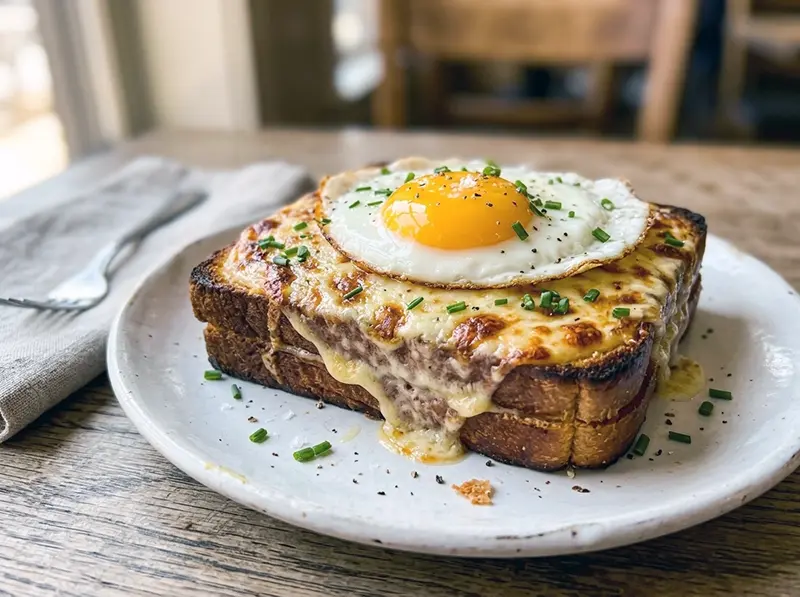
Croque Madame
A Croque Monsieur — ham, Gruyère, and béchamel on toasted white bread — with a fried egg on top. The name comes from the egg supposedly resembling a woman's hat. The sandwich itself has been on Parisian café menus since the early 1900s. What separates a good one from a mediocre one is the béchamel: not as a hidden layer inside, but also spread generously on top, where it bubbles and browns under the grill and becomes something closer to a savory soufflé crust than a sauce. The egg yolk, broken at the table, does the rest.
Ingredients
- 4 slicespain de mie or thick-cut white sandwich bread
- 150 gGruyère or Comté
- 100 ggood-quality ham
- 2 tbspDijon mustard
- 2 large eggs
- 30 gunsalted butter
- 20 gunsalted butter
- 20 gplain flour
- 250 mlwhole milk
- 1 pinchfreshly grated nutmeg
- 1 pinchsalt and white pepper
- 10 gunsalted butter, for frying the eggs
Method
- Make the béchamel first. Melt 20 g of butter in a small saucepan over medium-low heat. Add the flour all at once and whisk constantly for 2 minutes — the roux should look like a smooth, slightly golden paste and smell faintly of cooked flour (this step cooks out the raw flour flavor). Remove from the heat and add the milk in one go, whisking hard to prevent lumps. Return to medium heat and whisk constantly until the sauce thickens — about 3 to 4 minutes. It should coat the back of a spoon thickly. Season with a pinch of nutmeg, salt, and white pepper. Cover with cling film pressed directly onto the surface to prevent a skin forming. Set aside.
- Toast the bread in butter. Preheat the grill (broiler) on high. Meanwhile, melt 30 g of butter in a large non-stick frying pan over medium heat. Working in batches if needed, toast both sides of all 4 bread slices in the butter until golden and slightly crisp — about 2 minutes per side. You are building the structural integrity of the sandwich here: untoasted bread goes soggy under the béchamel. Transfer the toasted bread to a baking sheet lined with foil.
- Assemble the sandwiches. Spread a thin layer of Dijon mustard on one side of each slice of bread. Spread 1 to 2 tablespoons of béchamel over the mustard on 2 of the slices. Distribute the ham evenly over the béchamel, then scatter a third of the grated Gruyère over the ham. Place the remaining 2 slices on top, mustard-side down. Now spread a thick, generous layer of béchamel over the top of each sandwich — go to the edges. Scatter the remaining Gruyère over the béchamel top. Do not be stingy: the thick béchamel-cheese topping is the point.
- Grill until bubbling and golden. Slide the baking sheet under the hot grill and cook for 3 to 5 minutes, watching constantly, until the Gruyère on top is melted, bubbling, and developing dark golden spots. The béchamel should puff slightly. Remove from the grill. Meanwhile, fry the eggs: melt the 10 g of butter for the eggs in the frying pan over medium-low heat, crack in the eggs, and cook until the whites are fully set but the yolks are still completely runny — baste with butter from the pan using a spoon if needed to set the whites without overcooking the yolks.
- Place the eggs on top and serve immediately. Slide one fried egg on top of each grilled sandwich. The yolk must be runny — if it has set, the point of the dish is lost. Serve immediately on warmed plates with nothing else required, or alongside a lightly dressed green salad. This is a knife-and-fork sandwich. Cut into it first at the yolk: the yolk runs into the béchamel and becomes an additional sauce. That is the moment the whole thing comes together.
FAQ
Exactly one thing: the egg. A Croque Monsieur is a ham and Gruyère sandwich with béchamel, toasted or grilled until the top is bubbling and golden. A Croque Madame is the same sandwich with a fried egg placed on top. The yolk, broken at the table, runs into the béchamel and creates an additional sauce. The Madame is richer and more substantial; the Monsieur is slightly cleaner to eat. Both have béchamel both inside and on top of the sandwich.
Pain de mie — the classic French white sandwich loaf — is traditional. It's soft, close-crumbed, slightly sweet, and holds up well to butter and béchamel without going soggy. Thick-cut white sandwich bread is the most practical substitute. Brioche works and produces a richer result. Sourdough can work but its open crumb absorbs the béchamel too fast. Avoid thin sliced bread: the sandwich compresses and the béchamel soaks through before you've finished cooking it.
Emmental is the most natural substitute — milder but with the same melting quality. Comté is close to Gruyère in flavor and is excellent. Beaufort is richer and more intense. Raclette melts beautifully but the flavor is different. Mature cheddar is a reasonable workaround in a pinch but produces a sharper, less French-tasting result. Avoid soft cheeses (mozzarella, brie) — they don't brown under the grill in the same way and the flavor doesn't stand up to the béchamel.
Yes, entirely on the stovetop. After assembling the sandwiches, cover them with a lid in the frying pan over low heat — the steam from the pan will melt the cheese on top. Or use a kitchen torch to brown the béchamel and cheese. The result isn't quite as dramatic as the grill version (the top won't puff and blister the same way) but the flavor is the same. You can also finish them in a covered frying pan: add a splash of water to the pan and cover — the steam melts the cheese in 60 to 90 seconds.
Partially. The béchamel can be made up to 3 days in advance and kept refrigerated, covered with cling film pressed against the surface. Bring it back to room temperature or gently warm before using — cold béchamel is too thick to spread. The sandwiches can be assembled (without the egg) up to several hours ahead and kept covered in the fridge, then grilled just before serving. Add the fried egg at the last minute. Do not make and store the fully assembled, grilled Croque Madame — the egg will overcook when reheated.
Rate this
Recipes by email
One letter a week: a recipe picked for your taste, plus whatever is new on the site. Unsubscribe in one click.
Welcome gift: Sergei's cookbook (e-book).
By subscribing you agree to the privacy policy.
Tell us what you like to cook (30 seconds) →Keep browsing
More dishes from the French archive — picked by overlap with what you're cooking now.

Join the conversation
Comments (2)
Room temperature eggs make a noticeable difference in this croque madame. Cold eggs don't incorporate as smoothly and can leave you with an uneven texture. Twenty minutes on the counter is all they need.
Частенько ем такое! Нормуль!