
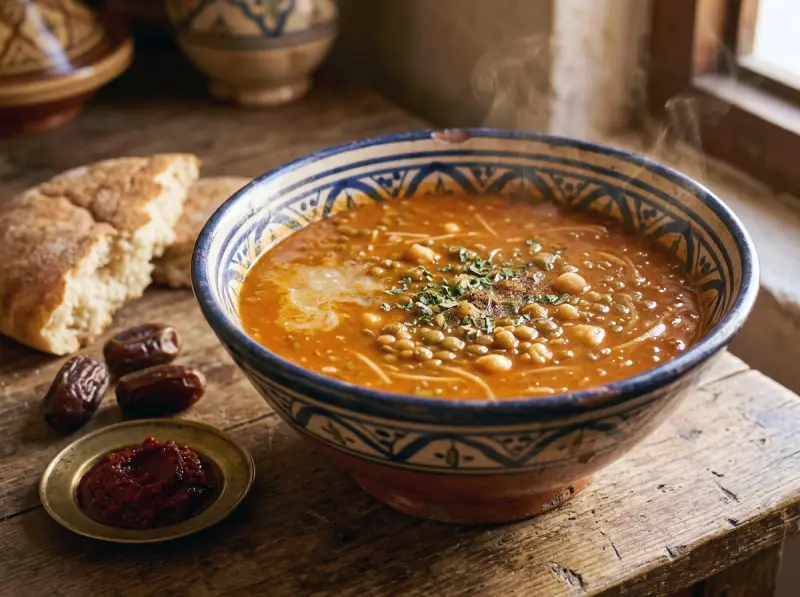
Harira
Harira is a Moroccan tomato soup with chickpeas, lentils, a little lamb or beef and plenty of fresh herbs, thickened at the end with a flour-and-water slurry called tedouira. The name comes from the Arabic word for silk, after the velvety texture the tedouira gives it. Every Moroccan family has its own version, but the spine is always the same: tomatoes, chickpeas, lentils, fresh herbs, ginger, and warm spices. It is especially popular during Ramadan, when it is served at iftar alongside dates, hard-boiled eggs, and chebakia pastries. It is also eaten through the rest of the year, as a starter or as a meal in itself. A meatless version is common too.
Ingredients
- 300 gboneless lamb shoulder or beef chuck
- 240 gcanned chickpeas
- 100 ggreen or brown lentils
- 400 gcanned crushed tomatoes or 4 large fresh tomatoes
- 2 tbsptomato paste
- 1 medium onion
- 3 celery stalks
- 3 garlic cloves
- 30 gfresh coriander (cilantro)
- 20 gfresh flat-leaf parsley
- 3 tbspextra-virgin olive oil
- 1.5 tspground ginger
- 1 tspground turmeric
- 1 tspground cinnamon
- 1 tspsweet paprika
- 0.5 tspblack pepper
- 1.2 Lwater or light chicken or vegetable stock
- 4 tbspplain flour
- 150 mlcold water
- 1 lemon
- to tastesalt
Method
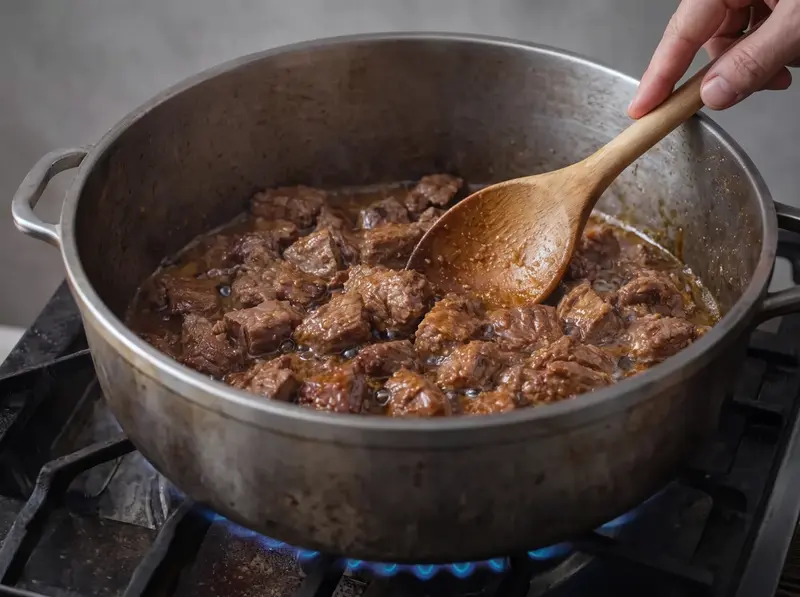
- Brown the meat and build the base. Cut the meat into 1.5 cm cubes. Grate the onion or chop it very finely, chop the celery finely and mince the garlic. Heat the olive oil in a large heavy-bottomed pot over medium-high heat. Add the lamb or beef and brown on all sides — 5 to 6 minutes. Don't crowd the pot; brown in batches if needed. Add the onion and cook for 5 minutes until golden. Add the garlic, celery, ginger, turmeric, cinnamon, paprika, and black pepper. Stir and cook for 2 minutes until the spices are fragrant. For a vegetarian version, skip the meat and start directly with the onion.
- Add the tomatoes, herbs, and legumes. Add the crushed tomatoes and tomato paste. If you are using fresh tomatoes, grate them on a box grater and throw away the skins. Stir and cook for 3 to 4 minutes until the tomato paste darkens slightly. Drain the chickpeas (240 g is the drained weight, one 400 g can) and add them with the lentils and half each of the coriander and parsley, both finely chopped. Pour in the stock or water. Stir everything together and bring to a boil over high heat.
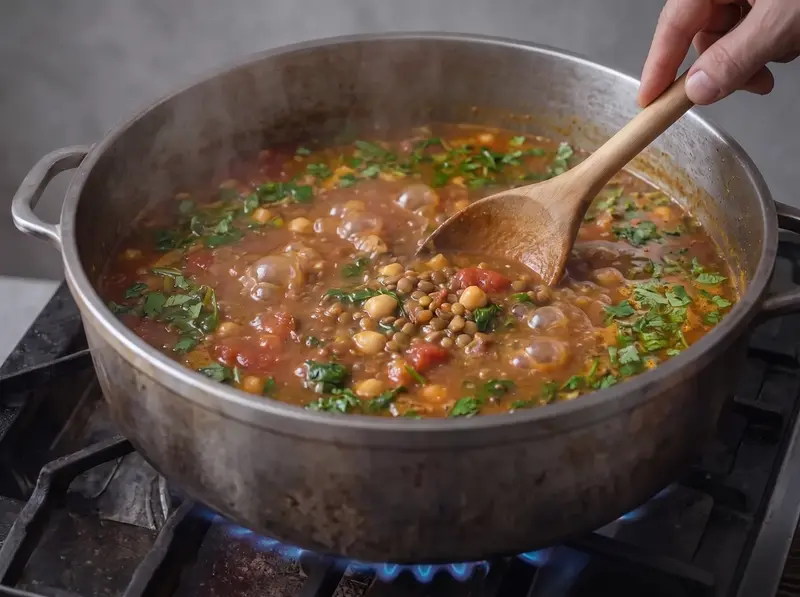
- Simmer until everything is tender. Reduce the heat to low, cover, and simmer for 60 to 75 minutes (beef chuck can need up to 90), stirring occasionally, until a cube of meat breaks apart when you press it with a spoon and the lentils have begun to fall apart. Without meat, 45 to 55 minutes is enough. The lentils thicken the soup naturally as they cook. If the soup looks too thick, add a little more water. Taste and adjust salt — harira needs generous seasoning. Many Moroccan cooks add 3 tablespoons of broken vermicelli or rice towards the end of the simmer and cook it until tender. This version leaves it out; add it if you like a fuller soup.
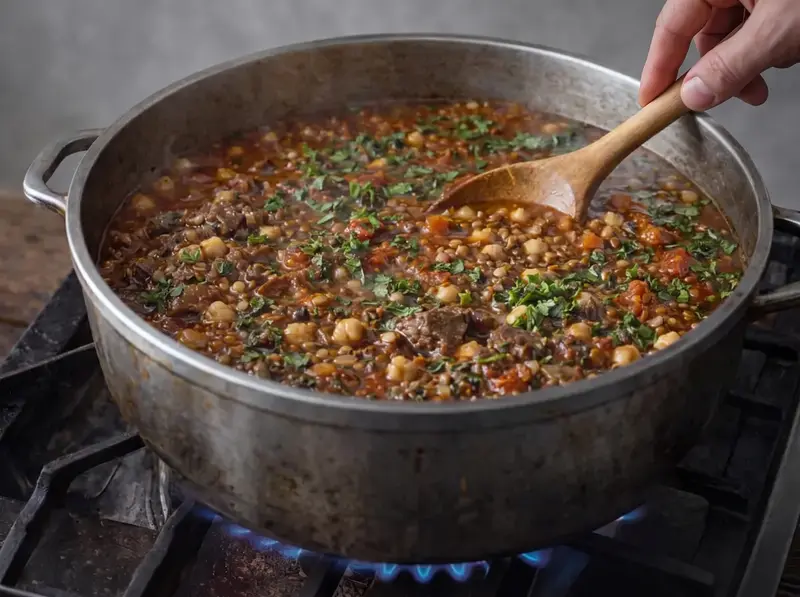
- Make the tedouira and finish the soup. In a small bowl, whisk the flour with the cold water until completely smooth with no lumps. This is the tedouira — the traditional flour slurry that gives harira its silky texture. With the soup at a gentle simmer, slowly pour in the tedouira while stirring constantly. It takes 2 to 3 minutes to thicken, so add it in stages and stop when the soup lightly coats the back of a spoon; you may not need all of it. Keep stirring to prevent lumps. Simmer for another 5 minutes to cook out the raw flour taste.
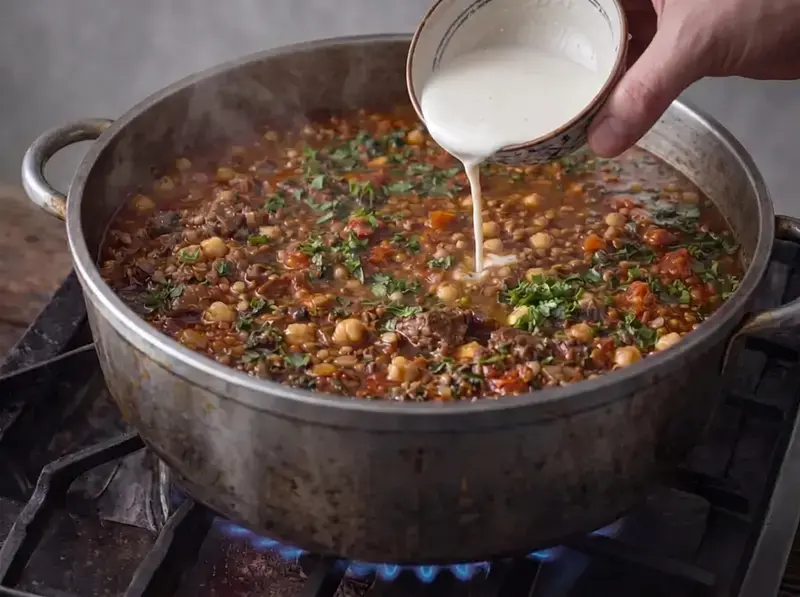
- Finish with herbs and serve. Stir in the remaining coriander and parsley. Taste one final time and adjust seasoning. The soup should be thick, silky, and deeply flavoured. Ladle into bowls and serve hot with lemon wedges. Traditional accompaniments: fresh dates, hard-boiled eggs, and warm Moroccan bread (khobz).
FAQ
Tedouira is a thin paste made from flour whisked with cold water. Stirred into harira near the end of cooking, it thickens the broth and gives the soup its characteristic silky texture — the quality described by the name 'harira' which means silk in Arabic. Some modern versions use cornstarch instead of flour, which produces a cleaner, more neutral thickening. Both work; flour is more traditional.
Yes, and it's very common. Skip the meat entirely and use vegetable stock or water. The chickpeas and lentils provide plenty of protein and body. The spice profile and fresh herbs carry the flavor. The vegetarian version is lighter and takes less time: with no meat to tenderise, the simmer takes 45 to 55 minutes instead of 60 to 75 and is done as soon as the lentils are soft. Add a touch more salt and tomato paste to compensate for the depth that meat adds.
Green or brown lentils are traditional in harira — they hold their shape partially but also break down enough to thicken the soup. Red lentils work and cook faster, but they dissolve completely and make the soup more uniform and smooth, which changes the texture significantly. Either is fine. If using red lentils in the meatless version, reduce the simmering time by about 15 minutes.
At iftar — the evening meal breaking the Ramadan fast — harira is typically the first thing eaten after the call to prayer. It is served hot alongside fresh dates, hard-boiled eggs, and chebakia — sesame and honey fried pastries. Moroccan mint tea is prepared at the same time.
Yes, but without the tedouira. Freeze the soup after the lentils and chickpeas are cooked through but before the flour slurry is added. The tedouira doesn't freeze and reheat well — the texture can become gluey. Freeze in portions for up to 3 months. Thaw overnight in the fridge, bring the soup back to a boil, then stir in a fresh tedouira and the remaining herbs.
Keep browsing
More dishes from the Moroccan archive — picked by overlap with what you're cooking now.
Recipes by email
One letter a week: a recipe picked for your taste, plus whatever is new on the site. Unsubscribe in one click.
Welcome gift: Sergei's cookbook (e-book).
By subscribing you agree to the privacy policy.
Tell us what you like to cook (30 seconds) →
Join the conversation
Comments
No comments yet — be the first!