
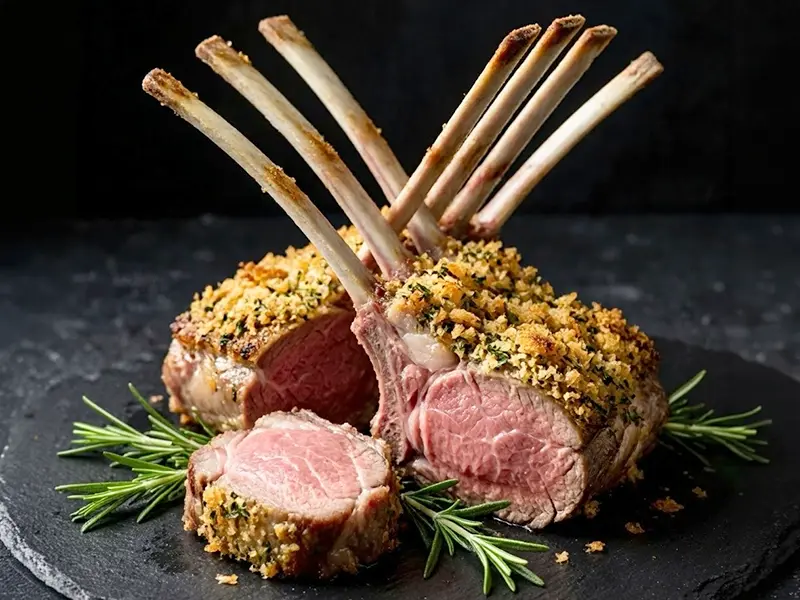
Rack of Lamb with Herb Crust
Carré d'agneau — rack of lamb — is the apex cut of French fine dining: the loin section of a young lamb with eight rib bones, frenched (trimmed bare to the bone) and roasted until the eye of meat is a uniform rose-pink medium-rare throughout. The herb crust — breadcrumbs, rosemary, thyme, garlic, parsley, and Parmesan bound with olive oil — is pressed onto the meat after an initial sear, then baked until crackling golden while the lamb underneath stays tender and juicy. The frenched bones fan out on the plate creating one of the most photogenic presentations in classical cuisine. Served resting or crossed (guards of honour), it signals celebration.
Ingredients
- 2 racks of lamb, frenched
- 2 tbspDijon mustard
- 80 gpanko breadcrumbs
- 4 tbspfresh flat-leaf parsley
- 2 tbspfresh rosemary
- 1 tbspfresh thyme leaves
- 4 garlic cloves
- 40 gParmesan
- 3 tbspextra-virgin olive oil
- 1 lemon, zest only
- 2 tbspneutral oil
- 30 gunsalted butter
Method
- Bring to room temperature and season. Remove the lamb racks from the refrigerator 45 to 60 minutes before cooking. This is essential — cold lamb placed in a hot oven cooks unevenly, producing a thick gray ring of overcooked meat around a raw center. Pat completely dry with paper towels. Season generously on all sides with fine salt and black pepper.
- Make the herb crust. Combine the panko, parsley, rosemary, thyme, garlic, Parmesan, olive oil, and lemon zest in a bowl. Mix until the breadcrumbs are evenly coated and the mixture just holds together when pressed. Taste for seasoning. Set aside.
- Sear hard on all sides. Heat the neutral oil in a large oven-safe skillet over the highest heat until smoking. Place the racks fat-side-down and sear without moving for 2 minutes until deeply golden. Add the butter, turn the racks, and sear the meat side for 1 to 2 minutes, basting constantly with the foaming butter. Sear the ends briefly. Remove from heat and leave in the pan.

- Apply the crust and roast. Preheat the oven to 200°C (400°F). Brush the Dijon mustard generously over the meaty top of each seared rack — the mustard acts as the glue for the herb crust. Press the herb-breadcrumb mixture firmly onto the mustard-coated surfaces, patting firmly so it adheres. Place the pan in the oven (or transfer to a baking sheet, bone-side-down). Roast for 15 to 20 minutes until the crust is golden and crisp and the internal temperature at the thickest part of the loin reaches 52–54°C (125–130°F) for medium-rare.

- Rest and carve. Remove from the oven and transfer to a warm board. Tent loosely with foil — not tightly, as steam will soften the crust. Rest for 10 minutes. The internal temperature will rise to 57–60°C. To serve, stand the rack upright and slice down between each rib bone with a sharp knife, producing individual chops. Fan 3 to 4 chops per person on warm plates, crust facing up. The cross-section shows the uniform pink of perfect medium-rare lamb.
FAQ
Frenching refers to the trimming of a rack of lamb in which all meat, fat, and sinew is scraped away from the upper portion of each rib bone, leaving the bones completely bare and clean. The practical purpose is aesthetic: the exposed white bones create the classic presentation of individual chops with a clean handle. Frenching has no effect on flavor — the bones themselves contribute negligible flavor to the meat during the short roasting time. Most supermarkets sell pre-frenched racks; a butcher can french an un-trimmed rack for you on request. If buying already frenched, check that the fat cap on the loin meat has been trimmed to a thin 3 to 5 mm layer — too much fat on top prevents the mustard and crust from adhering properly.
For medium-rare — the standard for rack of lamb in restaurant cooking — pull the rack from the oven when the thickest part of the eye of meat reads 52 to 54°C (125 to 130°F) on an instant-read thermometer. It will rise to 57 to 60°C during the 10-minute rest, which is the ideal serving temperature for medium-rare. For medium: pull at 57°C (135°F), rest to 63°C. For well-done: pull at 65°C (150°F). Rack of lamb should never be served well-done — the meat becomes tight, dry, and loses its characteristic flavor. The color at medium-rare is uniformly rose-pink throughout the eye, with no gray ring.
The preparation can be staged effectively. The herb crust can be made up to 24 hours ahead and refrigerated. The racks can be seasoned, seared, and mustard-coated up to 4 hours before the dinner — refrigerate after searing, then apply the crust 20 minutes before you intend to roast (bringing the rack to room temperature). Do not apply the herb crust before refrigerating — the breadcrumbs absorb moisture and become soggy. The final roasting and resting must happen just before serving: rack of lamb does not reheat well and loses the medium-rare doneness and the crispness of the crust.
Panko breadcrumbs are Japanese-style breadcrumbs made from bread without crusts and processed to produce larger, flakier, more irregular flakes than European-style breadcrumbs. These larger flakes create more surface area exposed to the oven heat, crisping to a dramatically lighter, crunchier texture than the dense, uniform coating of standard breadcrumbs. On rack of lamb, the textural contrast between the crackling panko crust and the soft, yielding lamb underneath is a significant part of the dish's appeal. Regular breadcrumbs can be substituted but will produce a denser, less crunchy crust.
In classical French cuisine, rack of lamb is served with a red wine jus — the natural juices from the roasting pan deglazed with red wine and veal or lamb stock, reduced to a glossy, intensely flavoured sauce. Accompaniments include dauphinoise potatoes (gratin with cream and garlic), haricots verts (French green beans briefly blanched), and flageolet beans (the traditional French accompaniment to lamb). The color of mint — mint sauce, mint jelly, or a mint and pea purée — is also a classic pairing, particularly in British tradition. The acid note of mint or a lemon-dressed vegetable cuts through the richness of the meat and the buttery crust.
Rate this
Recipes by email
One letter a week: a recipe picked for your taste, plus whatever is new on the site. Unsubscribe in one click.
Welcome gift: Sergei's cookbook (e-book).
By subscribing you agree to the privacy policy.
Tell us what you like to cook (30 seconds) →Keep browsing
More dishes from the French archive — picked by overlap with what you're cooking now.

Join the conversation
Comments (1)
The herb crust needs to be pressed on firmly and then the rack goes into the oven crust-side up. If it falls off, the mixture was too dry — add a bit more oil. I sear the fat side in a screaming hot pan for 2 minutes before applying the crust, which renders some of the fat cap and helps the crust stick. Pull the lamb at 52°C internal for medium-rare. It will carry over to 55°C while resting. Every degree above 58°C is a degree closer to wasting an expensive piece of meat.