
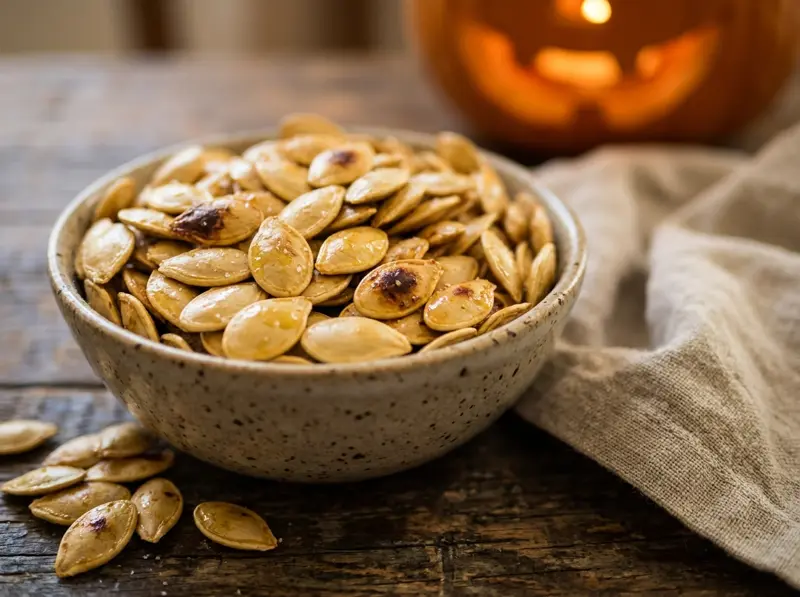
Roasted Pumpkin Seeds
Roasted pumpkin seeds are the whole seeds scooped out of a pumpkin, white hull and all, washed free of pulp, tossed with a little olive oil and salt, then baked until golden and crisp. In the US they are the snack made once the jack-o'-lantern is carved, in German they are geröstete Kürbiskerne, in Japanese かぼちゃの種, and the dark green pepitas sold in bags are the same seeds without the hull. We skip the salt-water boil some American recipes start with and roast the seeds low, at 150 °C, for 30 to 40 minutes. Cleaning, drying and roasting take just under an hour, plus cooling on the tray.
What you are roasting: whole pumpkin seeds or pepitas
The seeds inside a pumpkin sit in a cream-white hull. Roasted whole, they are crunchy, the hull takes some chewing, and you eat them hull and all. Pepitas, the dark green seeds sold in bags, are the kernels with that hull removed.
How many seeds you get depends on the pumpkin. One recipe writer counts about 1 cup of cleaned seeds from a large carving pumpkin and about half that from a pie pumpkin. A Japanese recipe gets about 50 g from half a kabocha. Hokkaido and butternut seeds are smaller and have a thinner hull. The proportions stay the same: for every 115 g of seeds, 1 tbsp olive oil and ½ tsp salt.
Which pumpkin to use: carving pumpkin or cooking pumpkin
Big jack-o'-lantern pumpkins are good for carving and less good for cooking. Utah State University Extension describes their flesh as fibrous, stringy and watery with a mild flavour, while pie or sugar pumpkins are bred for cooking and have dense, smooth flesh. King Arthur Baking suggests a sugar pumpkin of 1.8 to 3.6 kg, about the size of a volleyball, for homemade purée. Our pumpkin pie uses a Hokkaido or butternut for the same job.
That gives a simple plan: carve the big one and roast its seeds, and cook with a smaller pumpkin. Our German Kürbissuppe uses Hokkaido, and a handful of these roasted seeds is good scattered over a bowl.
Ingredients
- 115 gpumpkin seeds
- 1 tbspolive oil
- 0.5 tspsalt
Method
- Heat the oven to 150 °C (conventional, top and bottom heat) and line a rimmed baking tray of about 30 × 40 cm with baking paper. The oven heats while you clean the seeds. A low oven dries the seeds through before they start to colour.
- Use a pumpkin sold for eating, never an ornamental gourd. Before you scoop, taste a small raw piece of the flesh: if it is clearly bitter, spit it out and throw away the whole pumpkin, seeds included, because cooking does not destroy the bitter substances. Scoop the seeds and stringy pulp into a large bowl (about 3 litres) of cold water and rub them between your hands. The seeds come loose and float to the top, so you can skim them into a sieve. Throw out any cut, mouldy or darkened seeds. A few threads left on the seeds do no harm.
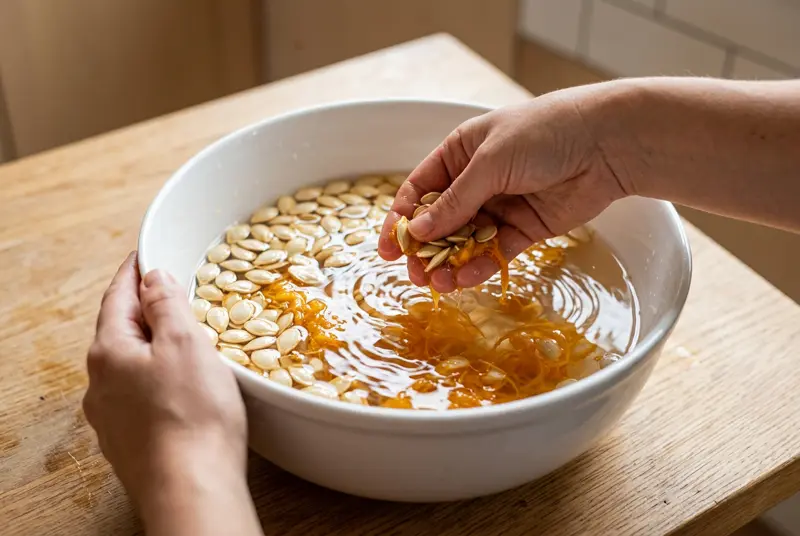
- Tip the seeds onto a clean kitchen towel and pat them dry on both sides, until there are no water drops left and the seeds no longer feel slippery. Water left on the seeds has to steam off before they can crisp.
- Weigh the dried seeds (115 g is about 1 cup) and put them in a medium bowl. Add 1 tbsp olive oil and ½ tsp salt for every 115 g, and toss until every seed looks shiny with oil.
- Spread the seeds on the tray in a single layer, with no seed lying on another. Roast for 30 to 40 minutes, stirring every 10 minutes so they colour evenly. Each time, pull the tray out with oven gloves, stir with a spatula and slide it back. Start checking at 30 minutes: they are done when they have turned from cream-white to golden, look dry and rattle crisply when you stir them. A few will be browner than the rest, which is fine. Take them out before they turn dark brown: by then they are over-roasted.
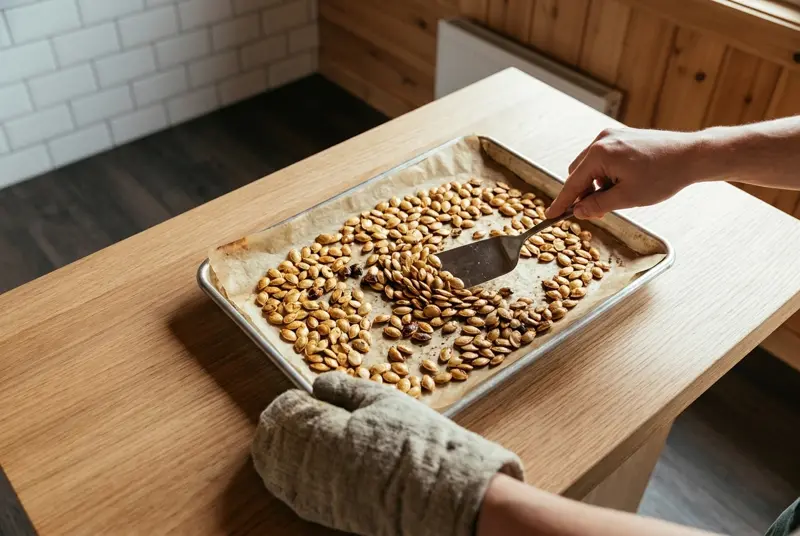
- Leave the seeds on the tray until completely cool, then store them in an airtight jar. The hull is edible. If it is too tough for you, crack it with your teeth and eat the green kernel inside.
FAQ
No. Most of the recipes we checked roast the seeds straight after cleaning, and University of Illinois Extension, which does boil them, says the step can be skipped. Their version boils the seeds for 10 minutes in about 950 ml of water with 2 tbsp salt, and says this makes them roast more evenly. University of Alaska Fairbanks boils them for 30 minutes. If you boil, drain the seeds, pat them completely dry on a towel and leave out the ½ tsp salt in the toss, as the Illinois recipe does.
Most often the seeds went in wet or piled up, or came out of the oven too soon. Pat them dry on a towel until they no longer feel slippery, spread them in a single layer and roast at 150 °C for 30 to 40 minutes, stirring every 10 minutes. They are ready when they are golden, look dry and rattle crisply when stirred. Then let them cool completely on the tray before you judge them or put them in a jar.
Yes, the white hull is edible, though University of Alaska Fairbanks Extension notes it can be tough to chew. This recipe roasts the seeds whole, hull and all. Pepitas are the flat, dark green kernels you buy in bags: the same seed with the white hull taken off, sold raw or roasted. If the hulls bother you, crack each roasted seed and eat only the kernel, as the Japanese recipe site Delish Kitchen suggests for かぼちゃの種.
As a rule, the seeds of any ripe pumpkin sold for eating can be roasted, a big carving pumpkin included, as long as it is sold as food: Germany's Federal Centre for Nutrition (BZfE) advises eating only pumpkins labelled as Speisekürbis. Ornamental gourds are inedible, the BZfE says, because of toxic bitter substances, and heat does not destroy them. The consumer advice centre in Bremen names these substances, cucurbitacins, as a cause of nausea, vomiting, diarrhoea and stomach cramps. Before you scoop, taste a small raw piece of the flesh, and if it is clearly bitter, spit it out and throw away the whole pumpkin, seeds included. For cooking, a smaller cooking pumpkin is better than a carving pumpkin: a sugar pumpkin, or the Hokkaido or butternut that our pumpkin pie uses for homemade purée.
Let them cool completely on the tray first, then pack them airtight. NC State and Utah State extension keep them in an airtight container at room temperature for up to 2 weeks. University of Alaska Fairbanks is more cautious and keeps them in the fridge for no more than 10 to 14 days. For longer, freeze them for up to 3 months. They are good as a snack on their own or scattered over a bowl of Kürbissuppe.
Keep browsing
More dishes from the American archive — picked by overlap with what you're cooking now.
Recipes by email
One letter a week: a recipe picked for your taste, plus whatever is new on the site. Unsubscribe in one click.
Welcome gift: Sergei's cookbook (e-book).
By subscribing you agree to the privacy policy.
Tell us what you like to cook (30 seconds) →
Join the conversation
Comments
No comments yet — be the first!