
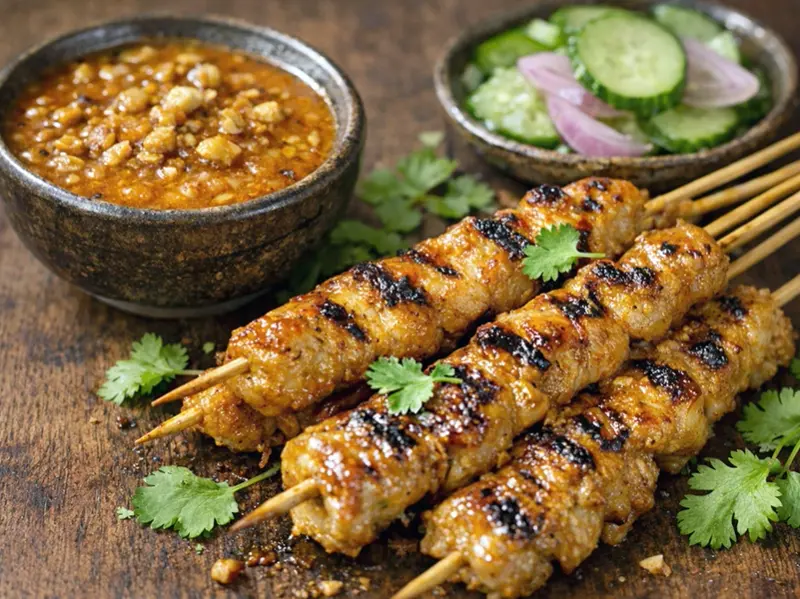
Thai Satay with Peanut Sauce
Satay (สะเต๊ะ) arrived in Thailand from Indonesia via Malay traders and became one of the country's most beloved street foods. Thin strips of chicken or pork are marinated in lemongrass, turmeric, coconut milk, and warm spices, then threaded onto bamboo skewers and grilled over charcoal until caramelized at the edges and fragrant throughout. The essential accompaniment is the satay sauce — a rich, sweet, slightly spicy peanut sauce made with roasted peanuts, red curry paste, and coconut milk — not the peanut butter version common elsewhere. In Thailand it is often served with a quick cucumber pickle to cut the richness and toasted white bread for dipping into the sauce.
Ingredients
- 600 gchicken thighs
- 1 lemongrass stalk, tender inner part only
- 1 tspturmeric powder
- 1 tspground coriander
- 0.5 tspground cumin
- 1 tbspfish sauce
- 1 tbspbrown sugar
- 120 mlfull-fat coconut milk
- 150 groasted peanuts
- 2 tbspred curry paste
- 400 mlfull-fat coconut milk
- 2 tbspfish sauce
- 2 tbsppalm sugar or brown sugar
- 1 tbsptamarind paste or lime juice
- 20 bamboo skewers
Method
- Marinate the meat. Combine the minced lemongrass, turmeric, ground coriander, cumin, fish sauce, brown sugar, and coconut milk in a bowl. Slice the chicken into strips about 2 cm wide and 8 cm long, cutting against the grain so the fibres are short. Add to the marinade and massage well. Cover and refrigerate for at least 2 hours — overnight is significantly better. Thread each strip onto a soaked bamboo skewer in a zigzag weave so the meat lies flat and cooks evenly.
- Make the peanut sauce. Roughly grind the roasted peanuts to a coarse meal — they should be sandy and textured, not smooth like peanut butter. The texture is part of the authentic character of Thai satay sauce. Heat 80 ml of the coconut milk in a small saucepan over medium heat until it thickens slightly. Add the red curry paste and stir-fry in the coconut cream for 2 minutes until fragrant and the oil separates. Add the remaining coconut milk, ground peanuts, fish sauce, palm sugar, and tamarind paste. Stir well. Simmer gently 5 to 7 minutes until the sauce is thick enough to coat the back of a spoon. Taste: it should be rich, slightly sweet, nutty, and gently spiced. Add water to thin if needed.
- Make the quick cucumber pickle (optional but traditional). Slice half a cucumber and one shallot thinly. Dissolve 2 tablespoons sugar and 1 teaspoon salt in 4 tablespoons rice vinegar with 2 tablespoons water. Pour over the cucumber and shallot. Leave 10 minutes — the pickle is ready when the cucumber softens slightly but still has crunch. This acid cuts through the rich peanut sauce.
- Grill the skewers. Cook over a hot charcoal grill or a very hot griddle pan, turning every 60 seconds, for 6 to 8 minutes total. The chicken is done when golden-caramelized at the edges with a slight char and cooked through. Do not cook on low heat — satay needs high direct heat to develop the caramelized exterior that makes it distinctive. If using an oven: grill/broil at maximum temperature for 12 to 15 minutes, turning halfway.
- Serve. Arrange the skewers on a plate. Pour the warm peanut sauce into a small bowl alongside. Add the cucumber pickle. In Thailand, satay is commonly served with toasted white bread for dipping into the remaining peanut sauce once the skewers are finished. Garnish with sliced red chilli and crushed roasted peanuts.
FAQ
Both use skewered grilled meat with peanut sauce, but the details differ. Thai satay marinade typically includes lemongrass, turmeric, coriander, cumin, and coconut milk — warm spices with a clear Southeast Asian herb character. Indonesian satay marinade is simpler, often just sweet soy sauce (kecap manis), garlic, and shallots. The sauces differ more: Thai satay sauce is built on coconut milk and red curry paste with coarsely ground peanuts; Indonesian satay sauce is tamarind-forward and less creamy. Thai satay is generally milder and more coconut-rich; Indonesian is bolder and more sour.
Yes, and many recipes do — it produces a quick, smooth, rich sauce that is genuinely delicious. Combine peanut butter with coconut milk, red curry paste, fish sauce, sugar, lime juice, and a small amount of water to achieve a dipping consistency. This version is smooth and homogeneous. The traditional Thai approach uses coarsely ground roasted peanuts, which produces a sauce with texture — grainy, nutty bits in a coconut-curry base. Both are valid; the peanut butter version is faster and the ground peanut version is more texturally interesting and considered more authentic.
Chicken thigh, boneless and skinless, is the best cut for satay. It has more intramuscular fat than breast, which keeps it moist even at the high heat required to achieve caramelisation. Breast meat cooked quickly over charcoal dries out easily because the muscles are lean and the fibres are long. If you prefer using chicken breast: slice it very thinly (3 to 4 mm strips) across the grain, marinate overnight in coconut milk, and pull it from the grill the moment it loses its pink color — the window between cooked and dry is narrow.
Soak bamboo skewers in cold water for at least 30 minutes — ideally 1 hour — before threading the meat. Waterlogged bamboo burns significantly more slowly than dry. When threading, leave 3 to 4 cm of skewer exposed at the handle end — this portion rarely gets direct heat exposure. On a very hot grill, the exposed tip can still char; keep a small dish of water nearby to briefly dip the ends before cooking. Metal skewers avoid this problem entirely but conduct heat and the meat can slide.
Yes. Replace the chicken with firm tofu (pressed well, cut into thick strips), tempeh, or thick slices of king oyster mushroom. Marinate for the same time. Replace fish sauce with soy sauce in both the marinade and the peanut sauce. Tofu satay works particularly well — the marinade penetrates the porous texture deeply, and the coconut milk creates a golden caramelized exterior when grilled over high heat. The peanut sauce is the same. Mushroom satay has the best char of the vegetarian options because of the natural moisture in the mushroom creating steam-caramelisation.
Rate this
Recipes by email
One letter a week: a recipe picked for your taste, plus whatever is new on the site. Unsubscribe in one click.
Welcome gift: Sergei's cookbook (e-book).
By subscribing you agree to the privacy policy.
Tell us what you like to cook (30 seconds) →Keep browsing
More dishes from the Thai archive — picked by overlap with what you're cooking now.
Join the conversation
Comments (1)
The peanut sauce is where most homemade satay falls short. Restaurant satay uses roasted peanuts ground fresh, not peanut butter from a jar. I dry-roast raw peanuts in a pan until dark golden, then blitz them in a food processor while still warm. The texture and flavour are incomparably better. For the skewers themselves, soak bamboo sticks for at least an hour or they catch fire on the grill. I learned that one the hard way at a dinner party.