

Sauce Mornay (Classic French Béchamel Cheese Sauce)
Sauce Mornay is the classic French cheese sauce — a béchamel enriched with grated Gruyère and Parmigiano-Reggiano. The name traces to either a 19th-century Parisian restaurant (Le Grand Véfour) or the Marquis de Mornay, the exact attribution still debated. Mornay is the workhorse of French haute cuisine: the base for cauliflower au gratin, eggs Mornay, sole Mornay, endives au jambon, fish gratins, cheese soufflé, and the cheesier version of croque monsieur. Silky, glossy, pale-cream — never bright yellow (that means the cheese broke). Vegetarian, ready in 20 minutes. Yields about 500 ml of sauce, serves 6 with vegetables, fish, eggs, or pasta.
Ingredients
- 30 gunsalted butter
- 30 gall-purpose flour
- 500 mlwhole milk
- 0.5 pieceyellow onion
- 1 piecebay leaf
- 60 gGruyère cheese
- 30 gParmigiano-Reggiano
- 0.25 tspfreshly grated nutmeg
- 0.5 tspfine sea salt
- 1 pinchwhite pepper
Method
- Infuse the milk (optional but worth it). Peel half a yellow onion, leaving the root intact. Pin a bay leaf to the flat side of the onion with three whole cloves — this is an onion piqué, the classic French aromatic. Combine the onion piqué with 500 ml of whole milk in a small saucepan and bring to a gentle simmer over medium heat. Reduce heat to low and let infuse for 10-15 minutes, stirring occasionally to prevent skin forming. Strain and set aside, keeping the milk warm.
- Make the roux. In a heavy-bottomed saucepan over medium heat, melt 30 g of unsalted butter until foaming. Whisk in 30 g of all-purpose flour and cook, whisking constantly, for 1 to 1.5 minutes. The roux should turn pale yellow with a faint nutty smell — do not let it brown. A blonde roux is essential for Mornay: a brown roux would give an off-color sauce and a different flavour profile.
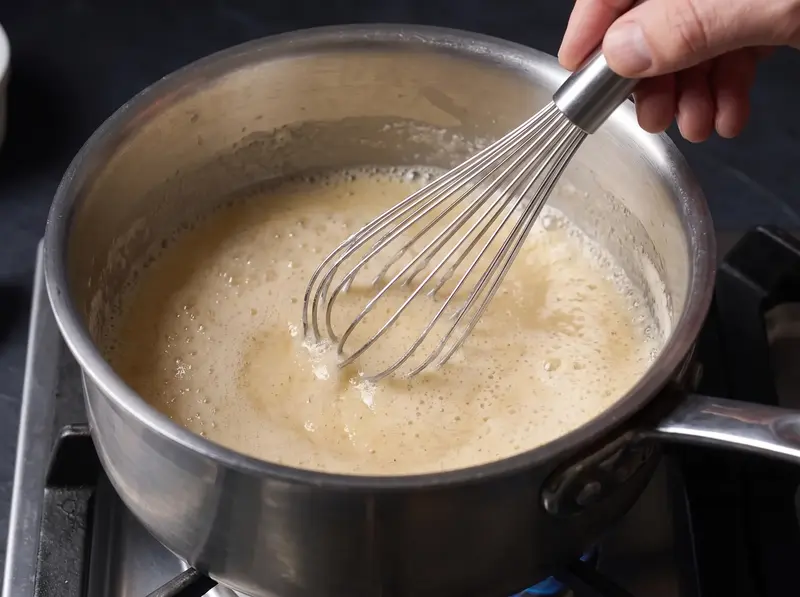
- Add the milk and build the béchamel. Pour the warm infused milk into the roux in a slow steady stream, whisking constantly. The first 100 ml will look thick and almost glue-like — keep whisking and adding more milk; it will smooth out. Continue until all the milk is incorporated. Bring to a gentle simmer over medium heat, whisking constantly, then reduce to low and simmer for 5-10 minutes, whisking every minute, until the sauce thickens enough to coat the back of a spoon (nappe consistency).
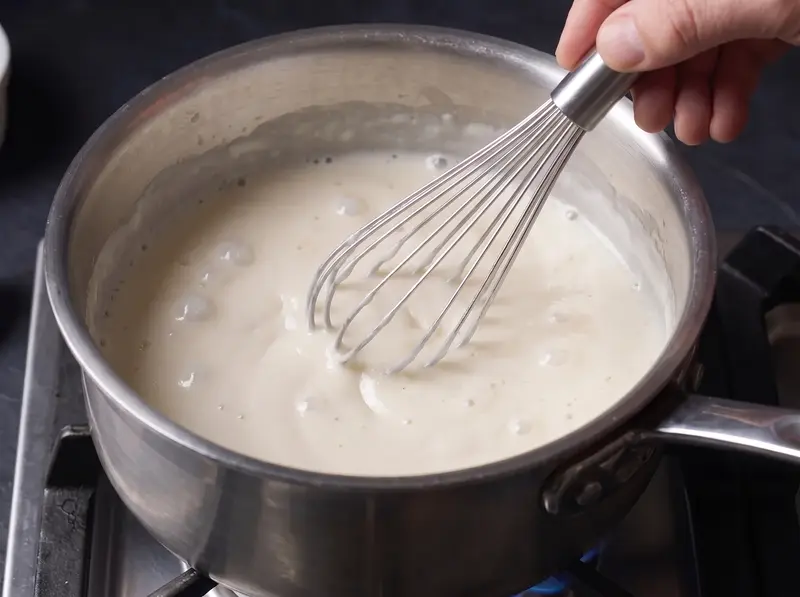
- Season the béchamel base. Whisk in ¼ tsp of freshly grated nutmeg, ½ tsp of fine sea salt, and a pinch of white pepper. Nutmeg is non-negotiable for classic French béchamel — without it, the sauce tastes flat. Use freshly grated, not pre-ground (pre-ground nutmeg loses 80% of its volatile oils within weeks of grinding). White pepper, not black: black pepper specks would mar the pale ivory color of the finished sauce.
- Take off the heat completely. This is the critical step that separates a silky Mornay from a grainy mess. Remove the saucepan from the burner entirely and let it cool for 30 seconds — the temperature should drop to about 75°C. Cheese added above 82°C will seize and split: casein proteins contract and squeeze out the milk fat, giving you a grainy or oily sauce that cannot be rescued.
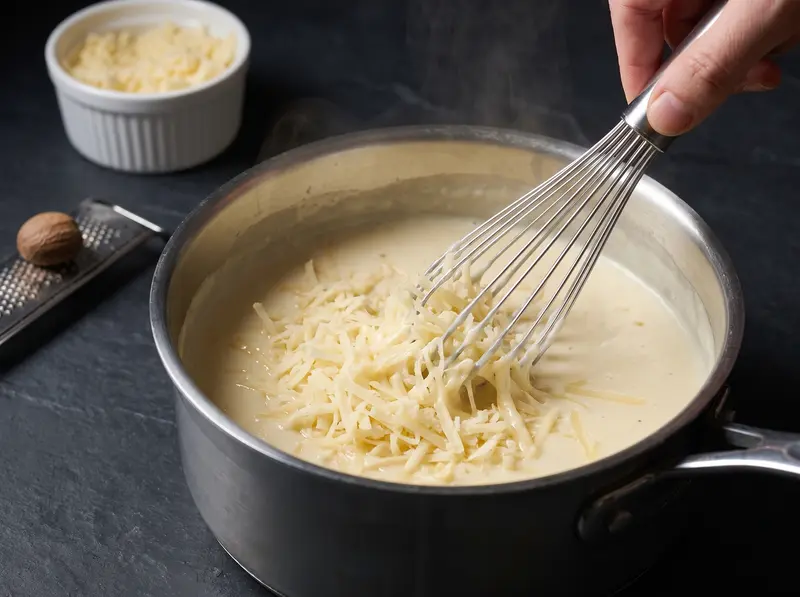
- Whisk in the cheese off-heat. Grate 60 g of Gruyère on the medium holes of a box grater and 30 g of Parmigiano-Reggiano on a microplane (the finer texture helps it dissolve). Add the cheese to the warm sauce in three additions, whisking each fully before the next. The sauce should turn glossy and pale gold — never bright yellow (that means the cheese is splitting). If it starts to look grainy, add a splash of warm cream and whisk vigorously to recover.
- Optional liaison for restaurant gloss. In a small bowl, whisk 1 egg yolk with 1 tablespoon of cold cream. Slowly drizzle in 2-3 tablespoons of the hot Mornay while whisking constantly to temper the yolk. Then pour the tempered mixture back into the saucepan, whisking constantly. Do not bring back to a boil — the yolk will scramble. This step is optional but gives the sauce a glossy finish typical of restaurant Mornay.
- Serve immediately or hold warm. Sauce Mornay is best the moment it is made — pour over poached eggs, white fish, asparagus, or pasta. To hold for 10-15 minutes: keep the saucepan on the lowest possible heat or in a warm water bath, whisking briefly every couple of minutes. For storage, see the FAQ — Mornay holds up to 3 days in the fridge with proper technique.
FAQ
Sauce Mornay is a specific French derivative of béchamel, and the structural hierarchy matters for understanding. Béchamel is one of the five mother sauces of French cuisine (codified by Escoffier, 1903): a roux of equal parts butter and flour combined with milk. It is a neutral white base with no cheese and no strong flavours, ready for further derivatives. Sauce Mornay = béchamel + Gruyère + Parmigiano-Reggiano + optional nutmeg and yolk. Named, by legend, after the Marquis de Mornay (Paris, 19th century) or the restaurant Le Grand Véfour. Regular cheese sauce (especially American-style) is often béchamel + cheddar without the classic technique: cheese added on heat, sometimes with corn starch or processed cheese for stability. Mornay differs in three ways: 1) Mornay uses Gruyère (or Gruyère + Parmigiano combo), not cheddar; 2) cheese is always added OFF the heat (cheddar in American cheese sauce often melts on heat with stabilizers); 3) Mornay frequently includes onion piqué and nutmeg for depth. Use Mornay for French classics (eggs Mornay, sole Mornay, vegetable gratins) and use regular cheese sauce for nachos, mac and cheese American-style, or fondue.
Graininess or oily 'split' texture is the most common Mornay error, and the cause is almost always one thing: cheese added on heat. When cheese is heated above approximately 82°C, casein proteins contract and squeeze out the milk fat, which you see as graininess or oily pools. Solution: always remove the béchamel from heat before adding cheese. Take the saucepan off the burner, wait 30 seconds (sauce will cool to about 75°C), then whisk in freshly grated cheese in small batches — each batch fully dissolved before the next. Additional rules: use freshly grated cheese, not pre-grated from a bag (contains anti-caking agents like cellulose that prevent smooth melting); grate on medium holes (4 mm) for optimal surface area; milk should be warm (room temperature or slightly heated, not from the fridge) when added to the roux — cold milk creates lumps. If graininess has already happened: 1) add 1 tbsp warm cream and whisk vigorously — cream casein can stabilize; 2) pass through a fine-mesh sieve (chinois) — removes large lumps; 3) if severely overheated, an immersion blender for 30 seconds may partially recover it, but texture will not be ideal. Prevention beats rescue: blonde roux 1-1.5 minutes; warm milk added gradually with constant whisking; simmer 5-10 minutes; remove from heat, then add cheese.
The classic French version uses Gruyère AOP (Swiss alpine, aged 5-12 months) as the primary cheese and Parmigiano-Reggiano as a counterpoint in a 2:1 ratio by weight (60 g Gruyère + 30 g Parmigiano per 500 ml béchamel). Gruyère provides a nutty-sweet base and ideal melt; Parmigiano adds salty umami and sharpness to balance the creamy sweetness. Substitutes for Gruyère, in descending order of authenticity: Emmental (Swiss, milder and sweeter, classic substitute); Comté AOP (French, closest cousin to Gruyère, nutty-fruity); Beaufort AOP (Savoyard, saltier); Appenzeller (Swiss, sharper); aged white cheddar (English-style — no longer classic Mornay but works for mac and cheese, croque monsieur). What does not work: mozzarella (too stretchy, wrong texture); feta or brined cheese (crumbles, does not emulsify); soft brie or camembert (too fatty, separates); pre-grated parmesan in jars (does not melt — it is a dry product, not real cheese); cream cheese and processed cheese (contain stabilizers that ruin the texture). Avoid pre-grated 'pizza cheese' blends — typically mozzarella with low-quality melters. Grate size matters too: Gruyère on medium box grater holes (4 mm), Parmigiano on the finest microplane. Freshly grated is critical; pre-grated with anti-caking agents will cause clumps.
Sauce Mornay holds storage and reheating better than emulsion-based sauces like beurre blanc or aïoli — this is its huge advantage. Storage: up to 3 days in an airtight container in the fridge (important: cover the surface with cling film pressed directly onto the sauce — this prevents skin formation). When chilled, the sauce thickens significantly and can almost set due to the flour starch — this is normal. Freezing is possible for up to 1 month, but post-thaw texture will be slightly grainier (milk proteins crystallize and do not fully revert); if freezing, leave out the yolk liaison (it does not survive freezing well). Reheating: on the lowest possible heat in a heavy-bottomed saucepan or in a water bath (more forgiving), whisking constantly. Add 2-4 tbsp warm milk or cream during reheating — the starch will release and texture will restore. Never reheat on max heat (sauce will split) or in a microwave at 100% power (creates hot spots, proteins denature). Best strategy for entertaining: make the béchamel and onion piqué 1-2 days ahead, store in fridge; reheat on low with extra milk 15 minutes before serving; add the cheese only at the moment of reheating, not in the original batch — cold cheese in cold sauce does not reactivate as well as freshly grated into warm sauce. This gives the cleanest texture.
Sauce Mornay is a workhorse of French classical cuisine, the base of dozens of dishes. Haute cuisine classics: oeufs mornay (eggs in cocottes with sauce and cheese, baked); sole mornay (Dover sole in white wine, coated with sauce, gratinated); chou-fleur au gratin (cauliflower in Mornay, baked with breadcrumbs) — the provincial blueprint; endives au jambon Mornay (Belgian endive wrapped in ham, sauced and baked — iconic French school cantine dish); gratin de poisson (any white fish under sauce, gratinated); soufflé au fromage Mornay (the soufflé base enriched with whisked whites); croque monsieur Mornay (the cheesier upgrade replacing the cream-mustard topping). Modern applications: mac and cheese (with cubed Mornay-cheddar version); rich casseroles with toast and egg (eggs Florentine with Mornay); roasted vegetables (broccoli, asparagus, artichoke, leeks under sauce); Mornay croquettes (thickener for filling); base for baked pasta (lasagne blanche); croque madame with egg; baked mussels; chicken breasts in the oven with sauce; baked marinated mushrooms. Where not to use Mornay: red meat (heavy + fatty); seafood with strong marine flavour like octopus or anchovies (sauce overpowers); Italian pasta (not Italian — béchamel is rare in Italy); desserts (sauce is unsweetened, obviously); cold dishes (Mornay cannot be eaten cold from the fridge, texture is wrong). Wine: dry white Chardonnay (French Burgundy) or Sauvignon Blanc (Sancerre, Pouilly-Fumé), served cold.
Rate this
Recipes by email
One letter a week: a recipe picked for your taste, plus whatever is new on the site. Unsubscribe in one click.
Welcome gift: Sergei's cookbook (e-book).
By subscribing you agree to the privacy policy.
Tell us what you like to cook (30 seconds) →Keep browsing
More dishes from the French archive — picked by overlap with what you're cooking now.

Join the conversation
Comments
No comments yet — be the first!