
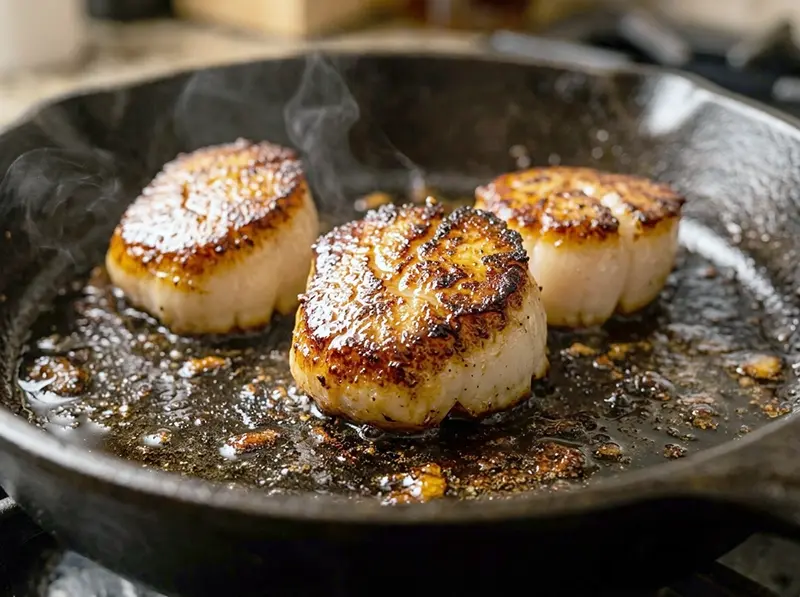
Scallops with Garlic Butter
Large sea scallops seared in a screaming-hot pan until golden, then finished in garlic butter with lemon and fresh herbs. Ready in about 20 minutes. The crust is what makes them — moisture and a cold pan are the two things that ruin it.
Ingredients
- 500 glarge sea scallops, dry-packed
- 2 tbspneutral oil with high smoke point
- 60 gcold unsalted butter, cut into cubes
- 4 garlic cloves, finely chopped
- 2 tbspfresh parsley, chopped
- 0.5 tspsalt
- 0.5 tspblack pepper
- 1 lemon: zest and juice of one half, the other half in wedges
Method
- Pat the scallops completely dry with paper towels. Set them on a fresh dry paper towel and leave for 10 minutes — surface moisture is the enemy of a good sear. Remove the tough side muscle if still attached (the small, hard rectangular tab on the side).
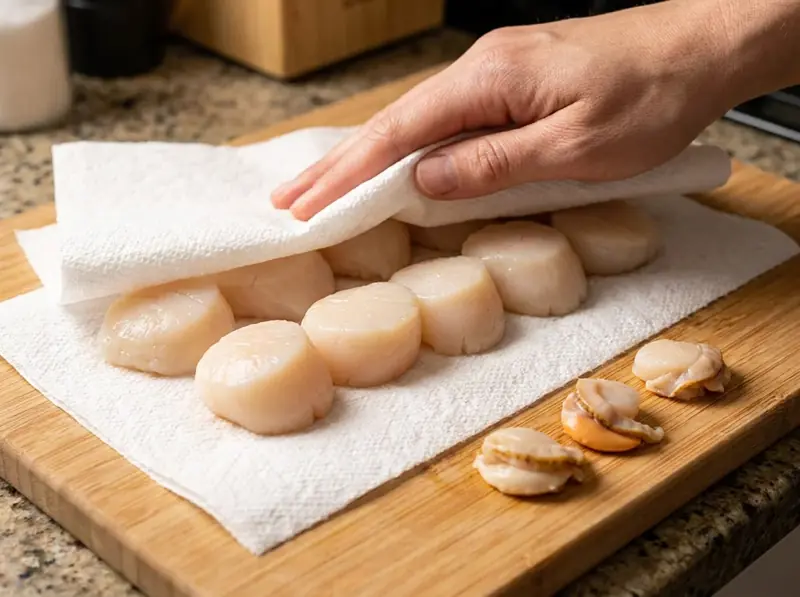
- Season both sides with salt and pepper right before cooking — salting too far ahead draws out moisture.
- Heat a heavy skillet (cast iron or stainless steel) over high heat for 2–3 minutes until very hot. Add the oil. When the oil shimmers and just begins to smoke, add the scallops in a single layer with at least 2 cm between each, frying in 2 batches so they don't crowd the pan — 500 g doesn't fit in one layer. Keep the first batch on a warm plate, loosely covered with foil, while you sear the second.
- Sear without moving for exactly 2 minutes. The scallop will release from the pan on its own when the crust has formed — if it sticks, wait 15 more seconds. Flip. Cook the second side for 1–2 minutes. After 1 minute the sides are opaque about two-thirds of the way up and the very center is still slightly translucent. For scallops cooked through to the food-safety standard (63°C), give the second side the full 2 minutes, until the flesh is firm, pearly and opaque all the way to the middle. Remove immediately to a plate.
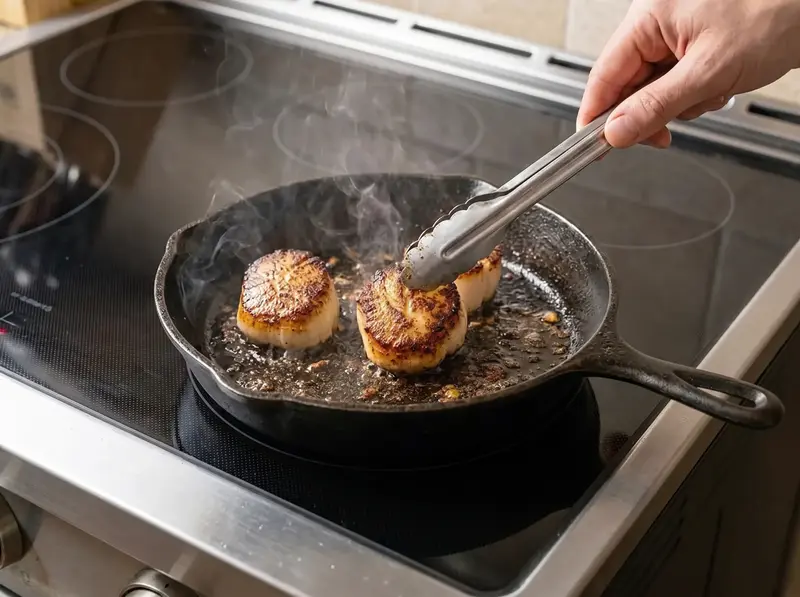
- Take the pan off the heat for a few seconds so it cools slightly, then set it back over medium-low heat. Add the garlic and cook 30 seconds, stirring constantly; it should smell fragrant and must not darken. Add the cold butter cubes one at a time, swirling the pan until each melts — cold butter emulsifies the sauce, while hot or room-temperature butter will just pool. Squeeze in the juice of half the lemon, add its zest (about 1 teaspoon) and the parsley, and stir once to combine. Cut the other half into wedges for serving.
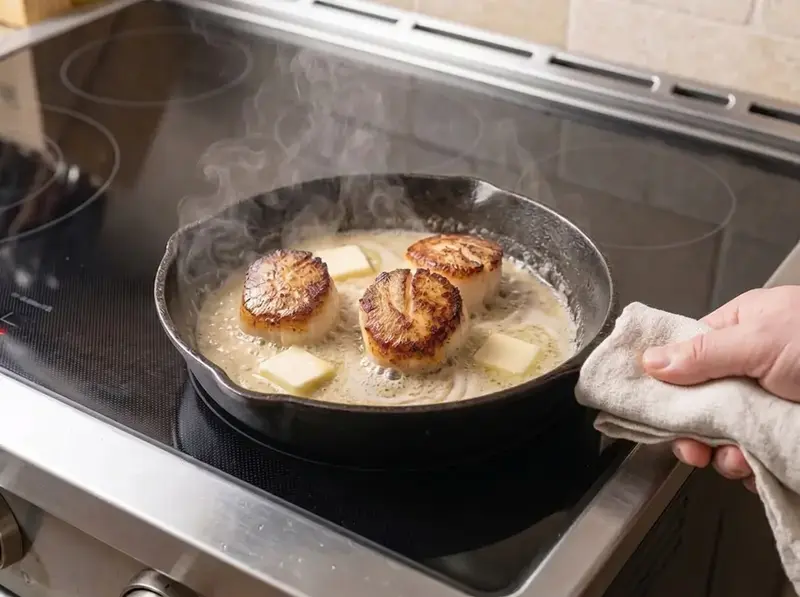
- Return the scallops to the pan and spoon the sauce over them for 15 seconds. Serve immediately — scallops do not hold.
FAQ
Three causes. First: scallops weren't dry — moisture creates steam instead of a sear. Pat with paper towels and leave on a dry towel for 10 minutes. Second: the pan wasn't hot enough. The oil must be shimmering and just beginning to smoke before the scallops go in. Third: they were moved — don't touch them for the first 2 minutes. The scallop will release from the pan on its own once the crust forms. If it sticks, wait another 15 seconds.
Scallops cook in 2 minutes per side on high heat. Signs they're ready: golden-brown crust on the bottom, the sides are opaque two-thirds of the way up. Press with a finger: raw feels soft like gel; perfectly cooked has a light spring and slight firmness; overcooked feels hard like a rubber ball. Take them off as soon as they reach the doneness you want — they continue cooking for a minute after you remove them from the heat. Scallops cooked through to the food-safety standard (63°C) are firm, pearly and opaque all the way to the middle.
Wet scallops are treated with sodium tripolyphosphate solution to increase weight. They absorb water and release it as steam when heated — this makes a proper sear impossible and gives a slightly chemical flavor. Dry scallops are untreated. Visually: dry scallops are creamy off-white and matte; wet scallops are bright white and slightly glistening. Always ask for dry scallops at the fish counter.
After. Adding butter to a screaming-hot pan burns it in seconds, and garlic turns bitter in under 30 seconds at high heat. The correct order: sear scallops in high-smoke-point oil, remove them, take the pan off the heat for a few seconds, reduce the heat to medium-low, add garlic for 30 seconds, then add cold butter cubes one at a time while swirling. Cold butter emulsifies into a glossy sauce; room temperature butter separates and pools.
Leave at least 2 cm between each scallop. In a standard 26 cm skillet that means 6 to 8 scallops per batch. Crowding the pan drops the temperature immediately: the scallops release moisture and steam instead of searing. Two perfect batches are always better than one gray steamed batch. Keep the first batch on a warm plate, loosely covered with foil, while you sear the second; both batches go back into the pan with the sauce for 15 seconds at the end.
Rate this
Recipes by email
One letter a week: a recipe picked for your taste, plus whatever is new on the site. Unsubscribe in one click.
Welcome gift: Sergei's cookbook (e-book).
By subscribing you agree to the privacy policy.
Tell us what you like to cook (30 seconds) →Keep browsing
More dishes from the French archive — picked by overlap with what you're cooking now.
Join the conversation
Comments (1)
I bring the large sea scallops to room temperature for 10 minutes before cooking scallops with garlic butter. Cold fish hitting a hot pan drops the temperature and you lose that crucial initial sear. Just 10 minutes, not more — food safety matters.