
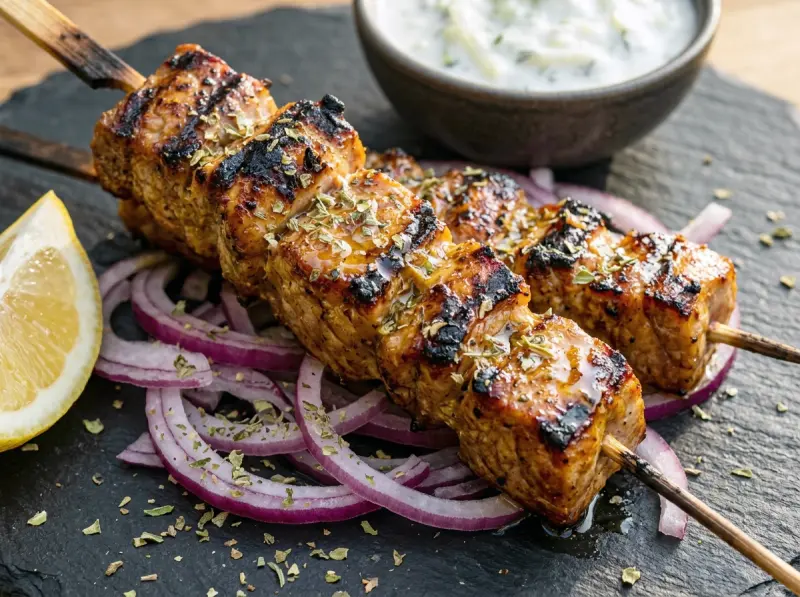
Souvlaki
Pork cubes marinated in olive oil, lemon juice, garlic, and dried oregano, skewered and grilled over high heat until the edges char and the inside stays juicy. The marinade is deliberately simple — this is street food, not a restaurant dish, and the flavor should come from the quality of the pork and the smoke of the grill rather than a complicated spice blend. Souvlaki is served two ways in Greece: straight off the skewer with lemon wedges and a slice of bread, or wrapped in a warm pita with tomato, onion, and tzatziki. Both are correct. This recipe makes 8 skewers.
Ingredients
- 800 gpork neck or shoulder, cut into 2.5 cm cubes
- 5 tbspgood Greek extra virgin olive oil
- 3 tbspfresh lemon juice
- 3 garlic cloves, grated or finely minced
- 1.5 tspdried Greek oregano
- 1 tspfine salt
- 0.5 tspblack pepper
- 1 red onion, cut into 2.5 cm chunks, layers separated
- 4 pita breads
- 1 large lemon
Method
- Marinate. Combine 2 tablespoons of the olive oil, all of the lemon juice, the garlic, oregano, salt, and pepper in a large bowl. Add the pork cubes and mix thoroughly, pressing the marinade into each piece. Cover and refrigerate for at least 2 hours — overnight is better. Remove from the fridge 30 minutes before cooking so the meat comes to room temperature: cold meat on a hot grill cooks unevenly, with the outside done before the center warms through.
- Prepare the skewers. If using wooden skewers, soak in water for at least 30 minutes to prevent burning. Thread the pork and onion pieces onto the skewers alternating as you go — about 5 to 6 pork pieces and a few onion chunks per skewer. Pack the pieces moderately close together: pieces with a little space char on all sides; pieces pressed too tight steam in the middle.
- Grill. Heat the grill or grill pan to medium-high — it must be genuinely hot before the meat goes on. Brush the grates or pan lightly with oil. Place the skewers on the grill and do not move them for the first 2 to 3 minutes: this builds the sear and prevents sticking. Turn every 2 to 3 minutes for a total of 10 to 12 minutes until the pork is cooked through and the edges have genuine char marks. Internal temperature: 71°C (160°F). Let rest 5 minutes off the heat.
- Finish with ladolemono. While the skewers rest, whisk together the remaining 3 tablespoons of olive oil, the juice of half the large lemon, a pinch of dried oregano, salt, and pepper. This simple Greek vinaigrette called ladolemono is what you drizzle over hot souvlaki just before serving — it lifts the char with acid, adds freshness, and is the small detail that separates street-quality souvlaki from the home version.
- Serve. On a platter: arrange the skewers on a bed of thinly sliced red onion, drizzle with ladolemono, and serve with warm pita, lemon wedges, and tzatziki on the side. In a pita wrap: pull the meat off the skewer onto a warm pita, add sliced tomato, red onion, and a generous spoonful of tzatziki, wrap and eat.
FAQ
Pork neck is the best choice for souvlaki and the one most commonly used in Greece. It has an even distribution of fat running through the muscle that keeps each cube moist over the direct high heat of a grill. Pork shoulder is a close second — slightly more variable fat but excellent flavor. Pork loin is the worst choice for souvlaki despite being a common recommendation: it is too lean and dries out on the grill before developing char. If you only have loin, reduce the cooking time and watch the internal temperature carefully.
Minimum: 30 minutes. Best: 4 to 8 hours or overnight. The marinade for souvlaki is simple — olive oil, lemon, oregano, garlic — and it does two things: flavors the surface of the meat and the lemon acid gently tenderises the muscle fibres. Thirty minutes produces noticeably less flavor penetration than overnight. If time is short, cut the pork into smaller cubes (1.5 cm instead of 2.5 cm) — more surface area means the marinade works faster. You can also marinate directly in the skewers and refrigerate assembled, which is the traditional method.
Both are Greek grilled pork served in pita, but the cooking method is completely different. Souvlaki is cubed pork on individual skewers, grilled over direct heat. Gyros (pronounced YEE-ros) is seasoned minced and pressed meat stacked on a vertical rotisserie spit and shaved off in thin slices as it cooks. Souvlaki is pork in recognisable pieces; gyros is shaved meat. Both are wrapped in pita with tomato, onion, and tzatziki, which is why the distinction blurs outside Greece. In Greece, ordering souvlaki gets you the skewered version; ordering a pita wrap with souvlaki gets you the wrap.
The most important variable is heat, not the heat source. A cast-iron grill pan on the highest burner setting, fully preheated for at least 5 minutes until visibly smoking, will produce char marks and a seared crust close to a grill. The key mistakes to avoid: putting the skewers on a pan that isn't hot enough (the meat steams rather than sears), moving the skewers too soon (pick them up only after they release naturally, not when they stick), and crowding the pan. For oven cooking: grill/broil function at maximum heat, top rack, 4 to 5 minutes per side.
Ladolemono (lemon-oil) is the simplest Greek vinaigrette: olive oil, fresh lemon juice, and dried oregano, whisked together. It is used across Greek cooking as a finishing sauce for grilled fish, meat, and vegetables. On souvlaki specifically, it is applied hot — drizzled directly over the skewers the moment they come off the grill. The lemon acid interacts with the charred surface and the lingering heat, releasing aromatics and cutting through the richness of the pork fat. Without it, souvlaki is good. With it, it is unmistakably Greek.
Rate this
Recipes by email
One letter a week: a recipe picked for your taste, plus whatever is new on the site. Unsubscribe in one click.
Welcome gift: Sergei's cookbook (e-book).
By subscribing you agree to the privacy policy.
Tell us what you like to cook (30 seconds) →Keep browsing
More dishes from the Greek archive — picked by overlap with what you're cooking now.


Join the conversation
Comments (2)
Pork neck is the correct cut for souvlaki. Chicken breast souvlaki is a tourist invention — the original is always pork, always fatty enough to stay juicy on the grill. Cut into 3cm cubes, not smaller. Marinate at least 2 hours but overnight transforms it. The dried Greek oregano must be crushed between your palms before going into the marinade. That single gesture releases oils that change the whole dish.
Сувлаки делал на мангале из свиной шеи. Маринад простой но работает — лимон, масло, орегано. Не надо никаких сложных соусов. Мясо нарезать кубиками 3 на 3 сантиметра, не мельче, иначе высыхает. С питой и дзадзики — отличная альтернатива шашлыку.