
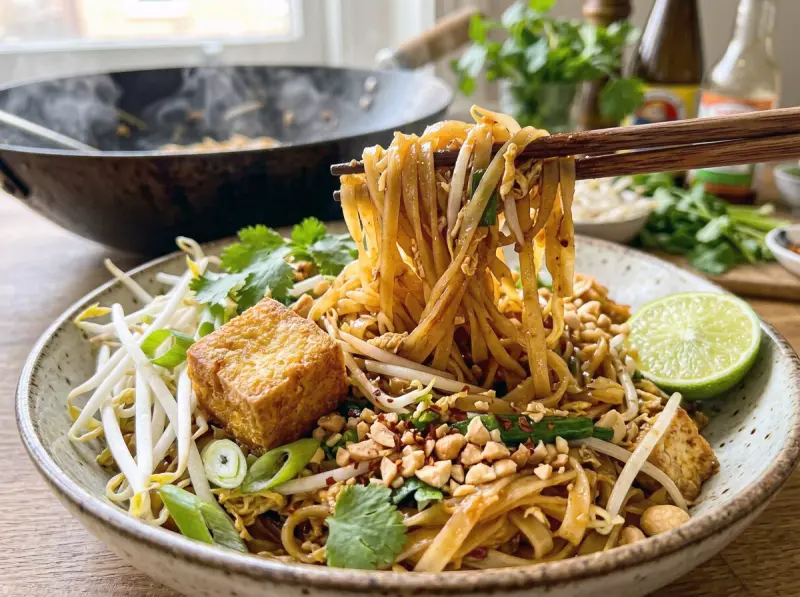
Tofu Pad Thai
Flat rice noodles stir-fried with pressed tofu, bean sprouts, and spring onions in a tamarind-fish sauce-palm sugar sauce, finished with crushed peanuts and lime. This is a vegetarian adaptation of the classic Thai street dish — not a compromise version, but a version that works because the sauce, technique, and noodle handling are treated correctly. The tamarind is non-negotiable. The wok needs to be genuinely hot. The tofu needs to be dry before it hits the pan. Get those three things right and the rest follows.
Ingredients
- 200 gflat rice noodles
- 300 gextra-firm tofu, pressed dry 15+ minutes, cut into 1.5 cm cubes
- 3 tbsptamarind paste
- 3 tbspsoy sauce
- 1.5 tbsppalm sugar or light brown sugar
- 2 tbspneutral oil with a high smoke point
- 3 garlic cloves
- 2 shallots
- 2 eggs
- 100 gbean sprouts
- 3 scallions
- 40 groasted peanuts, roughly crushed
- 1 lime
- 1 tspdried chilli flakes
Method
- Prepare everything before you start cooking. Pad Thai moves fast — there is no time to chop anything once the wok is hot. Soak the rice noodles in warm (not boiling) water for 20 to 30 minutes until they bend without snapping. Drain and set aside. Press the tofu: wrap in paper towels and place a heavy object on top for at least 15 minutes. Make the sauce: whisk together the tamarind paste, soy sauce, and palm sugar in a small bowl until the sugar dissolves. This is your complete flavor base — taste it. It should be sour, salty, and slightly sweet. Adjust with more tamarind for sourness or more sugar if it tastes sharp.
- Crisp the tofu. Heat 1 tablespoon of oil in the wok over medium-high heat until you see the first wisps of smoke. Add the tofu cubes in a single layer without crowding. Do not stir for the first 2 to 3 minutes — let the side in contact with the pan form a golden crust. Turn and repeat until all sides are golden. Remove to a plate. The tofu should be dry on the outside and slightly chewy — if it's soft, the wok wasn't hot enough or the tofu wasn't pressed dry.
- Build the stir-fry base. Add the remaining oil to the same wok over high heat. Add the shallots and garlic and stir-fry for 60 seconds until fragrant and lightly coloured. Add the drained rice noodles and pour the sauce over them. Toss continuously with tongs for 1 to 2 minutes — the noodles will start to absorb the sauce and turn amber. If they stick, add a tablespoon of water. Push everything to one side of the wok.
- Scramble the eggs and combine. Crack the eggs into the cleared space in the wok. Let them sit for 10 seconds, then scramble gently until just set but still slightly wet. Fold into the noodles and toss everything together. The egg should coat the noodles in small pieces rather than forming a solid omelette.
- Add the remaining ingredients and serve. Add the crisped tofu, bean sprouts, spring onions, and chilli flakes. Toss for 30 to 45 seconds — just enough to warm everything through. The bean sprouts should stay slightly crunchy. Divide between two bowls immediately. Top with crushed peanuts and serve with lime wedges and extra chilli on the side. Pad Thai does not hold — eat it right out of the wok.
FAQ
Soak flat rice noodles for pad thai in warm (not boiling) water for 20 to 30 minutes until they're pliable — they should bend easily without snapping but still have some firmness and resistance to the bite. Boiling water over-softens them before they even reach the wok, and they'll fall apart when stir-fried. Too short a soak leaves them stiff and they won't absorb the sauce. Check readiness by bending one noodle: it should fold cleanly in half without breaking. After soaking, drain well and use kitchen scissors to cut the noodles in half — shorter lengths are much easier to toss in the wok.
Tamarind is the defining flavor of pad thai. It provides a sour, fruity, slightly complex acidity that no single ingredient replicates exactly. Without it, the dish is a different thing — still good, but not pad thai. The closest substitute: 1 tablespoon tamarind = 2 teaspoons lime juice + 1 teaspoon brown sugar + 1 teaspoon Worcestershire sauce. Or: 1 tablespoon rice vinegar + a pinch of brown sugar for the sourness. The honest advice: find tamarind paste at an Asian grocery or online. It keeps for months and completely transforms the result. Note: Thai-style tamarind paste is looser and milder than Indian tamarind concentrate — if using the Indian version, use half the quantity stated in the recipe.
Soft tofu in a stir-fry usually comes down to three things. First, the wrong tofu: only extra-firm tofu has a low enough water content to crisp. Silken or soft tofu will never brown properly. Second, not pressed dry enough: wrap the block in paper towels and press under a heavy board for at least 15 minutes — the more water removed, the better the crust. Third, wok too cool or too crowded: the pan must be hot enough to sear, not steam. Add the tofu cubes in a single layer with space between each one and don't stir for the first 2 to 3 minutes. For an even better crust, toss the pressed tofu cubes in 1 teaspoon of cornflour before frying.
A carbon steel or cast iron wok over the highest heat your burner can produce is the ideal tool because it holds very high temperatures and has the surface area to stir-fry without steaming. At home, the largest, heaviest skillet you own — cast iron or carbon steel — works acceptably. The critical rule is not overcrowding: cook a maximum of two portions at a time. More than that and the ingredients release moisture faster than it evaporates, turning the dish into a braise. The pan must be smoking hot before the oil goes in. A thin non-stick pan is the worst option — it can't hold the heat needed and warps at the temperatures required.
Traditional pad thai contains eggs and fish sauce, so it's not vegan as usually made. To make it fully plant-based: skip the eggs or replace with crumbled silken tofu tossed with a little turmeric (for color) and nutritional yeast (for umami). Replace fish sauce with vegan fish sauce (available in Asian shops) or a combination of soy sauce and a small piece of dried seaweed (kombu or nori) simmered briefly to add oceanic umami. The remaining ingredients — rice noodles, tamarind, palm sugar, tofu, bean sprouts, peanuts, lime — are naturally vegan. The result is slightly milder than the fish sauce version but good seaweed-based substitutes bring enough depth to make a genuinely satisfying bowl.
Rate this
Recipes by email
One letter a week: a recipe picked for your taste, plus whatever is new on the site. Unsubscribe in one click.
Welcome gift: Sergei's cookbook (e-book).
By subscribing you agree to the privacy policy.
Tell us what you like to cook (30 seconds) →Keep browsing
More dishes from the Thai archive — picked by overlap with what you're cooking now.

Join the conversation
Comments (1)
After cooking pad thai across Bangkok for a week, the biggest lesson I brought home was about heat. Restaurant wok burners hit temperatures that home stoves simply cannot match, so I compensate by cooking in two batches — tofu first, then noodles separately. If you pile everything in at once on a home burner, the temperature drops and the noodles absorb sauce instead of getting that slightly charred wok flavour. Press the tofu for at least 30 minutes, ideally an hour. Patience with pressing equals crispiness in the pan.