
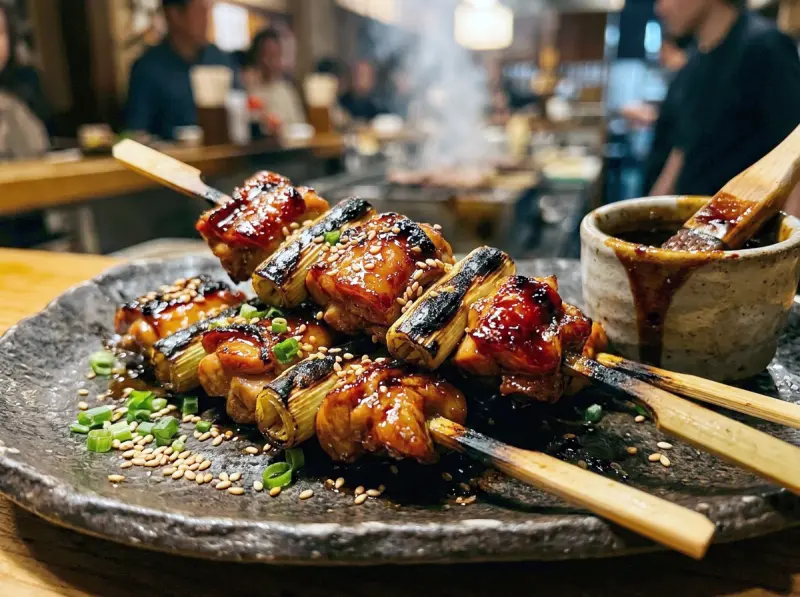
Yakitori (Japanese Grilled Chicken Skewers)
Yakitori (焼き鳥, yaki = grilled, tori = bird) is one of Japan's most beloved street foods and izakaya staples — bite-sized pieces of chicken threaded onto bamboo or metal skewers and grilled over charcoal, seasoned with either coarse salt (shio style) or brushed repeatedly with tare, a soy-mirin-sake glaze that caramelizes into a lacquered, sweet-savory coating. Authentic yakitori is cooked over binchotan (白炭), a white oak charcoal that burns at very high temperature with minimal smoke, allowing the fat dripping from the chicken to produce fragrant vapour rather than flare-ups. The two defining skewer styles covered here are negima (ねぎま) — chicken thigh alternated with long onion — and the plain momo (もも) thigh skewer. Both are grilled in multiple passes, dipped in tare, returned to the grill, and repeated until the exterior is lacquered dark and the interior is cooked through. The bamboo skewers soak for 30 minutes and the tare cools while you thread the chicken.
Ingredients
- 700 gboneless, skinless chicken thighs
- 4 scallions
- 120 mlsoy sauce
- 120 mlmirin
- 60 mlsake
- 2 tbspsugar or honey
- 1 tspcoarse sea salt
- 1 tbsptoasted white sesame seeds
- 1 lemon
- 1 tspshichimi togarashi
Method
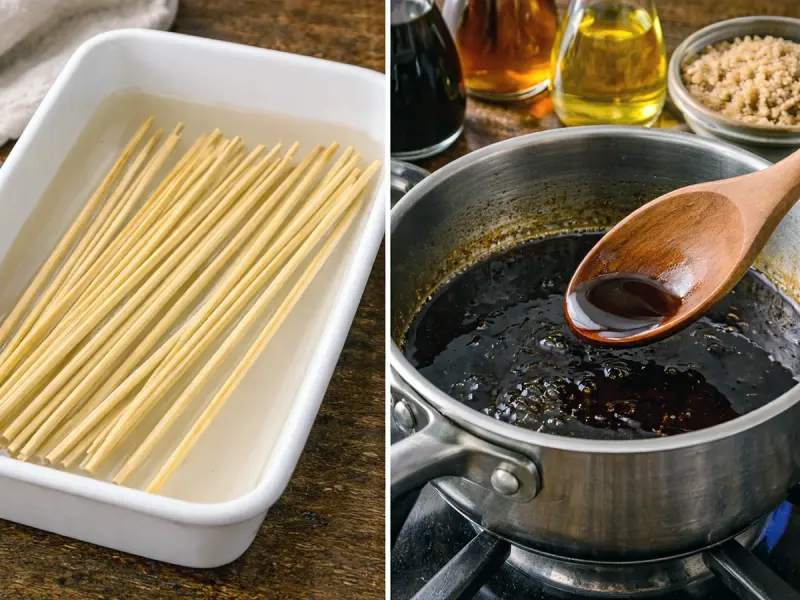
- Make the tare glaze and soak the skewers. Soak 12 to 16 bamboo skewers in cold water for at least 30 minutes — this prevents them from charring during grilling. For the tare: combine the soy sauce, mirin, sake, and sugar in a small saucepan. Bring to a boil over medium heat, stirring to dissolve the sugar. Reduce to a low simmer and cook uncovered for 20 to 25 minutes until the sauce has reduced by one-third and coats the back of a spoon. It will be glossy and slightly syrupy. Cool to room temperature — it thickens further as it cools. Reserve half in a separate small bowl for finishing (to avoid cross-contamination with raw chicken).
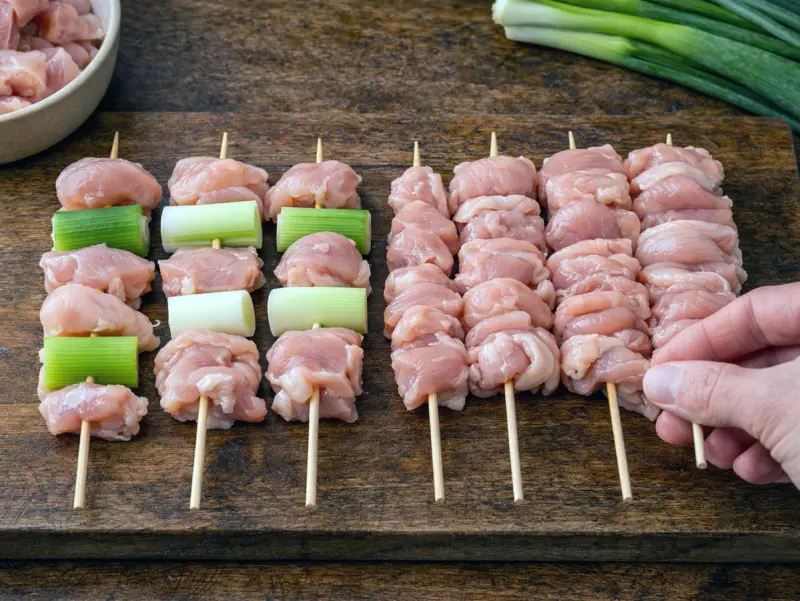
- Skewer the chicken — negima style and plain momo. Cut the chicken thighs into uniform 3 cm pieces — uniformity is critical for even cooking. For negima: alternate 3 pieces of chicken with 2 pieces of scallion on each skewer, beginning and ending with chicken. For momo (plain thigh): thread 4 to 5 pieces of chicken onto each skewer, pressing the pieces snugly together. Leave 5 cm of the skewer bare at the bottom as a handle — this part should not be over the coals. Press the assembled skewers gently flat to ensure even contact with the grill surface.
- Set up the grill for direct medium-high heat. For charcoal: arrange the coals in a narrow rectangular bed (ideally a konro grill or similar), light and wait until covered in white ash with no visible flames. The coals should be radiating strong heat. For gas: preheat all burners to medium-high for 10 minutes, then clean and lightly oil the grates. Position the grill so the bamboo handles of the skewers extend beyond the edge of the grill — this protects them from burning. The optimal grilling distance is 5 to 7 cm from the coals.
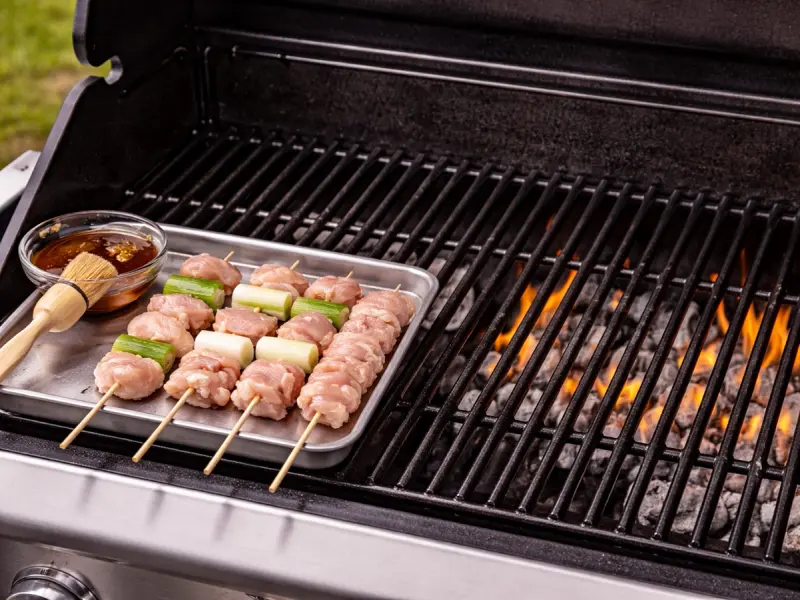
- Grill in multiple passes — the layering method. For tare-style negima: place skewers on the grill. Season lightly with salt on one side. Grill 2 minutes, turn, 2 minutes on the second side. When partially cooked (chicken is white outside but not cooked through), dip each skewer fully into the tare, shake off excess, return to the grill. Grill 1 minute, dip again, grill 1 minute more. Repeat the dip-and-grill cycle 2 to 3 times in total — each dip builds a thicker lacquer layer and the caramelisation deepens. Total cooking time approximately 10 to 12 minutes. When you finish, throw away the dipping tare, or bring it to a full boil before storing it. For shio-style: skip the tare entirely. Season generously with coarse salt when first placed on the grill, and again mid-cook. Finish with a squeeze of lemon.
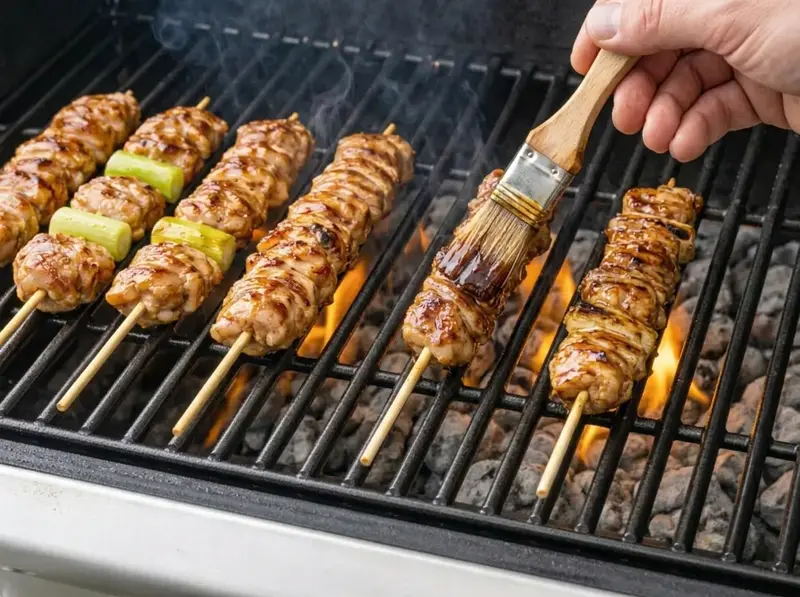
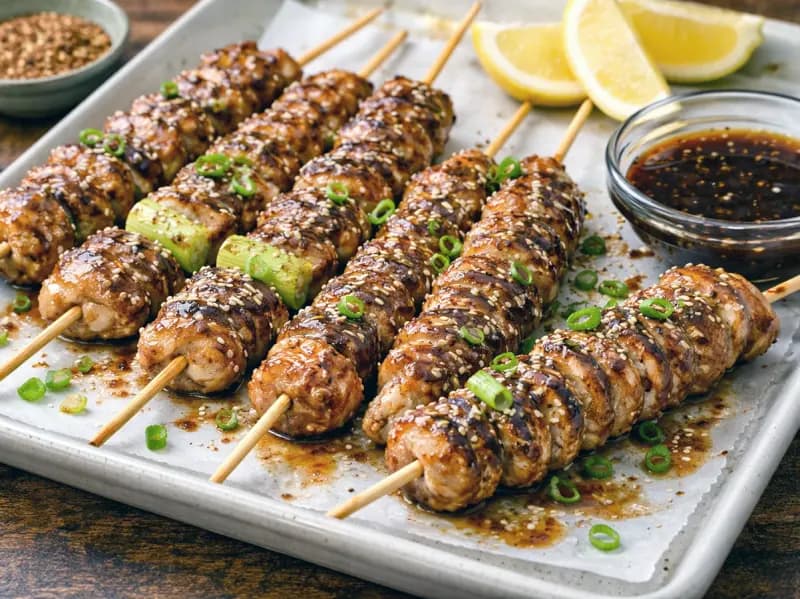
- Check doneness and serve. Yakitori is done when the exterior is lacquered and dark, the edges are slightly charred, and the interior reaches 74°C (165°F). The meat should feel firm when pressed. Remove from the grill and brush with the reserved clean tare one final time for maximum gloss. Arrange on a plate or serve directly on the skewers. Scatter toasted sesame seeds over the top. Serve shichimi togarashi on the side for those who want heat. In the izakaya tradition, yakitori is eaten immediately, skewer by skewer, with cold beer or sake.
FAQ
Binchotan (備長炭) is a Japanese white charcoal made from holm oak (ubame-gashi), carbonised at very high temperature in a specific way that makes it exceptionally dense and hard. It burns very hot and steadily, with almost no smoke and intense radiant heat. The key property for yakitori is that when chicken fat drips onto binchotan it does not flare up — instead the fat ignites briefly, producing a fragrant vapour that bastes the chicken in its own smoke. Regular charcoal briquettes flare aggressively, charring the exterior. If binchotan is unavailable, high-quality lump hardwood charcoal (not briquettes) is an acceptable substitute. Gas grills can produce excellent yakitori but lack the fat-vapour-smoke element that makes binchotan grilling distinct.
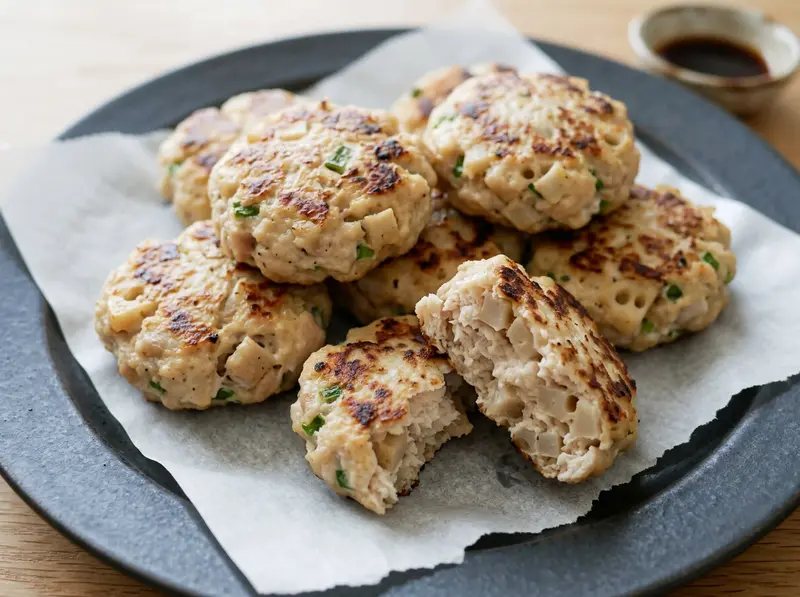
Yakitori restaurants offer a wide range of cuts, each with a specific character. Negima (ねぎま) — thigh with long onion, the most popular style. Momo (もも) — plain thigh, juicy and flavourful, served both with tare and with salt. Kawa (皮) — crispy rendered chicken skin, fatty and addictive. Sasami (ささみ) — breast tenderloin, lean and delicate, always shio. Tsukune (つくね) — chicken meatball on a skewer, bound with egg yolk. Hatsu (ハツ) — chicken heart, chewy and mineral-rich. Rebā (レバー) — chicken liver, rich and creamy. Undercooked chicken liver can carry Campylobacter however fresh it is, so cook it through to 74°C (165°F), with no pink left in the center. Bonjiri (ぼんじり) — fatty tail piece, very rich, a delicacy. All parts are grilled the same way; cooking times vary slightly by thickness. At home, tsukune also works as pan-fried patties: see renkon tsukune.
These are the two fundamental seasoning styles for yakitori. Shio (塩, salt) — the simplest and arguably most refined style: the chicken is seasoned only with coarse salt during and after grilling, and sometimes finished with a squeeze of yuzu or lemon. Shio is the correct style for delicate, less fatty cuts where the natural chicken flavor should shine without being masked by sauce. Tare (タレ, glaze) — the sweet-savory soy-based glaze that builds up in layers during the multiple dip-and-grill cycles. Tare is ideal for fattier cuts (thigh, skin, tail) where the rendered fat needs the counterbalance of saltiness and sweetness, and where the caramelisation adds complexity. In Japan, a table at a yakitori restaurant might order both styles of the same cut to compare them.
Yes — the broiler (grill function) of a home oven is the standard substitute. Preheat the broiler to maximum temperature for 10 minutes. Line a baking sheet with foil and place a wire rack on top. Arrange the skewers on the rack so the chicken is 5 to 7 cm below the broiler element. Broil for 5 to 6 minutes, remove and brush with tare, return, broil 2 to 3 minutes, brush again, repeat. Total time 12 to 15 minutes. The lack of charcoal smoke means the result is cleaner and less complex, but the caramelisation and glaze are fully achievable. A cast-iron grill pan at maximum heat is another option — the ridges produce grill marks and the high heat builds char.
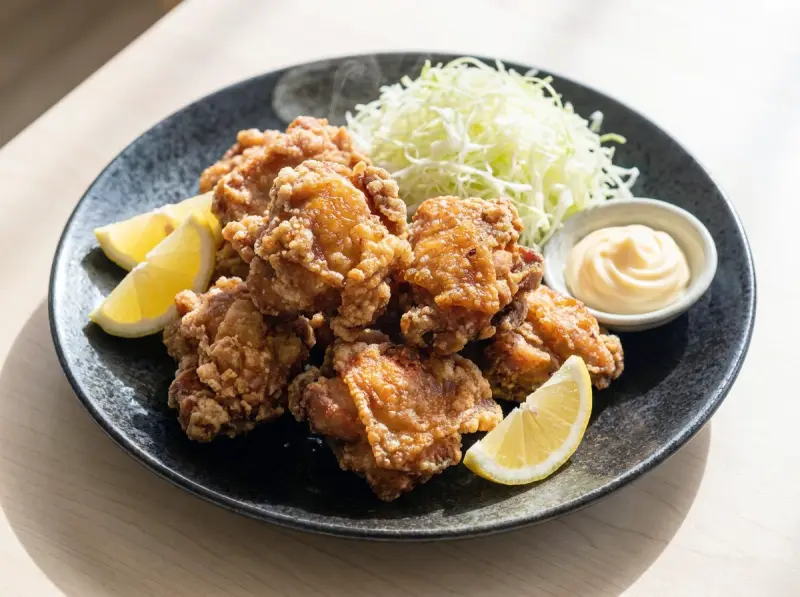
In the izakaya tradition, yakitori is eating food — it exists in the context of drinking. The classic pairing is cold beer (especially pale lager or pilsner, which cuts through the fat and sweetness) or cold sake (particularly junmai or honjozo styles). Highball (whisky and soda) is increasingly the modern Tokyo standard. Food accompaniments: a small bowl of the reserved, clean tare for dipping (never the tare the raw skewers went into: throw that away or boil it for a minute first); coarse salt and lemon wedges for shio-style; shichimi togarashi (seven-spice powder) for those who want heat; Japanese rice (gohan) if serving as a meal rather than a bar snack; Japanese pickles (tsukemono) for acidity. Yakitori should always be eaten immediately off the grill — it deteriorates within minutes as the glaze stiffens and the chicken loses its juiciness. Other Japanese dishes that go with a drink: chicken karaage and oden.
Keep browsing
More dishes from the Japanese archive — picked by overlap with what you're cooking now.
Recipes by email
One letter a week: a recipe picked for your taste, plus whatever is new on the site. Unsubscribe in one click.
Welcome gift: Sergei's cookbook (e-book).
By subscribing you agree to the privacy policy.
Tell us what you like to cook (30 seconds) →
Join the conversation
Comments (2)
炭火がなくても魚焼きグリルで十分美味しくできました。タレは多めに作って冷蔵庫に入れておけば1週間持ちます
タレが完璧!家の魚焼きグリルで作りましたが、ちゃんと焼き色がつきました。竹串は水に30分浸すのを忘れずに