Photo coming soon
Made a day ahead, this stew is noticeably better. The broth thickens overnight into something richer and more unified, and the fat rises to the surface where it can be lifted off. Reheat gently on low heat with the lid on — never at a rolling boil or the lamb tightens up.
For a completely traditional version without beer, replace the Guinness with an extra 330 ml of beef broth. The original peasant recipe used no beer at all — just lamb, root vegetables, water and whatever herbs were growing outside. Simple and still delicious.
Irish Stew
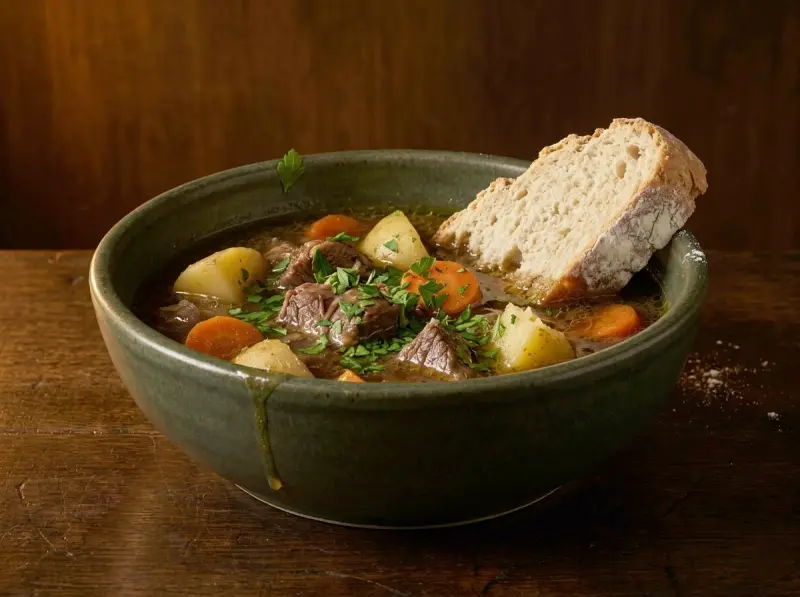
Lamb shoulder browned until dark, then slow-braised with potatoes, carrots and onions in a Guinness-spiked broth until the collagen melts and the whole pot turns rich and glossy. Ireland's national dish — honest peasant food that gets better overnight.
Key Ingredients
What you'll need
Ingredients
- 700 gSee recipes with lamb shoulder
lamb shoulder
i - 600 gSee recipes with potato
potato
i - 3See recipes with carrots
carrots
i - 2See recipes with onions
onions
i - 330 mlSee recipes with guinness stout
Guinness stout
i - 400 mlSee recipes with beef broth
beef broth
i - 2 tbsp
- 3See recipes with thyme sprigs
thyme sprigs
i - 2See recipes with bay leaves
bay leaves
i - 1See recipes with bunch of parsley
bunch of parsley
i - 1 tsp
- 0.5 tspSee recipes with black pepper
black pepper
i
How to make it
Instructions
- 1
Cut the lamb shoulder into 4 cm chunks, removing large sinew. Pat completely dry with paper towels — wet meat will steam, not brown. Season with salt and pepper, then toss with flour to coat.
- 2
Heat oil in a Dutch oven or heavy pot over high heat. Brown the lamb in 2–3 batches, leaving space between pieces, 3–4 minutes per side until genuinely dark. Don't rush this — the colour on the meat is the flavour base of the whole stew. Set the browned meat aside.
- 3
Reduce heat to medium. In the same pot, cook the diced onions for 5 minutes, scraping up the browned bits. Add the Guinness and let it bubble for 2 minutes, lifting everything from the bottom. Pour in the beef broth.
- 4
Return the lamb to the pot. Add thyme, bay leaves and the parsley stalks (save the leaves for serving). Bring to a gentle simmer — small, slow bubbles. Cover and cook on the lowest possible heat for 60 minutes.
- 5
Add the carrots cut into large chunks and the potatoes quartered or halved depending on size. Cover and continue simmering for another 35–40 minutes until the vegetables are tender and the lamb pulls apart with a fork.
- 6
Remove the thyme sprigs, bay leaves and parsley stalks. Taste and adjust salt. If the broth is too thin, simmer uncovered for 10 minutes. Ladle into deep bowls, scatter chopped parsley leaves on top and serve with soda bread.
Frequently Asked Questions
What is the difference between Irish stew and Guinness beef stew — are they the same dish?
They are different dishes. Irish stew is the traditional one: made with lamb or mutton, potatoes, carrots and onions in a light-coloured broth, sometimes with a splash of stout. It originates from peasant cooking where lamb was cheaper than beef. Guinness stew is a pub dish made with beef braised in stout, which produces a dark brown, intensely flavoured sauce. The confusion arises because both are served in Irish pubs. This recipe uses traditional lamb but adds Guinness for depth — a common modern compromise that works well. If you want the strictly traditional version, skip the Guinness and use all broth.
Why did the lamb in Irish stew turn out tough — which cut to use and how long to braise it?
For stew, use lamb shoulder or neck only — both are loaded with collagen that converts to gelatin during long, slow cooking, making the meat soft and the broth silky. Leg of lamb and chops are wrong for stew: they dry out instead of softening. Minimum cooking time is 90 minutes at the barest simmer. Hard boiling makes the fibres contract and the meat tightens up even with hours of cooking. The right temperature is a barely visible tremor on the surface. Lamb shoulder is ready when it tears apart with almost no resistance from a fork.
Can you make Irish stew without Guinness — what to substitute for dark stout in the recipe?
Yes — the traditional recipe contained no beer at all. Replace the Guinness with an additional 330 ml of beef broth for the fully classic, lighter-coloured version. For depth without beer: add 1 tablespoon of Worcestershire sauce and 1 teaspoon of tomato paste, which together provide similar umami and colour. Dark non-alcoholic beer or a dark malt beverage also works as a substitution. Whatever you use, add it at the same point as the broth — never at the end of cooking.
Why did the Irish stew broth turn cloudy and grey instead of clear and amber?
Cloudiness comes from two things. First: wet meat — if you don't pat the lamb dry before browning, it releases water instead of forming a crust, and that grey liquid clouds the broth. Always dry the meat with paper towels. Second: too vigorous a boil — hard bubbling breaks the proteins into fine particles that stay suspended. Keep the heat at the absolute minimum: a few lazy bubbles at the surface. For the clearest broth, skim the grey foam with a ladle during the first 10–15 minutes after adding the liquid — that is when most of the soluble protein comes out.
What to serve with Irish stew — traditional Irish sides and how it is eaten in Ireland?
Traditional Irish stew is served as a complete meal in a deep bowl — the potato is already inside. The essential accompaniment is Irish soda bread for soaking up the broth. The bread is not a side dish; it is a tool for finishing every drop of liquid at the bottom of the bowl. Colcannon (mashed potato with cabbage and spring onion) is sometimes served alongside instead of potato in the stew itself. Scatter fresh chopped parsley over the top just before serving — the greenness and slight bitterness cut through the richness of the braised broth.


Join the conversation
Comments
Loading comments…