
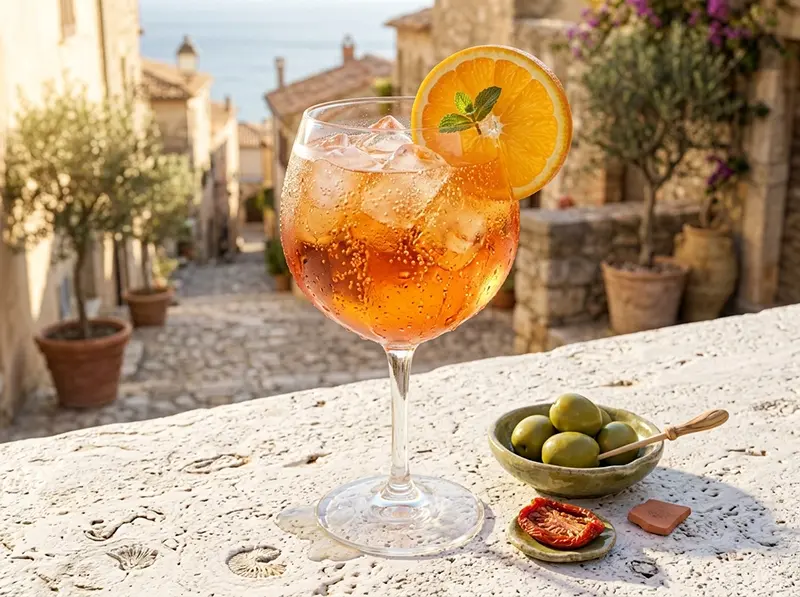
Aperol Spritz
Three parts Prosecco, two parts Aperol, one part soda water, poured in that order over ice in a large wine glass. The 3-2-1 ratio is the official recipe and it works — bitter, lightly sweet, sparkling, orange. The drink originated in the Veneto region of northeastern Italy as an aperitivo, meaning it's designed to be drunk before a meal to open the appetite. It's not complicated. What kills it at home is the wrong order of pouring and warm prosecco.
Ingredients
- 90 mlProsecco DOC
- 60 mlAperol
- 30 mlsoda water or sparkling water
- 1 large wine glass, preferably a balloon glass
- 3 large ice cubes
- 1 orange slice
Method
- Chill everything. The Prosecco should come straight from the fridge — room-temperature sparkling wine loses its bubbles within seconds and makes a flat, warm drink. The Aperol can also be stored in the fridge, though it's less critical. The glass can be chilled in the freezer for 5 minutes if you have time. A cold glass keeps the drink colder longer and prevents the ice from melting too quickly.
- Build the drink in the right order. Pour the chilled Prosecco into the glass first, then add the Aperol, then the splash of soda water. This order matters: pouring Prosecco over ice causes the bubbles to collapse immediately, and pouring it last over Aperol would require stirring which also kills the carbonation. The Aperol sinks slightly and the soda water lifts it — a gentle swirl or two is all the mixing this drink needs.
- Add the ice last. This is the step most people do first and it's why homemade Aperol Spritzes lose their fizz before the first sip. Once the liquids are in the glass, carefully add 3 large ice cubes. Large cubes melt more slowly than small ones — avoid crushed ice. Lower the ice into the drink gently; don't drop it. The drink is now assembled and the carbonation is intact.
- Garnish and serve immediately. Tuck an orange slice into the glass or rest it on the rim. In Venice, spritzes are sometimes served with a small skewer of green olives on the side — an odd pairing that somehow works beautifully with the bitter orange flavor. Do not stir again. Serve within 30 seconds of assembling. The drink does not improve with time.
- The 3-2-1 ratio is a starting point, not a law. If the bitterness is too much, reduce the Aperol to 45 ml and add 15 ml more Prosecco. If you want a lighter drink, increase the soda water and reduce both the Aperol and Prosecco proportionally. If you want something more intense, swap the Aperol for Campari — the same ratio but a completely different, more serious drink. Campari Spritz is what the Italians who work in aperitivo bars usually drink themselves.
FAQ
Aperol is an Italian aperitif liqueur made from bitter orange, gentian root, rhubarb, and cinchona bark, bottled at 11% ABV. It was created in Padua in 1919. The bitterness is mild and sweetly citrusy — significantly less intense than Campari, its closest relative. That accessibility is what made the Aperol Spritz a global phenomenon in the 2010s. The bitterness is intentional: aperitifs are designed to stimulate appetite before a meal, and bitter compounds do that effectively.
Yes. Cava (Spanish) is the closest substitute: dry, well-carbonated, and cheaper. French Crémant is more refined. Dry Champagne works but is expensive for a cocktail this casual. The key is using brut or extra dry sparkling wine — not demi-sec or dolce. Sweet Prosecco makes the spritz cloying. Still white wine won't work: the carbonation is structural, not decorative. Always use chilled sparkling wine straight from the fridge.
The main cause is pouring Prosecco over ice. Ice destroys carbonation on contact. The correct order is: Prosecco into a dry glass — Aperol — soda water — ice cubes added last, gently. Do not stir more than once or twice. Use large ice cubes rather than crushed ice — larger cubes have less surface area and melt more slowly, which means less dilution and longer-lasting carbonation. Serve immediately after assembling.
Less bitter: reduce the Aperol to 45 ml and increase the Prosecco to 105 ml (a 4:1:1 ratio). Even gentler: replace some soda with a splash of fresh orange juice. Stronger and more bitter: swap Aperol for Campari — same ratio, completely different drink, much more intense. Lighter and lower-alcohol: increase the soda water and reduce both Aperol and Prosecco proportionally, keeping the 3-2-1 structure but scaling down.
The closest substitutes: Campari (much more bitter and less sweet, a genuinely different drink), Select Aperitivo (the original Venetian aperitif, traditionally used in spritz before Aperol became dominant), Lillet Blanc (softer, more citrusy, almost no bitterness), Cynar (artichoke-based, more herbal and very bitter). Any Italian amaro works in the structural ratio — just expect a different flavor profile depending on how bitter and how sweet your alternative is.
Rate this
Recipes by email
One letter a week: a recipe picked for your taste, plus whatever is new on the site. Unsubscribe in one click.
Welcome gift: Sergei's cookbook (e-book).
By subscribing you agree to the privacy policy.
Tell us what you like to cook (30 seconds) →Keep browsing
More dishes from the Italian archive — picked by overlap with what you're cooking now.
Join the conversation
Comments (1)
The quality of your prosecco doc is the entire foundation of this aperol spritz. There's no technique that can salvage a subpar base ingredient when the drink is this straightforward.