
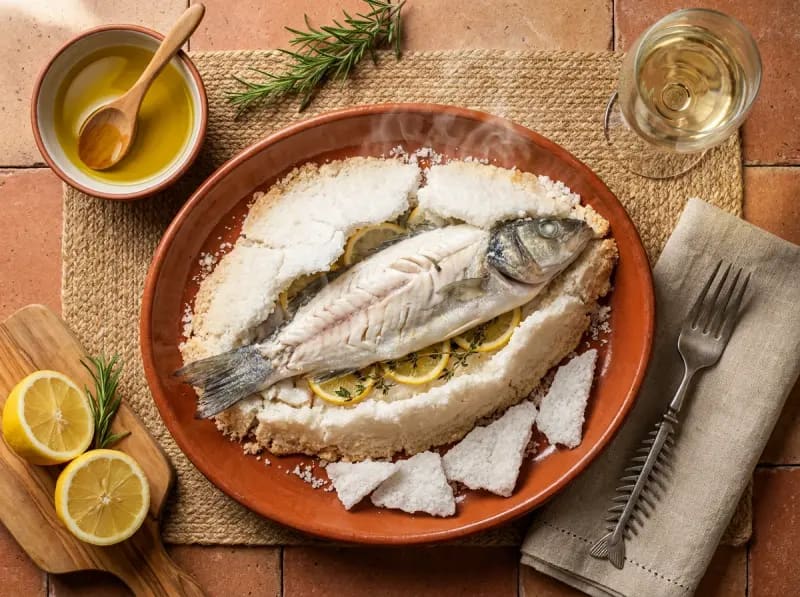
Branzino al Sale (Italian Salt-Crusted Whole Sea Bass)
Branzino al sale is the classic Italian salt-crusted sea bass — a whole fish buried under coarse sea salt mixed with egg whites, baked at 200°C for 30 minutes, then cracked open at the table. The salt forms a hard dome that turns the oven into a sealed steam chamber: the fish cooks in its own moisture and the aromas of lemon, thyme, and rosemary. Despite the dramatic amount of salt, the flesh emerges perfectly seasoned, never salty — the skin and scales keep the salt out. Restaurant-style Mediterranean seafood in its simplest form: high-protein, gluten-free, keto-friendly, and entirely hands-off once in the oven. Active work 10 minutes, bake 30 minutes. Serves 4 from two 700 g fish.
Ingredients
- 2 piecewhole branzino
- 2 kgcoarse sea salt
- 3 pieceegg whites
- 2 piecelemons
- 8 piecefresh thyme sprigs
- 4 piecefresh rosemary sprigs
- 20 gfresh parsley
- 4 clovesgarlic cloves
- 30 mlextra virgin olive oil
- 1 pinchblack pepper
Method
- Prep the fish. Ask your fishmonger to gut and clean the branzino but to leave the scales, head, and tail intact — together with the skin, the scales are an extra barrier against the salt. Rinse the fish under cold water, pat thoroughly dry inside and out. Preheat the oven to 200°C with a rack in the centre.
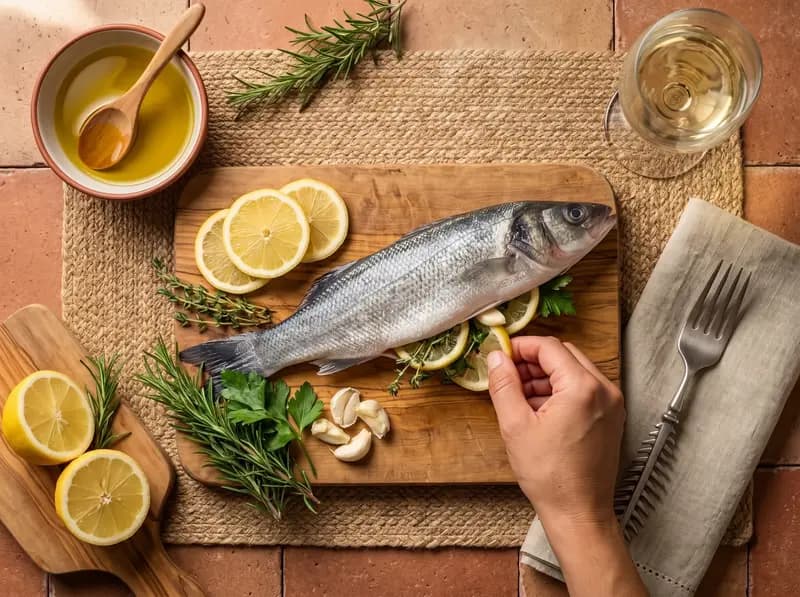
- Stuff the cavity. Slice one lemon into thin rounds. Inside each fish: 4 thyme sprigs, 2 rosemary sprigs, half the parsley, 2 smashed garlic cloves, and 4 to 5 lemon slices. Add a turn of black pepper, no salt — the crust will season enough. Stuff loosely so heat circulates inside.
- Make the salt mixture. Whisk the egg whites in a large bowl with a fork until foamy, about 30 seconds — not stiff peaks, just broken up. Add the coarse sea salt and mix with your hands until uniformly damp and packs together when squeezed, like wet sand. If too dry add 1 to 2 tbsp cold water; if too wet add more salt.
- Build the salt bed. Line a rimmed baking tray with parchment. Spread one-third of the salt mixture in two oval shapes slightly larger than the fish, 1.5 cm thick. Place each fish on its salt bed, mound the remaining salt over the top, press firmly to seal completely. No gaps — gaps mean steam escape and dry fish.
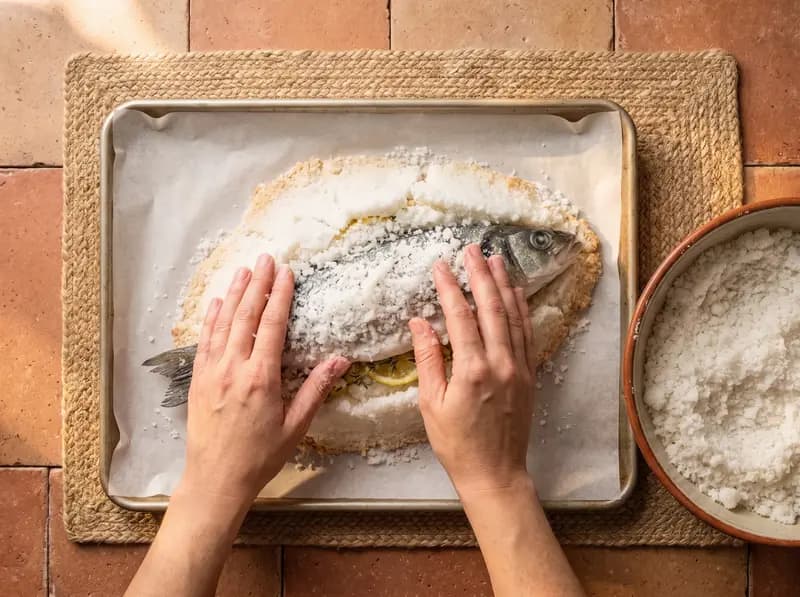
- Bake for 30 minutes. The crust turns pale ivory and rock-hard. Time is the main guide: 30 minutes for two fish of about 700 g each; heavier fish need longer. If you have an instant-read thermometer, push it through the crust into the thickest part behind the head: the fish is done at 63°C (145°F). The real check comes once the crust is open: the flesh should be opaque white and lift off the bone in flakes. If it is still translucent along the backbone, return the fish to the oven for 5 minutes.
- Rest exactly 5 minutes — no longer. Beyond 5 minutes the salt slowly migrates into the flesh and the fish over-seasons. Bring the tray to the table: tap the salt dome firmly with the back of a chef's knife or wooden spoon. The crust cracks with a dramatic snap. Lift off the top half in one piece, brush off any salt grains with a pastry brush.
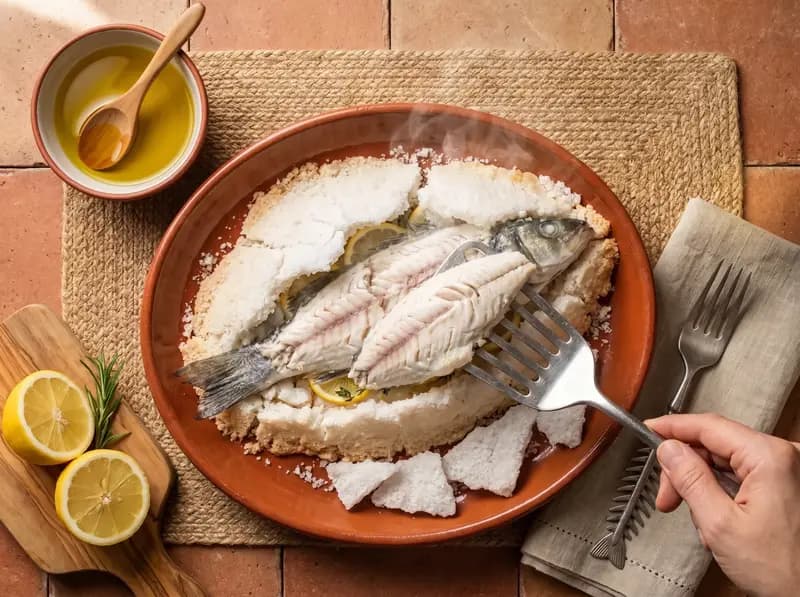
- Fillet at the table. Peel off the top skin in one motion — it lifts away with the salt residue stuck to it. Use a fish spatula to lift the top fillet onto a warm plate. Lift the central spine and head off in one piece, then transfer the bottom fillet. Repeat for the second fish.
- Drizzle each fillet generously with extra virgin olive oil, squeeze fresh lemon juice from the second lemon, finish with a turn of black pepper. Serve immediately on warm plates with roasted potatoes, fennel and orange salad, or grilled vegetables. The fish loses heat fast once filleted.
FAQ
Salt does NOT penetrate the flesh when the technique is correct, for two reasons. First, the skin of the fish is a natural barrier, and the scales are left on as extra protection. Second, the salt crust works like a clay oven: when heated, it hardens into an airtight dome creating saturated steam from the fish's own juices. The salt contacts only the skin surface, never the flesh. The final flavour is delicate, oceanic, perfectly seasoned. If your fish came out salty, the usual causes are a crust that cracked during baking, fish left under the salt for more than 5 minutes after the oven, or fine salt used instead of coarse.
Branzino (Italian), loup de mer (French), Wolfsbarsch (German), European sea bass (English) — all the same fish, Dicentrarchus labrax, the Mediterranean sea wolf. Dorada (gilthead sea bream, orata in Italian) is a different species, Sparus aurata, with a gold spot on the head and denser, slightly sweeter flesh. By shape they are similar (oval, silver, around 700 g), but branzino is softer and oilier with a tender oceanic flavour, while orata is firmer with mild sweetness. Both work in salt crust; Italians use them interchangeably (spigola al sale, branzino al sale, orata al sale are parallel names). In US markets 'sea bass' is sometimes Patagonian toothfish — a completely different Antarctic fish that does not work for whole-fish baking. Look specifically for European sea bass or Mediterranean branzino.
Yes, you can. Egg whites are optional: they bind the salt into a shell that sets hard and lifts off in large pieces, which is handy when you open the fish at the table. Many Italian recipes use plain coarse salt, dry or dampened with a little water. This recipe uses 3 egg whites for 2 kg of salt, about 1 egg white per 600–700 g. Whisk them lightly with a fork until foamy, not to stiff peaks. Without egg whites, use 100–150 ml cold water per 2 kg salt and mix to the texture of wet sand.
Optimal size is 700–900 g per fish for 2 portions, or one 1.5 kg fish for 4 portions. Under 500 g the fish over-salts due to thin flesh; over 2 kg the inside undercooks at standard temperature, requiring 180°C for longer. Standard rule: 25–30 minutes at 200°C for a 700–800 g fish, 30–35 minutes for 1 kg, 40–45 minutes for 1.5 kg, 50–55 minutes for 2 kg (with temperature dropped to 180°C for large fish). For precision use an instant-read thermometer: push it through the crust into the thickest part behind the head 5–10 minutes before the end; the fish is done at 63°C (145°F). Without a thermometer, open the crust and look: the flesh should be opaque white and lift off the bone in flakes. Salt-to-fish ratio stays constant at 1.5:1 by weight.
Branzino al sale is an immediate-serving dish — its key value is freshness and the steam-chamber effect under the crust, neither of which survive holding. Prep can be done ahead but final baking cannot. Up to 4 hours before serving: prep the fish (gutted with scales on, stuffed with lemon and herbs), refrigerate; prepare the salt and egg-white mixture, cover with plastic film and refrigerate as well. About 50 minutes before serving: preheat the oven, build the salt crust around the fish, bake 30 minutes and rest 5. Serve tableside, cracking the crust in front of guests. Classic side dishes: roasted potatoes with rosemary; fennel and orange salad for citrus contrast; grilled summer vegetables; warm cannellini beans with tomatoes for winter. Sauces: salsa verde, beurre blanc, or simply extra virgin olive oil with lemon. Wine pairing: dry mineral whites — Vermentino from Sardinia, Falanghina from Campania, or Greek Assyrtiko. Never red wine — tannins clash with the oceanic flavour.
Rate this
Recipes by email
One letter a week: a recipe picked for your taste, plus whatever is new on the site. Unsubscribe in one click.
Welcome gift: Sergei's cookbook (e-book).
By subscribing you agree to the privacy policy.
Tell us what you like to cook (30 seconds) →Keep browsing
More dishes from the Italian archive — picked by overlap with what you're cooking now.
Join the conversation
Comments
No comments yet — be the first!