


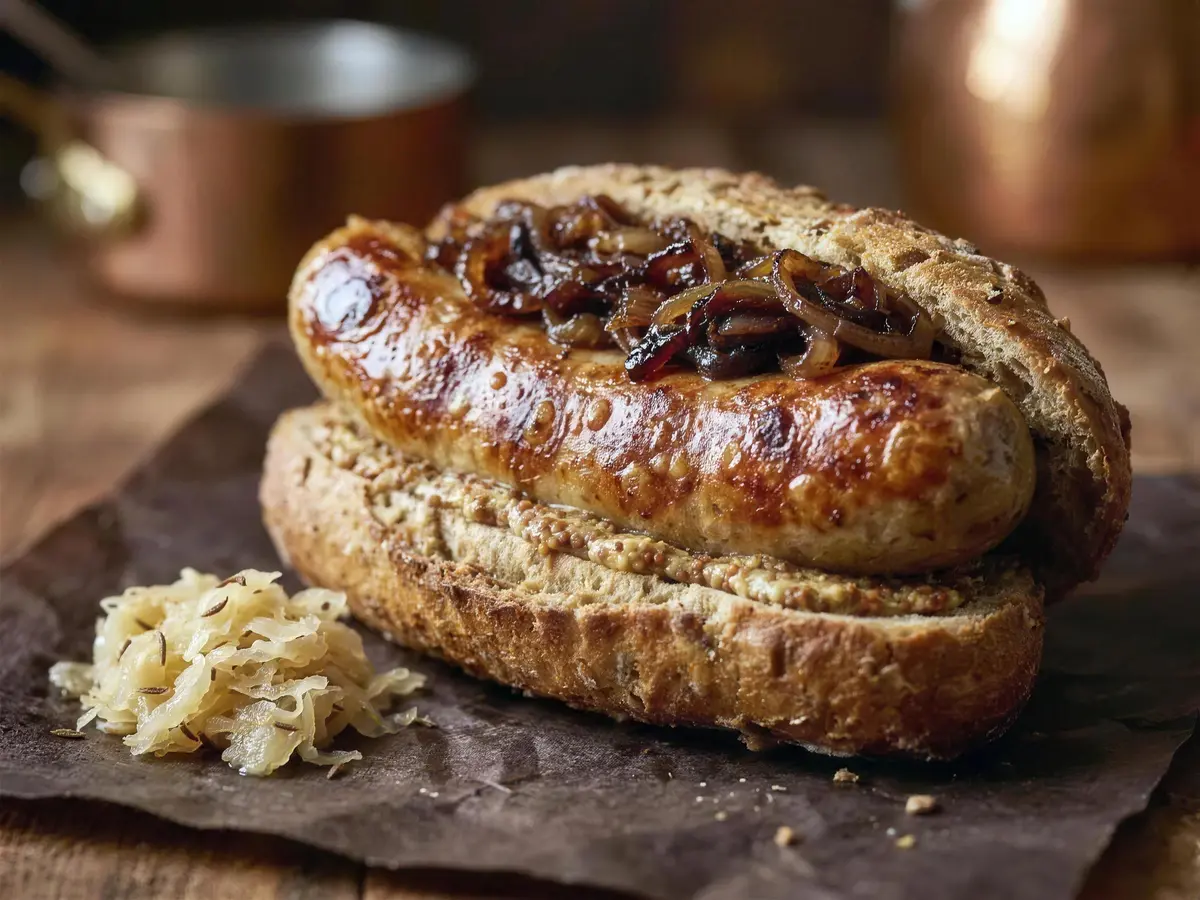
Bratwurst
Bratwurst is a German fresh pork sausage, grilled or pan-fried until the skin is deeply browned and the fat inside sizzles. The method here is the American beer brat from Wisconsin: simmer briefly in beer with onions first, then finish on a hot grill or cast-iron pan to build color and crispness. The beer bath cooks the sausages through gently and infuses flavor without the risk of splitting or drying out. Serve with German mustard, sauerkraut, and crusty bread. Bratwurst is street food, tavern food, market food — always eaten immediately, always hot.
Ingredients
- 4 fresh bratwurst sausages, raw, about 100 g each
- 500 mlGerman lager or pilsner beer
- 1 large onion
- 1 bay leaf
- 3 whole peppercorns
- 1 tbspneutral oil or lard
- 4 crusty bread rolls or hot dog buns
- 4 tbspGerman mustard, medium-hot (mittelscharfer Senf) or coarse-ground
- 300 gsauerkraut
- 1 pinchcaraway seeds
Method
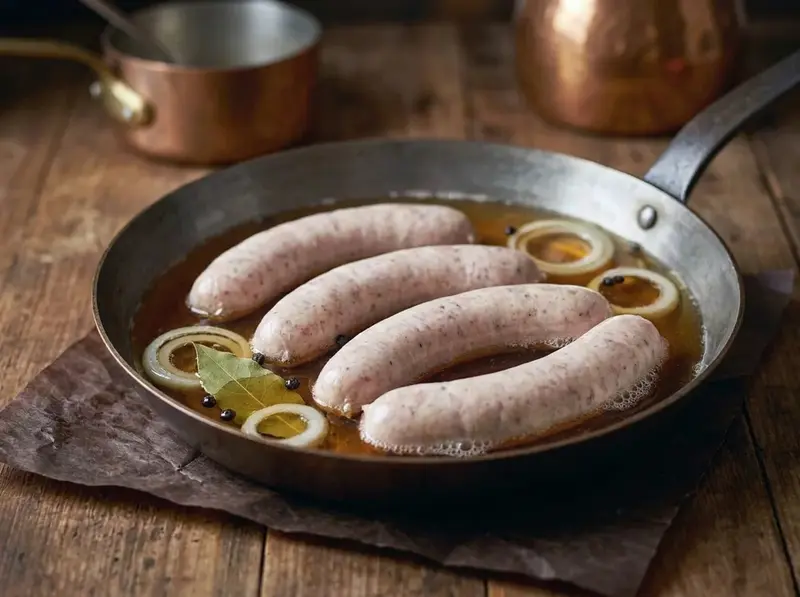
- Simmer in beer. Place the bratwurst in a single layer in a wide pan. Add the sliced onion, bay leaf, and peppercorns. Pour the beer over until the sausages are just covered. Bring to a gentle simmer over medium heat — do not boil. Simmer for 10 to 12 minutes, turning once. The sausages will turn pale and plump. Check that they are cooked through: a thermometer pushed into the center of one sausage should read 71°C (160°F); without a thermometer, cut one sausage open — the meat should be grey-white with no pink and the juices clear. If they are not there yet, simmer for another 3 to 5 minutes. Once they pass this check, the sear that follows is purely about the skin. Remove them from the beer bath. The beer-braised onions can be kept warm and served alongside.
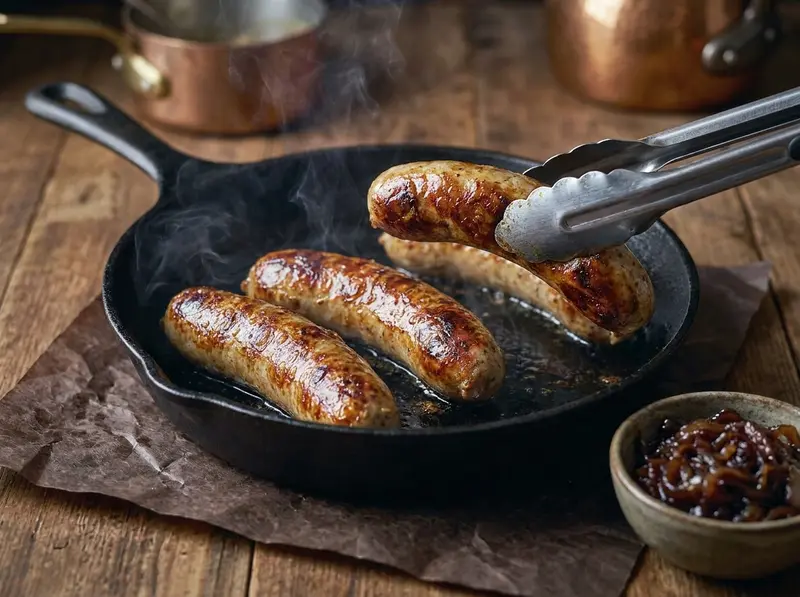
- Sear on high heat. Heat the oil or lard in a cast-iron skillet or grill pan over high heat until very hot. Add the sausages. Do not pierce them. Cook for 3 to 4 minutes per side, turning every 2 minutes, until the skin is deeply golden-brown and visibly blistered. The high heat after the gentle simmer creates the characteristic crackling skin without the risk of splitting. On a charcoal grill: 4 to 5 minutes total over direct heat, turning frequently.
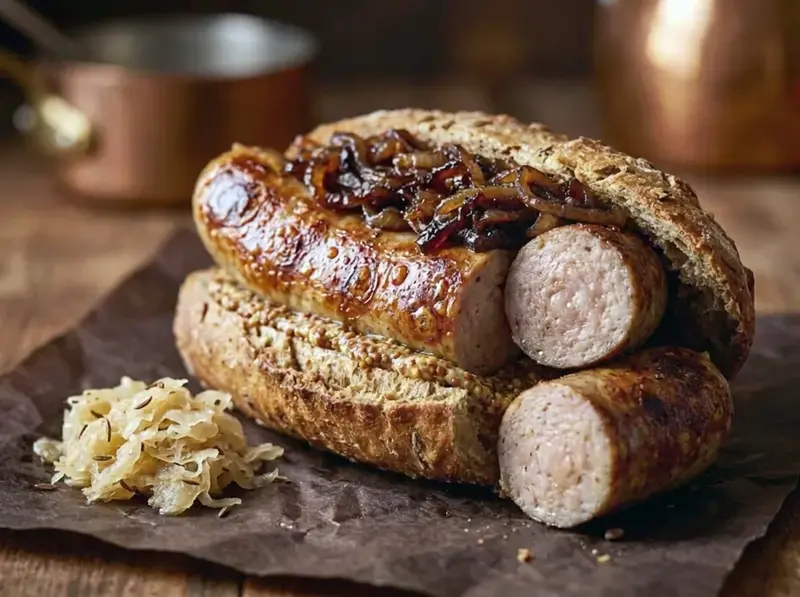
- Rest briefly and serve. Warm the sauerkraut with the caraway seeds in a small saucepan over low heat for 3 to 5 minutes — start it while the sausages are searing. Let the bratwurst rest on a wire rack for 1 to 2 minutes after the sear — the juices settle slightly. To serve in a roll: split the roll, spread mustard generously on both sides, tuck in the bratwurst, and pile the beer-braised onions on top. Serve the warm sauerkraut on the side or pile it into the roll. Eat immediately while the skin is still crackling.
Cooked it? Rate the recipe
FAQ
Bratwurst splits when the fat inside heats faster than the casing can expand, or when the outside is already firm while the inside is still cold and contracting. Three ways to prevent it: first, never put cold bratwurst directly onto a very hot grill — bring them to room temperature for 20 minutes first. Second, use the beer-bath method: simmer gently in beer for 10 minutes first, then sear. The simmer cooks the sausage through and allows the casing to stretch gradually. Third, do not prick the sausages before or during cooking — every hole is a potential split point and loses juice; check doneness on just one sausage.
Beer poaching does three things. First, it cooks the sausage through safely and gently so that when it goes onto the grill or pan, the sear is purely for skin color and texture rather than a race against time to cook the interior. Second, the beer infuses a subtle malt and hop flavor into the meat. Third, the simmered onions and liquid become a natural accompaniment — sweet, beer-soaked onions. The beer bath is an American habit, from Wisconsin, rather than a German one; plain water works instead of beer and achieves the cooking benefit, but beer adds flavor the water cannot.
Germany has dozens of regional bratwurst varieties, and two of the names are protected by the EU: Thüringer Rostbratwurst and Nürnberger Rostbratwurst. Thüringer Rostbratwurst from Thuringia — long and thin, seasoned with marjoram and caraway, traditionally grilled over charcoal. Nürnberger Rostbratwurst from Nuremberg — tiny (about 9 cm long), finely ground, mildly spiced with marjoram, traditionally served three to a roll or by the 6 or 12 with sauerkraut. Fränkische Bratwurst from Franconia — large, coarsely ground, simply spiced. In Germany many bratwurst are sold already scalded and only need browning; raw ones, as in this recipe, must be cooked through.
The classic German accompaniments: German mustard — medium-hot (mittelscharfer Senf, smooth) or coarse-ground; sweet mustard and mild American yellow mustard are not the usual choice here. Sauerkraut, warm or at room temperature, is the standard vegetable side. Beer-braised onions come with the beer-bath method and go well in the roll. Bread: a crusty Brötchen (roll) or Laugenbrötchen (pretzel roll) split and pressed around the bratwurst. For a plated meal: German potato salad (Kartoffelsalat, dressed with vinegar not mayonnaise in the southern style) or simply boiled potatoes with parsley butter. The combination of fat, salt, acid (sauerkraut or mustard), and bread is what makes the meal work.
Yes, with reasonable results. Buy ground pork from a butcher (medium grind) and mix in the spice blend: per 500 g pork, add 1 teaspoon salt, ½ teaspoon white pepper, ½ teaspoon ground mace or nutmeg, ½ teaspoon dried marjoram, ¼ teaspoon caraway seeds, and 3 tablespoons cold water or white wine. Mix vigorously until the mixture becomes slightly sticky — this develops the protein bonds. Shape into patties (Bratwurst Frikadellen) or, if you can get natural hog casings from a butcher, press through a piping bag into the casings. The patty version skips the casing entirely and fries like a burger; cook patties and homemade sausages alike until the center reaches 71°C (160°F) — no pink inside, clear juices. Sausage casings are available online and from butchers.
Keep browsing
More dishes from the German archive — picked by overlap with what you're cooking now.



Recipes by email
One letter a week: a recipe picked for your taste, plus whatever is new on the site. You can stop the letters in one click.
Welcome gift: Sergei's cookbook (e-book).
By signing up for the newsletter you agree to the privacy policy.
Tell us what you like to cook (30 seconds) →
Join the conversation
Comments (3)
Bei mir sind die beim ersten mal geplatzt weil die Pfanne zu heiß war. Mittlere Hitze und Geduld, dann werden sie perfekt. Senf dazu und fertig
Hmm bei mir sind die Würste beim Braten geplatzt. Nächstes mal steche ich sie vorher an denke ich
Gestern zum ersten mal selbst gemacht, hat super geklappt! Meine Familie kommt aus Nürnberg und ich muss sagen die Rezept kommt dem Original schon sehr nah. Nur mit der Gewürzmischung muss man aufpassen nicht zu viel Majoran.