
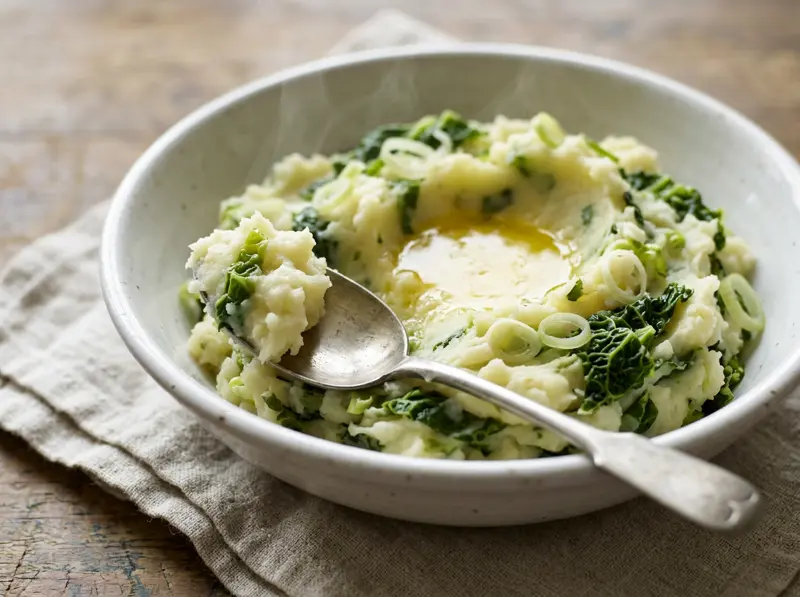
Colcannon (Irish Mashed Potatoes with Cabbage)
Colcannon is Irish mashed potato with cooked cabbage or kale, milk and plenty of butter, often with scallions (spring onions), served with a pool of melted butter in a hollow on top. The name is usually traced to the Irish cál ceannann, 'white-headed cabbage', although nobody is sure where the word comes from, and in County Mayo it was called cally (in Japanese it is コルカノン). In Ireland it is one of the dishes most closely tied to Halloween, and older people put a ring into the colcannon to tell someone's future. This version uses Savoy cabbage, boiled briefly and squeezed dry, with scallions warmed in the milk, and takes about 45 minutes, because the cabbage and the milk are done while the potatoes simmer.
Colcannon at Halloween
Colcannon is one of the dishes most closely tied to Halloween in Ireland. The folklorist Michael Fortune, writing for RTÉ, says that in Wexford Halloween night was also called Colcannon Night, and that older people put a ring into the colcannon, as they did into the barmbrack, to tell your future. He says the custom is still especially strong in Dublin. It was never only a Halloween dish, though. The Schools' Folklore Collection of 1937–38 mentions colcannon often in Leinster and rarely in Cork and Kerry, and people made it whenever the vegetables were in season.
The charms changed from place to place. In the meanings IrishCentral and Tourism Ireland give, a ring meant a wedding, a coin meant money, a thimble meant another year as a spinster and a button another year as a bachelor.
If you want to keep the custom, be careful with it. Spoon out small children's portions first, before anything goes into the dish. Then wash the ring or coin, wrap it in baking paper, the way charms go into an Irish barmbrack, and push it into the mash just before serving. Do it only when everyone at the table knows that something is hidden in the dish, and ask them to eat slowly and bite carefully. Ireland's health service lists coins and small jewellery among the things children choke on, and says a child under 3 should not wear jewellery at all.
Cabbage, kale and what else goes in
Fortune grew up in Wexford with garden cabbage and always a parsnip (in some homes a carrot instead), while in Dublin many people used curly kale. Theodora Fitzgibbon's recipe, printed in The Irish Times in 1983, used cabbage or kale, leeks or scallions simmered in the milk, and a pinch of nutmeg. Kevin Dundon's colcannon on BBC Good Food adds bacon. Fortune also points out that nobody had scallions in an Irish October in the past, so the scallions in this recipe are a newer habit.
His family never added meat to colcannon, and a fried egg on top is his optional extra. Similar mashes turn up outside Ireland as well. Fortune mentions the Welsh 'mash of 9 sorts' or 'mash of 10 sorts', named for the number of vegetables, and the cabbage and potato mash eaten in parts of the Netherlands and Germany on St Martin's Night, 11 November.
Ingredients
- 1200 gpotatoes
- 300 gsavoy cabbage
- 6 scallions
- 200 mlmilk
- 100 gbutter
- 4 tspsalt
- 0.25 tspground black pepper
Method
- Peel floury potatoes, such as Roosters or russets, until you have 1200 g of peeled potato, and cut them into chunks of about 5 cm so they all cook at the same pace. Put them in a large pot of about 5 litres, pour in cold water to cover them by 2.5 cm and add 2 tsp of the salt. Bring to the boil over high heat, then turn the heat down to medium and simmer for 15 to 20 minutes. They are done when a knife slides into the biggest chunk with no resistance and the edges are starting to crumble.
- While the potatoes cook, put about 1.5 litres of water on to boil in a second pot, a saucepan of about 3 litres with one long handle, and prepare the greens. Pull the dark, tough outer leaves off a small Savoy cabbage, cut it into quarters, cut out the core and slice the quarters thinly across the grain. Weigh out 300 g of sliced cabbage. Trim the 6 scallions (spring onions) and slice them, white and green parts, into thin rings.
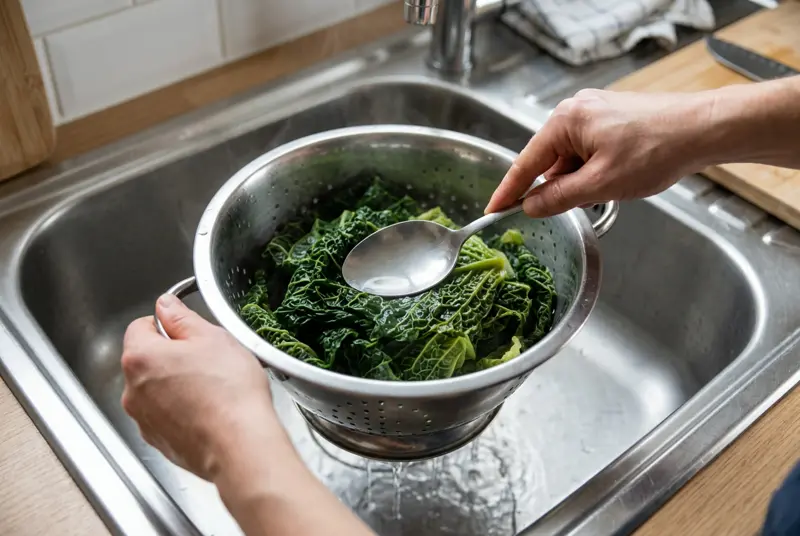
- When the water boils, add 1 tsp of the salt and the cabbage and boil it over high heat for 3 to 5 minutes, until it has wilted and turned a darker green but still has a little bite. If it turns grey and soft, it has gone too far. Tip it into a colander and press out as much water as you can with the back of a large spoon, because water left in the cabbage makes the colcannon wet. Put the cabbage in a bowl with 25 g of the butter and cover it with a plate to keep it warm.
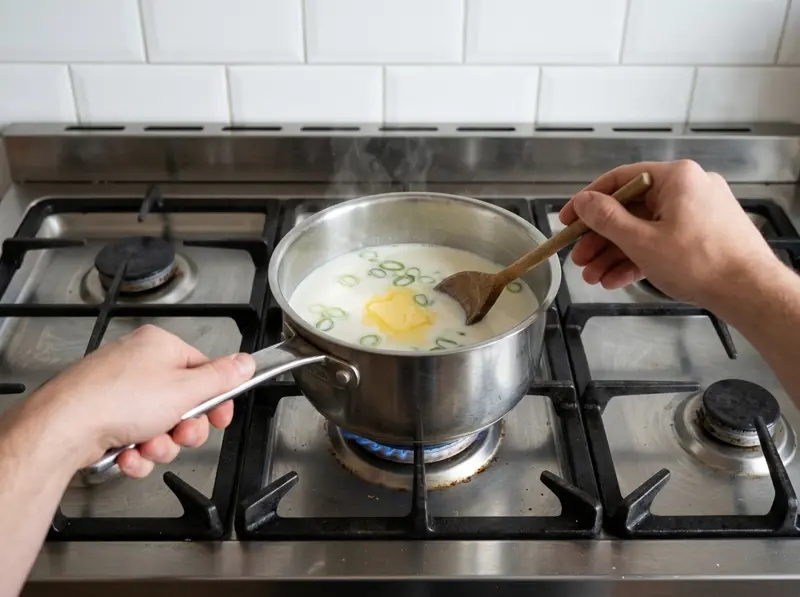
- Pour the 200 ml of whole milk into the empty cabbage pot and add 50 g of the butter and the sliced scallions. Warm it over low heat for 3 to 4 minutes, until the butter has melted and the milk is steaming but not bubbling. The scallions soften in the milk and give it their flavour. Keep it over the lowest heat, without letting it bubble, until the potatoes are ready.
- Drain the potatoes and put them back in their pot over low heat, without the lid, for 1 to 2 minutes, shaking the pot now and then. Stop when steam no longer rises and the outside of the potatoes looks dry and floury. Water left on the potatoes makes the mash loose and watery.
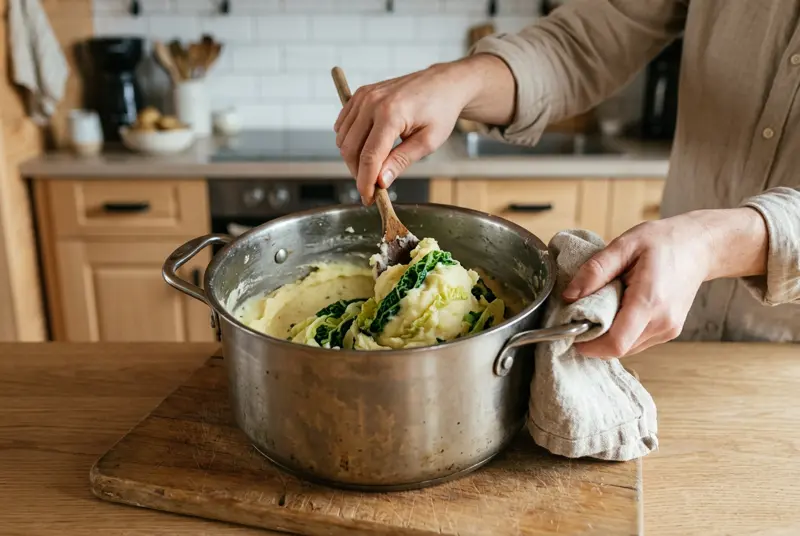
- Take the pot off the heat. Mash the potatoes with a potato masher, pouring in the hot milk with the scallions a little at a time, until the mash is smooth, with no lumps, and soft enough to drop slowly from a spoon. Don't use a blender or an electric mixer, which work the potatoes too hard and make them gluey. Taste, then season with up to the last 1 tsp of salt (less if your butter is salted) and the ¼ tsp of ground black pepper, and fold in the cabbage with its butter until the green is spread evenly through the potato.
- Pile the colcannon into a warmed serving dish, press a hollow into the middle with the back of a spoon and drop the last 25 g of butter into it to melt. Serve straight away while it is hot, and let everyone dip each spoonful into the butter. Put any leftovers in the fridge within 2 hours.
FAQ
Gluey colcannon usually means the potatoes were worked too hard. IrishCentral warns that a ricer or, worse, an electric mixer makes the mash gluey, so use a potato masher and stop as soon as it is smooth (America's Test Kitchen is fine with a ricer if you prefer one). IrishCentral also says waxy potatoes won't do, so buy a floury kind. Watery colcannon comes from water left in the pot: dry the drained potatoes over low heat with the lid off for 1 to 2 minutes, until the steam stops, and press the boiled cabbage hard in the colander before it goes in. Add the hot milk a little at a time, because you can always pour in the rest of the 200 ml but you can't take it back out.
Yes, and in Dublin many people grew up with it that way. Pull curly kale leaves off their tough stalks, slice them thinly and weigh out 300 g, the same as the cabbage. Boil them in salted water for 3 to 4 minutes (the time the Café Rua recipe from County Mayo on Tourism Ireland's site gives), then drain, squeeze and butter them just like the cabbage. Donegal chef Brian McDermott cooks his finely sliced kale in a little butter for 2 minutes instead. Plain green cabbage works too and takes the same 3 to 5 minutes as Savoy.
In the old custom a ring or a coin went into the mash: whoever found the ring would marry and the coin meant money, and some families added a thimble or a button, which meant another year unmarried. Do it only when everyone at the table knows about it. Spoon out small children's portions first, before the charm goes in, and only then push the washed charm, wrapped in baking paper the way charms are wrapped for an Irish barmbrack, into the mash. Ask everyone to eat slowly and bite carefully: Ireland's health service, the HSE, lists coins and small jewellery among the things children can choke on. Check that someone has found it before the leftovers go into the fridge.
Put it in the fridge within 2 hours of cooking and eat it within 3 to 4 days. Darina Allen of Ballymaloe makes colcannon ahead and reheats it in a 180 °C oven for 20 to 25 minutes. However you reheat it, it should be steaming hot all the way through, 74 °C in the middle. She also shapes leftover colcannon into potato cakes and fries them in bacon fat until they are crisp and brown on both sides. Fry them in butter if you want to keep the dish vegetarian.
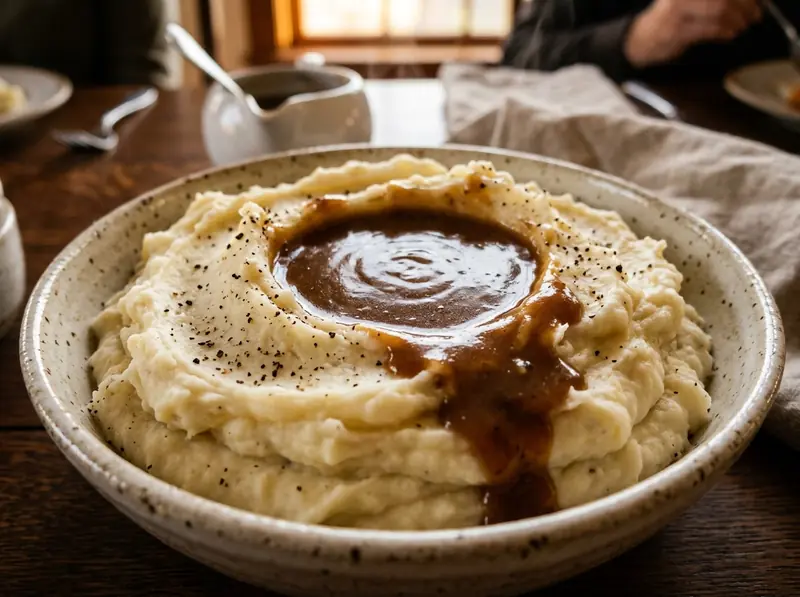
Colcannon is mashed potato with cabbage or kale and onions folded in, finished with butter melting in a hollow on top. Plain mashed potatoes have no greens, and the American version on this site is served with gravy. Colcannon is often served with ham, bacon or corned beef. Michael Fortune suggests a fried egg on top as an option, but in his Wexford family colcannon was always a meal without meat. For another Irish potato dish, try Irish stew.
Keep browsing
More dishes from the Irish archive — picked by overlap with what you're cooking now.
Recipes by email
One letter a week: a recipe picked for your taste, plus whatever is new on the site. Unsubscribe in one click.
Welcome gift: Sergei's cookbook (e-book).
By subscribing you agree to the privacy policy.
Tell us what you like to cook (30 seconds) →
Join the conversation
Comments
No comments yet — be the first!