
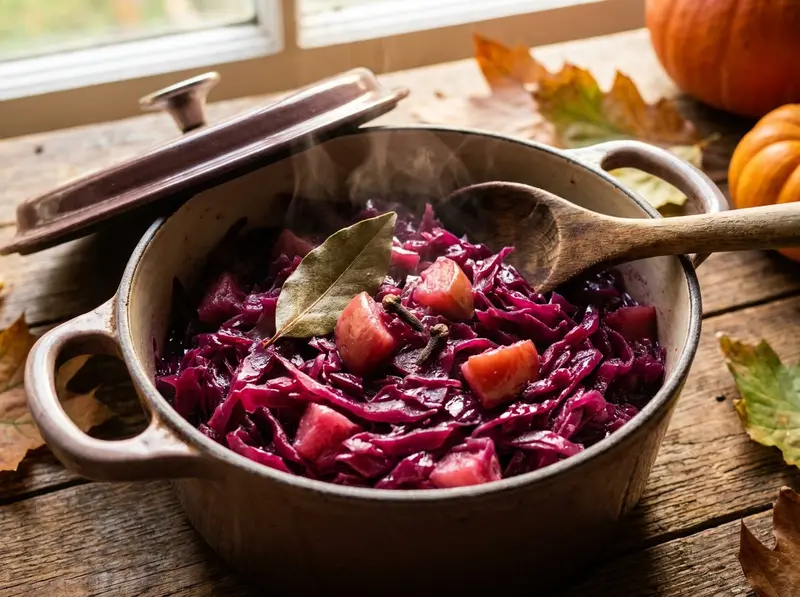
Rotkohl (German Braised Red Cabbage)
Rotkohl is the braised red cabbage that sits next to almost every German roast from October onwards: shredded cabbage cooked down for an hour with apple, onion, vinegar and cloves until it goes glossy and deep purple. The vinegar is not only there for taste. The pigment in red cabbage works like a pH indicator, and without acid the pot turns a murky blue-grey, which is also why the same vegetable is called Blaukraut in Bavaria and Rotkohl in the north. It tastes better on the second day, so most households cook it the night before the roast and take one job off the table.
Ingredients
- 1 kgred cabbage
- 2 pcsapple
- 1 pcsonion
- 40 gbutter
- 4 tbspred wine vinegar
- 250 mlapple juice
- 2 tbspsugar
- 2 pcsbay leaf
- 4 pcscloves
- 5 pcsjuniper berries
- 1 tspsalt
- 2 tbspredcurrant jelly
Method
- Quarter the cabbage, cut out the white core at an angle and shred the quarters about 4 mm thick. Thinner than that and an hour of braising turns the whole pot to mush; much thicker and the strands stay chewy at the centre. A large knife does this better than a food processor, which bruises the leaves and presses the juice out before you want it.
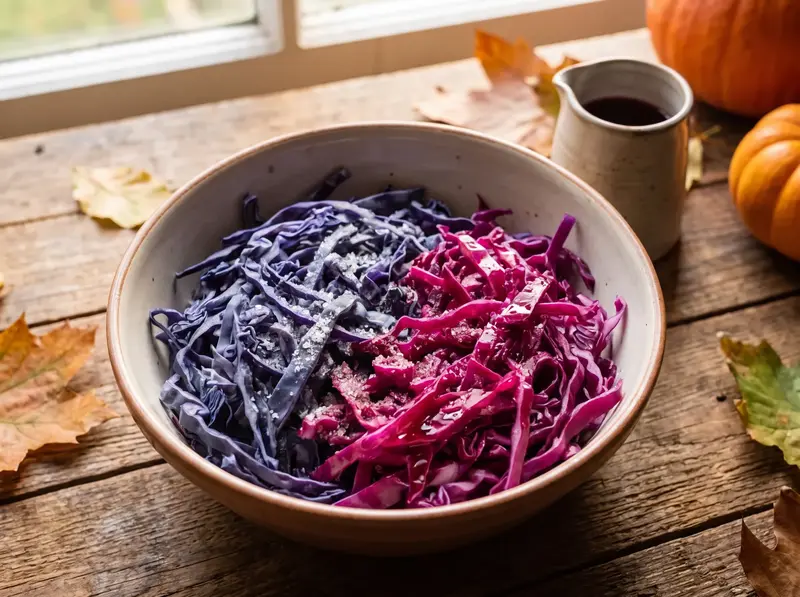
- Put the shredded cabbage in a bowl, pour over the vinegar, scatter on the salt and sugar and toss it with your hands for a minute. Watch the colour while you do it: the raw cabbage is a dull blue-violet and it turns clear magenta almost at once. Red cabbage pigment behaves like a pH strip, and this step is what keeps the finished dish red instead of grey. Leave it to stand for 20 minutes, or overnight in the fridge if you are planning ahead.
- Peel and dice the onion. Melt the butter in a wide heavy pot over medium heat and cook the onion for five minutes until it is soft and still pale. Do not brown it; caramelised onion pushes this dish toward sweetness, and there is already sugar and apple coming.
- Peel and core the apples, cut them into 1 cm dice and stir them into the onion for two minutes. Use something sharp like Boskoop, Elstar or a Bramley. Sweet supermarket apples disappear into the sauce and take the fruit acidity with them.
- Tip in the cabbage together with every drop of liquid in the bowl, pour over the apple juice, and add the bay leaves, the cloves and the juniper berries. The liquid will look far too little for the volume of cabbage. It is not: the cabbage collapses within ten minutes and gives up most of the water the pot needs.
- Cover, turn the heat to the lowest setting that keeps a lazy bubble, and braise for one hour, stirring every 20 minutes so the bottom does not catch. It is done when a strand bends double without snapping and the whole pot has shrunk to about half its starting volume. If it looks dry before the hour is up, add water a splash at a time.
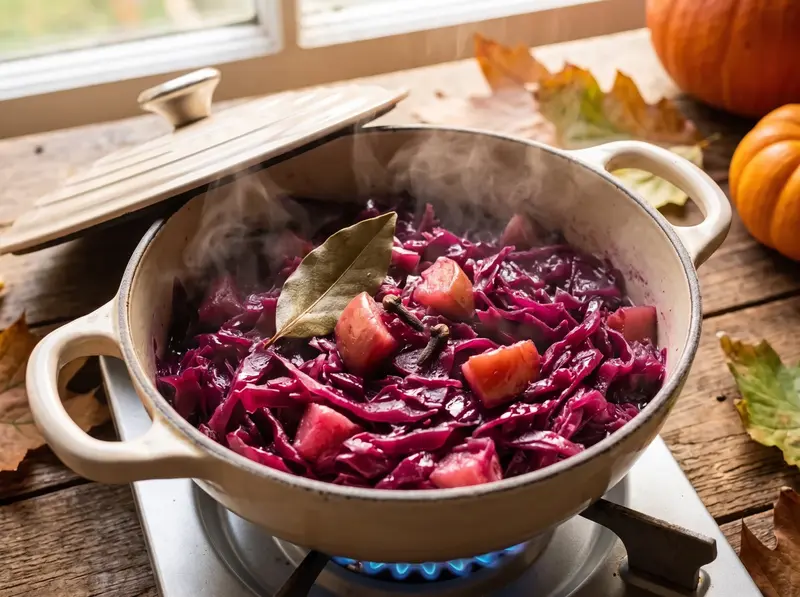
- Take the lid off and let the remaining liquid cook away for ten minutes, then stir in the redcurrant jelly off the heat and fish out the bay leaves and cloves. Taste and correct: another splash of vinegar if it reads flat, a pinch of salt if the sweetness dominates. Let it stand at least half an hour before serving, and if you can, make it the day before.
FAQ
There was not enough acid in the pot, or it went in too late. The pigment in red cabbage is an anthocyanin that behaves like a pH indicator: red in acid, blue-violet at neutral, green in alkaline conditions. Hard tap water alone is enough to push it toward blue. Toss the raw shreds with the vinegar before anything else touches them and the colour locks in within a minute. If the pot has already gone grey, a tablespoon of vinegar stirred in at the end brings most of the colour back.
None, in the vegetable. They are two regional names for the same cabbage: Rotkohl in the north, Rotkraut in the middle and south-west, Blaukraut in Bavaria and Austria. Local water chemistry and local habits around vinegar probably explain how the names split, since the same head really does cook up redder with acid and bluer without. What you order under either name in a German restaurant is the same braised side.
Make it ahead on purpose. The flavour rounds out overnight as the vinegar and the clove settle into the cabbage, and most German households cook it a day before the roast. It keeps four to five days covered in the fridge and freezes well for three months in portions. Reheat gently with a splash of water; a hard boil breaks the strands down into paste.
Lingonberry preserve is the closest substitute and is sold in most German supermarkets next to the jams. Cranberry sauce works, so does a tablespoon of plum butter, and at a pinch two tablespoons of apple sauce plus a squeeze of lemon. The jelly is there for a sweet-sour finish, not for fruit flavour, so whatever you use should carry some acidity of its own.
Roasts, almost exclusively, and almost always with a starch to catch the sauce: potato dumplings, Spätzle or boiled potatoes. It is the standard partner for goose and duck in November and December, and for Rinderrouladen all winter. It works just as well next to duck confit or a simple pork roast, and a spoonful alongside Schnitzel is not traditional but is very good.
Rate this
Keep browsing
More dishes from the German archive — picked by overlap with what you're cooking now.



Join the conversation
Comments
No comments yet — be the first!