
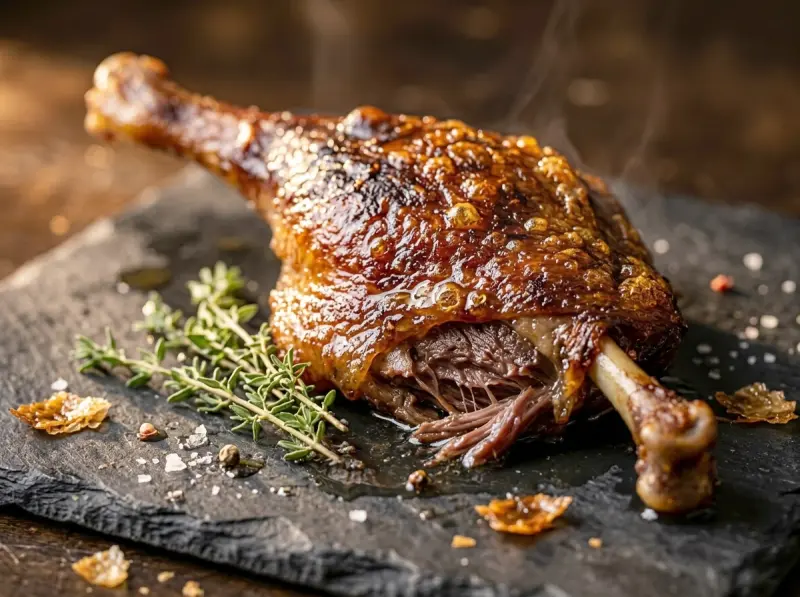
Duck Confit (Confit de Canard)
Confit de canard is duck legs cured overnight in salt, thyme and juniper, then cooked slowly submerged in melted duck fat until the meat slides off the bone. It comes from Gascony in south-west France, where ducks are raised for foie gras; confit comes from confire, to preserve. After the 12 to 24 hour cure, the legs spend 2 to 2.5 hours in a 120°C (250°F) oven, fully covered by fat that only trembles, so the work is about 3 hours and the cure is waiting. Cooked legs keep under their fat, which is how the meat was preserved before refrigeration; today the container goes in the fridge. To serve, lay the legs skin-side down in a cold, dry pan and heat gradually to medium until the skin turns dark gold and crackles; legs from the fridge then go into the oven to heat through. The leftover fat is excellent for frying potatoes.
Ingredients
- 4 duck legs
- 3 tbspcoarse sea salt
- 1 tspblack peppercorns, coarsely crushed
- 1 tspjuniper berries, coarsely crushed
- 6 sprigs of fresh thyme
- 3 bay leaves
- 4 garlic cloves, unpeeled and lightly crushed
- 800 gduck fat
- 6 black peppercorns
Method
- Cure the duck overnight. Use legs of about 300 to 350 g each. Mix the 3 tbsp (about 45 g) of coarse sea salt with the crushed peppercorns, crushed juniper berries, thyme, and bay leaves in a bowl. Rub this mixture all over the duck legs on every surface — skin side, flesh side, around the bone — coating generously. Pack the legs in a snug dish or zip-lock bag, add the crushed garlic, cover, and refrigerate for 12 to 24 hours. The salt draws moisture from the meat and begins to season it deeply.
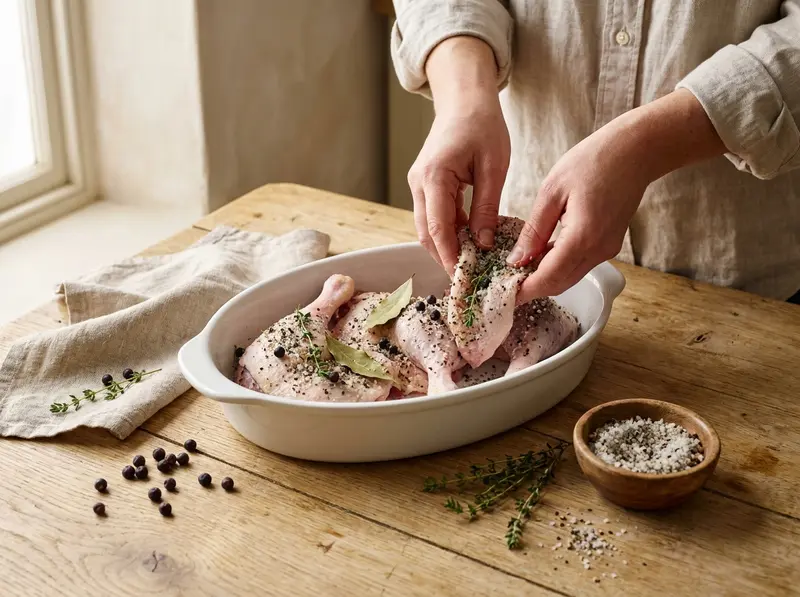
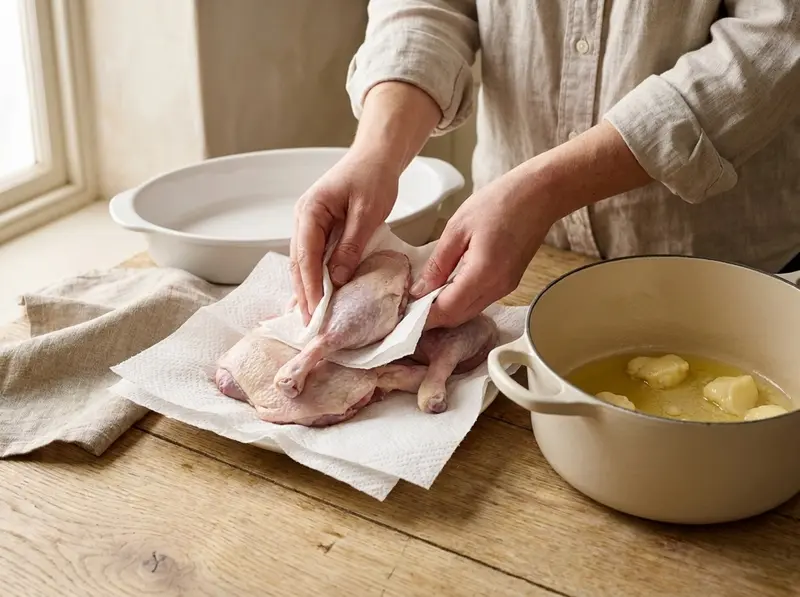
- Rinse, dry, and prepare the fat. Take the legs out of the cure and rinse them thoroughly under cold running water to remove all the salt, spices, and herbs — salt left on the surface will make the confit too salty. Pat the legs completely dry with paper towels, because water in the fat makes it spit, and leave them to air-dry for 30 minutes if you can. Meanwhile prepare the fat: trim the loose skin and fat from the legs and render it in a small pan with a splash of water over low heat for 20 to 30 minutes, until the fat runs clear and the bits turn golden. Strain it into a deep, snug-fitting pot or Dutch oven, just large enough to hold the legs in a single layer, add the rest of the duck fat and the 6 peppercorns, and melt everything gently over low heat. You want warm liquid fat, not hot.
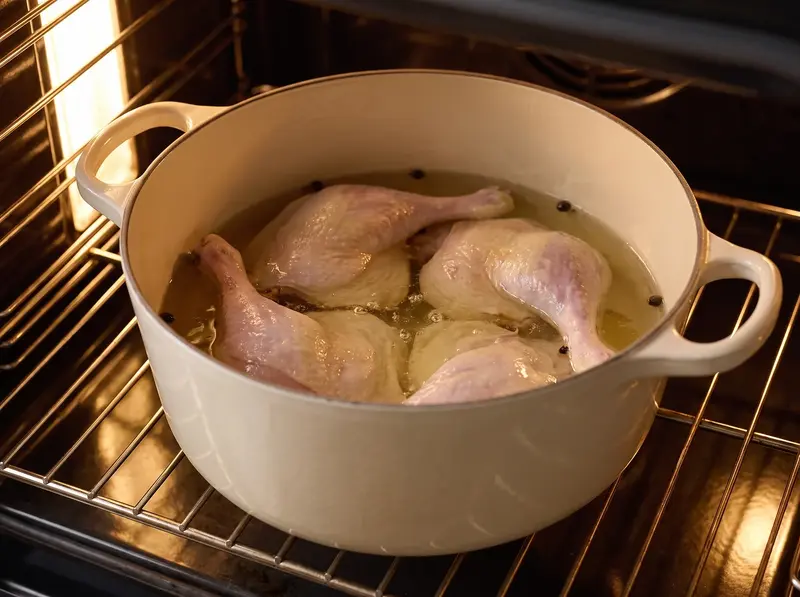
- Cook low and slow. Heat the oven to 120°C (250°F). Lay the legs skin-side down in the warm melted fat so that they are covered; if a piece sticks out, top up with more fat — a little skin or bone above the surface is fine, the meat shrinks as it cooks. Put the pot in the oven and cook for 2 to 2.5 hours. The fat should only tremble: a few small bubbles rising lazily around the legs. If it bubbles briskly or sizzles, the legs are frying, so lower the oven by 10°C. On the stovetop instead, keep the burner on its lowest setting (use a heat diffuser if needed) and hold the same bubble pattern, with the fat around 90 to 100°C (195 to 210°F). The confit is ready when the meat has visibly shrunk from the bone, feels very soft when gently pressed, and a skewer passes into the thickest part with no resistance; by then it is well past the 74°C (165°F) that makes poultry safe.
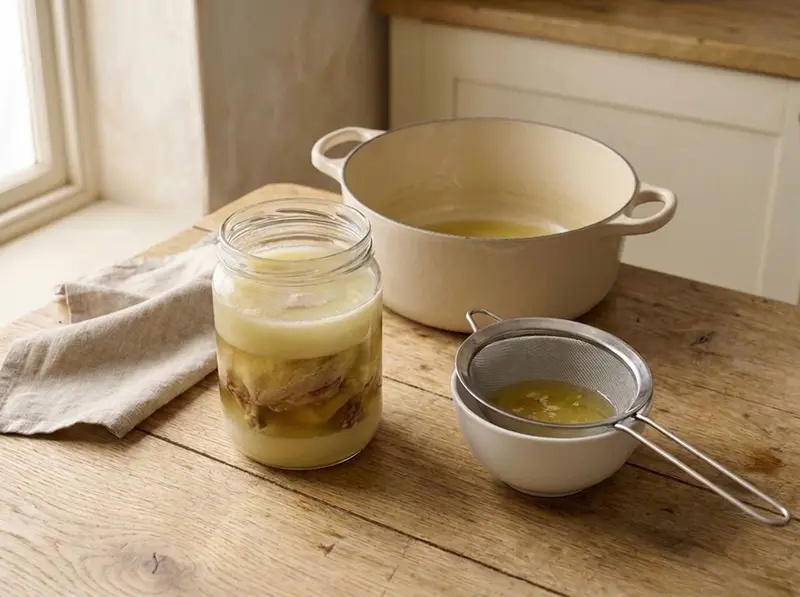
- Store under fat, or skip this step. To keep the confit, lift the legs out carefully with tongs and pack them into a clean container. Strain the fat through a fine sieve into a jug and let it stand for 10 minutes: the brown meat juices sink to the bottom. Pour only the clear fat over the legs until every piece is completely covered, because a leg left sticking out can spoil, and leave the juices behind (keep them in the fridge for 2 to 3 days for a sauce or the lentils). Then cool and refrigerate within 2 hours. For safety plan on eating it within about 1 week; French tradition keeps it for months, but only with full fat cover, a clean container, and clean utensils each time you take a leg. The flavor improves after 3 to 5 days. For longer storage, freeze it for up to 3 months. If you are serving the legs the same day, skip the container: let them cool in the pot until you can lift them out, then strain the fat, let it settle and pour the clear fat into a jar.
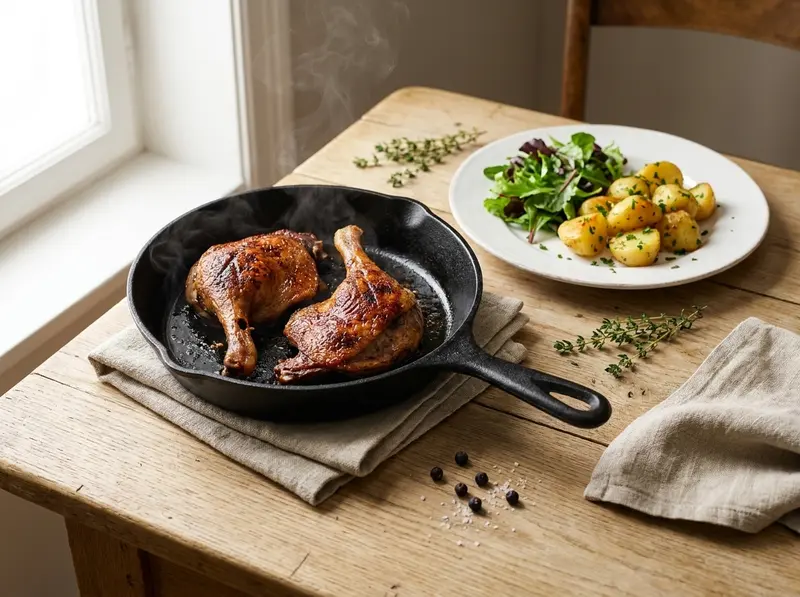
- Crisp the skin before serving. Lift the legs out of the fat — stored legs: scrape off the excess fat; same-day legs: let them drain. Place skin-side down in a cold, dry, heavy ovenproof pan — cast iron is ideal. Set over medium heat and cook undisturbed for 6 to 8 minutes as the skin renders its own fat and gradually crisps. Do not touch, press, or move the legs — patience produces the shattering crackle. When the skin is dark amber and crackling, turn briefly for 1 minute to heat the flesh side. Legs served straight from the pot are still warm inside and need nothing more. Legs that were stored in the fridge must be heated through, so heat the oven to 175°C (350°F) before you start: once the skin is crisp, turn the legs skin-side up and put the pan in the oven for about 12 minutes, until the meat is hot right to the bone (74°C / 165°F). Serve immediately: duck confit does not hold well after crisping. Typical accompaniments: sarladaise potatoes (fried in the confit duck fat with garlic and parsley), Puy lentils with shallots, or a bitter green salad to cut the richness.
FAQ
Confit is a preservation technique in which meat is slow-cooked submerged in its own fat at low temperature. Duck legs go into melted duck fat in a 120°C (250°F) oven, and the fat only trembles for 2 to 2.5 hours, far below frying temperature. The tough collagen in the leg, a hard-worked, load-bearing muscle, turns slowly into gelatin, which gives the silky texture that slides off the bone. Fat carries heat evenly and gently from all sides, so the legs do not dry out the way they do when roasted. If the fat bubbles briskly, the legs are frying and go stringy, so lower the heat.
The cure is the foundational step and skipping it produces a noticeably inferior result. The salt draws moisture out of the surface and seasons the meat to the bone, which a sprinkle of salt before cooking cannot do. Twelve hours is the minimum; 24 hours seasons more deeply.
Yes. Use a pot that fits the duck legs snugly in a single layer: for four legs, 600 to 800 g of fat usually covers them, and a wide pot needs much more. Trim the loose skin and fat from the legs and render it in a small pan with a splash of water over low heat, then add it to the pot. If you are still short, top up with goose fat or pork lard, which is milder in flavor but works. Olive oil is not traditional: it does not give the usual taste and spoils the fat you want to save for frying potatoes. Duck fat in jars is sold in good supermarkets and online.
Fully submerged under clear, strained fat, with the meat juices left behind, in a clean container in the refrigerator, duck confit keeps about 1 week with confidence. French tradition keeps it for months, but only if every piece is covered by fat, the container is clean and you use clean utensils each time; if any piece is exposed or the fat smells off, throw it out. The fat shuts out air, and the flavor improves over the first 3 to 5 days, so a leg crisped on day 4 is more complex than one eaten right after cooking. For longer storage, pack the legs in airtight bags and freeze them for up to 3 months. To serve stored legs, crisp the skin in a pan and then heat them through in a 175°C (350°F) oven for about 12 minutes, to 74°C (165°F) at the bone.
Pommes sarladaises is the traditional accompaniment from Sarlat-la-Canéda in the Dordogne — thin-sliced potatoes layered and fried in duck confit fat with garlic, finished with flat-leaf parsley. The potatoes absorb the flavoured duck fat and develop a golden, slightly crisp exterior. Other traditional accompaniments include Puy lentils with bacon lardons and shallots (which provide earthy contrast), or simply bitter green leaves dressed with a sharp classic French vinaigrette, whose acidity cuts through the richness of the duck. Duck confit is also the essential protein in cassoulet, the great bean stew of Toulouse and Carcassonne.
Keep browsing
More dishes from the French archive — picked by overlap with what you're cooking now.

Recipes by email
One letter a week: a recipe picked for your taste, plus whatever is new on the site. Unsubscribe in one click.
Welcome gift: Sergei's cookbook (e-book).
By subscribing you agree to the privacy policy.
Tell us what you like to cook (30 seconds) →
Join the conversation
Comments
No comments yet — be the first!