


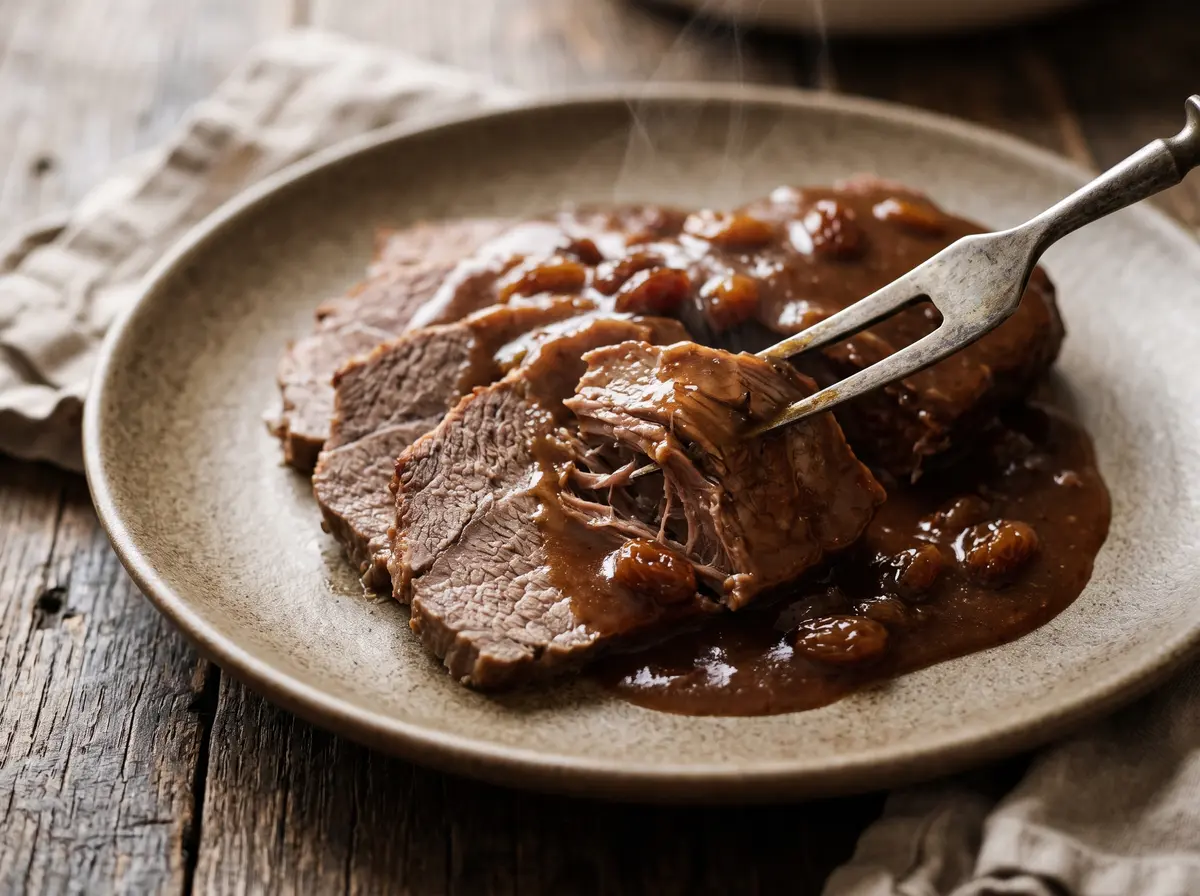
Sauerbraten (Rhenish Marinated Pot Roast)
Sauerbraten is a German pot roast: a whole piece of beef soaked for days in vinegar, usually with red wine, vegetables and spices, then browned and braised in that same marinade, which turns into the sauce. The marinade is called the Beize. This is the Rhineland version, Rheinischer Sauerbraten, the sweet-sour one: the sauce is thickened with Aachener Printen, a spiced gingerbread, and sweetened with raisins and sugar beet syrup (Rübenkraut). Kitchen Stories notes that the Rhineland version was traditionally made with horse meat, but today it is mostly beef. Plan ahead: 15 minutes to set up the marinade, 3 days in the fridge, then a little over 3 hours on the day you cook it, most of that in the oven.
What Sauerbraten is
Sauerbraten means sour roast. A whole piece of beef goes into a marinade of vinegar, usually red wine, vegetables and spices, the Beize, and stays there for days. It is browned and then braised in the strained marinade until it is soft, and the braising liquid becomes the sauce. Kitchen Stories puts it simply: every region seems to have its own recipe.
The Rhineland version is the sweet-sour one. Raisins and sugar beet syrup (Rübenkraut) go into the sauce, and Aachener Printen, a spiced gingerbread, thicken it. The sauce should taste of both, sour first and then sweet and spiced.
What to serve with Sauerbraten
The classic plate is Sauerbraten with potato dumplings (Klöße) and Rotkohl, braised red cabbage. LECKER names Klöße as the most common side, followed by Spätzle and plain boiled potatoes, and serves apple compote alongside. The Daring Gourmet also lists bread dumplings, Semmelknödel. Whatever you choose, it should soak up a lot of sauce.
Ingredients
- 1.5 kgbeef chuck
- 750 mlred wine
- 250 mlred wine vinegar
- 250 mlwater
- 2 onion
- 1 carrot
- 150 gcelery root
- 2 bay leaf
- 4 cloves
- 5 juniper berries
- 4 allspice berries
- 1 tspblack peppercorns
- 2 tspsalt
- 2 tbspvegetable oil
- 1 tbsptomato paste
- 75 ggingerbread
- 50 graisins
- 1 tbspsugar beet syrup
- 0.25 tspground black pepper
Method
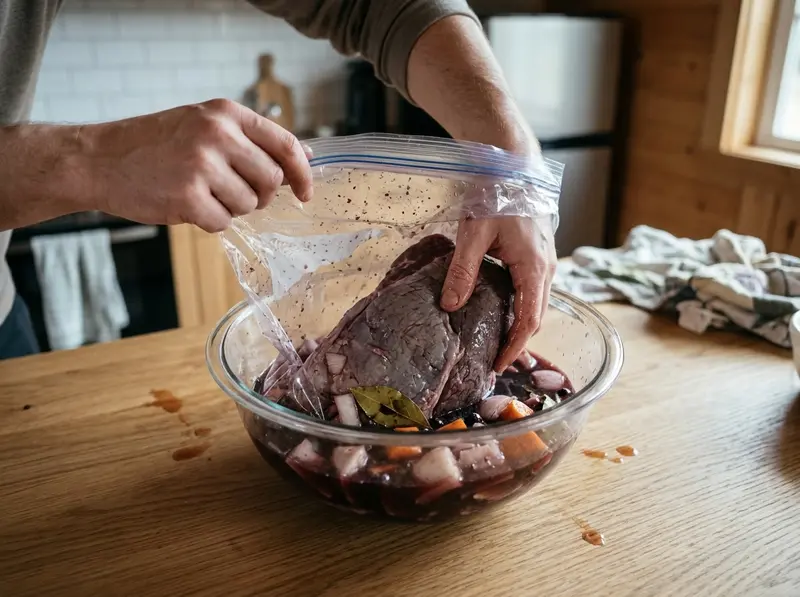
- Three days ahead, peel the 2 onions, the carrot and the 150 g of celery root and cut them into walnut-sized chunks of about 2 cm. Press the 5 juniper berries with the flat of a knife so they crack open. Set a large zip-top freezer bag (about 4 l) in a bowl and put in the beef chuck in one piece, the vegetables, the juniper, 4 cloves, 4 allspice berries, 2 bay leaves and 1 tsp of black peppercorns. Pour in 750 ml of red wine, 250 ml of red wine vinegar and 250 ml of water, press out the air and seal the bag. In the bag the liquid wraps the meat on all sides, and the bag doesn't react with the acid. A snug glass, ceramic or enamel bowl with a lid works too.
- Leave the beef in the fridge for 3 days and turn the bag once a day so every side sits in the liquid. The surface of the meat turns violet to grey. That's the wine and vinegar at work, and it's what you want.
- On the day you cook, heat the oven to 170 °C with top and bottom heat, not the fan. Lift the beef out, pour the marinade through a sieve into a bowl, and keep the liquid and the vegetables separate. Pat the beef very dry with paper towels until the surface looks matt, then rub it with 1.5 tsp of salt. A wet roast steams in the pot instead of browning.
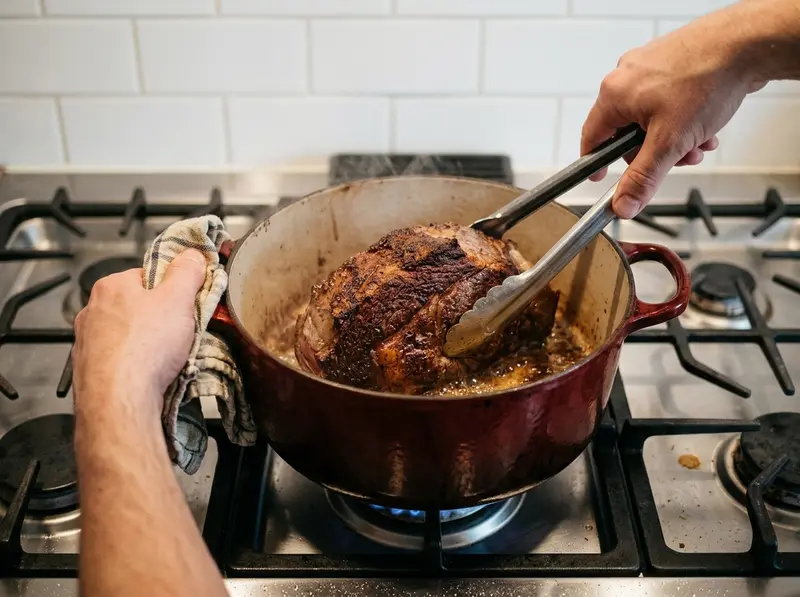
- Heat 2 tbsp of vegetable oil in a 5-litre ovenproof Dutch oven over medium-high heat until it shimmers. Brown the beef on all sides for about 10 minutes, turning it only once each side has a dark crust, then lift it onto a plate. Take your time here. The deep brown crust is what gives the sauce its flavour and its dark colour.
- Drain the marinade vegetables well and fry them in the same pot for about 5 minutes, until the edges brown. Stir in 1 tbsp of tomato paste and cook it for about 2 minutes, until it turns a shade darker. Pour in all of the strained marinade, scrape the bottom of the pot clean and bring it to the boil, skimming off the grey foam that rises. Put the beef back in and cover with the lid. The marinade has touched raw meat, so it only ever goes into the pot to boil and braise.
- Braise in the oven for 2 to 2.5 hours. After 1 hour, take the pot out with oven gloves and turn the roast once so the top half gets its turn in the liquid. From 2 hours on, test it with a skewer or a carving fork: the beef is done when the skewer slides in and comes out with almost no resistance. If it still grips, give it 15 minutes more and test again. Don't go by colour, because the meat is already grey from the marinade. Tenderness is the test here, not temperature: a braise passes the safe 63 °C for beef long before it gets soft.
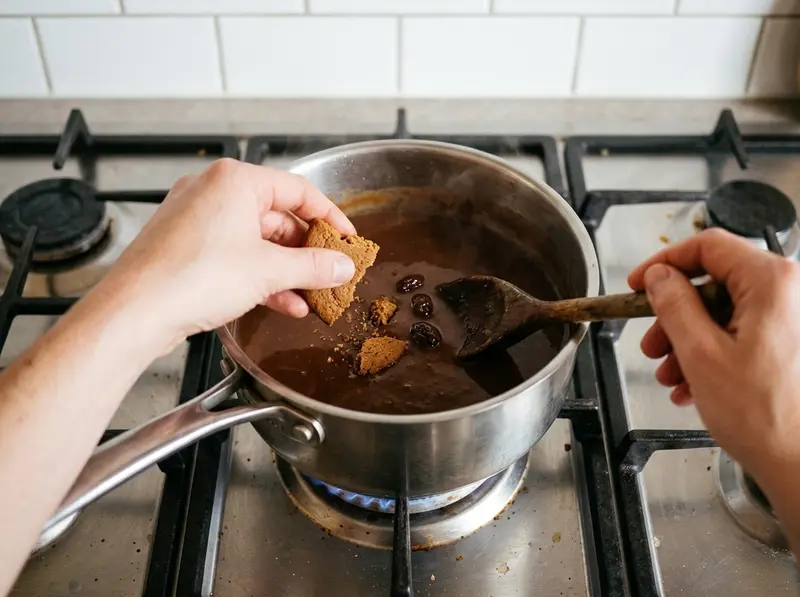
- Lift the beef onto a board and cover it loosely with foil. Pour the braising liquid through the sieve into a saucepan and throw away the vegetables and spices. Boil it uncovered over high heat until it has reduced by about half, roughly 15 minutes. Then turn the heat to medium, break or grate in 75 g of plain Aachener Printen (Kräuterprinten, without a chocolate coating) or unglazed Lebkuchen, and add 50 g of rinsed raisins and 1 tbsp of sugar beet syrup. Simmer uncovered for about 10 minutes, stirring, until the gingerbread has dissolved and the sauce is glossy and coats the back of a spoon. If it's still thin, let it bubble for a few minutes more. Season with up to 0.5 tsp of salt and 0.25 tsp of ground black pepper, and if it tastes too sour, add a little more syrup.
- Cut the beef into thin slices across the grain and lay them in the sauce for a minute to warm through. The slices should hold together but give way to a fork. Serve with plenty of sauce.
Cooked it? Rate the recipe
FAQ
Kitchen Stories finds 2 to 3 days in most German recipes, and this one uses 3. LECKER has quicker versions that marinate only overnight. At the long end, Küchengötter goes 6 to 7 days and The Daring Gourmet recommends 7. The USDA's food safety service, though, gives no more than 5 days for beef in a marinade in the fridge, so anything longer follows German tradition rather than that guidance. Can it go too far? Kitchen Stories notes that the longer the beef sits, the deeper its colour and the stronger its flavour, and the shorter it needs to braise. Whatever you choose, keep it in the fridge the whole time and turn it once a day.
Kitchen Stories names the shoulder as the best cut, the Schaufelstück: it is well marbled and full of connective tissue that melts into gelatine during the long braise. German recipes also use Hüfte, Oberschale or other parts of the leg (Keule), and Kitchen Stories notes that the leg is a little leaner. In the US, ask for a chuck roast, or a bottom round or rump roast, as The Daring Gourmet suggests. Count on 200 to 250 g of raw meat per person. This recipe uses 1.5 kg in one piece for 6 servings.
Küchengötter calls for Saucenlebkuchen or Christmas Lebkuchen without a glaze, and The Daring Gourmet uses gingersnaps, which are easier to find in the US. Dark bread crusts or pumpernickel thicken the sauce as well. In place of sugar beet syrup you can use apple syrup (Apfelkraut) or blackcurrant jelly. If the sauce is still thin after 10 minutes, boil it down a little more or crumble in another piece of gingerbread.
All of them marinate beef in vinegar for days and braise it. The Rhenish one, made here, is the sweetest: raisins, sugar beet syrup and Aachener Printen go into the sauce. LECKER describes Swabian Sauerbraten as usually served with red cabbage and Spätzle, and the Franconian kind with a creamy sauce finished with cream or crème fraîche. Kitchen Stories adds that the Baden version leaves out sweet syrup.
Put leftovers in the fridge within 2 hours of cooking and eat them within 3 to 4 days. Reheat the slices in the sauce until everything is steaming hot, 74 °C in the thickest slice. The Daring Gourmet freezes Sauerbraten together with its sauce for up to 3 months. Thaw it slowly in the fridge before you reheat it.
Keep browsing
More dishes from the German archive — picked by overlap with what you're cooking now.




Recipes by email
One letter a week: a recipe picked for your taste, plus whatever is new on the site. You can stop the letters in one click.
Welcome gift: Sergei's cookbook (e-book).
By signing up for the newsletter you agree to the privacy policy.
Tell us what you like to cook (30 seconds) →
Join the conversation
Comments
No comments yet — be the first!