


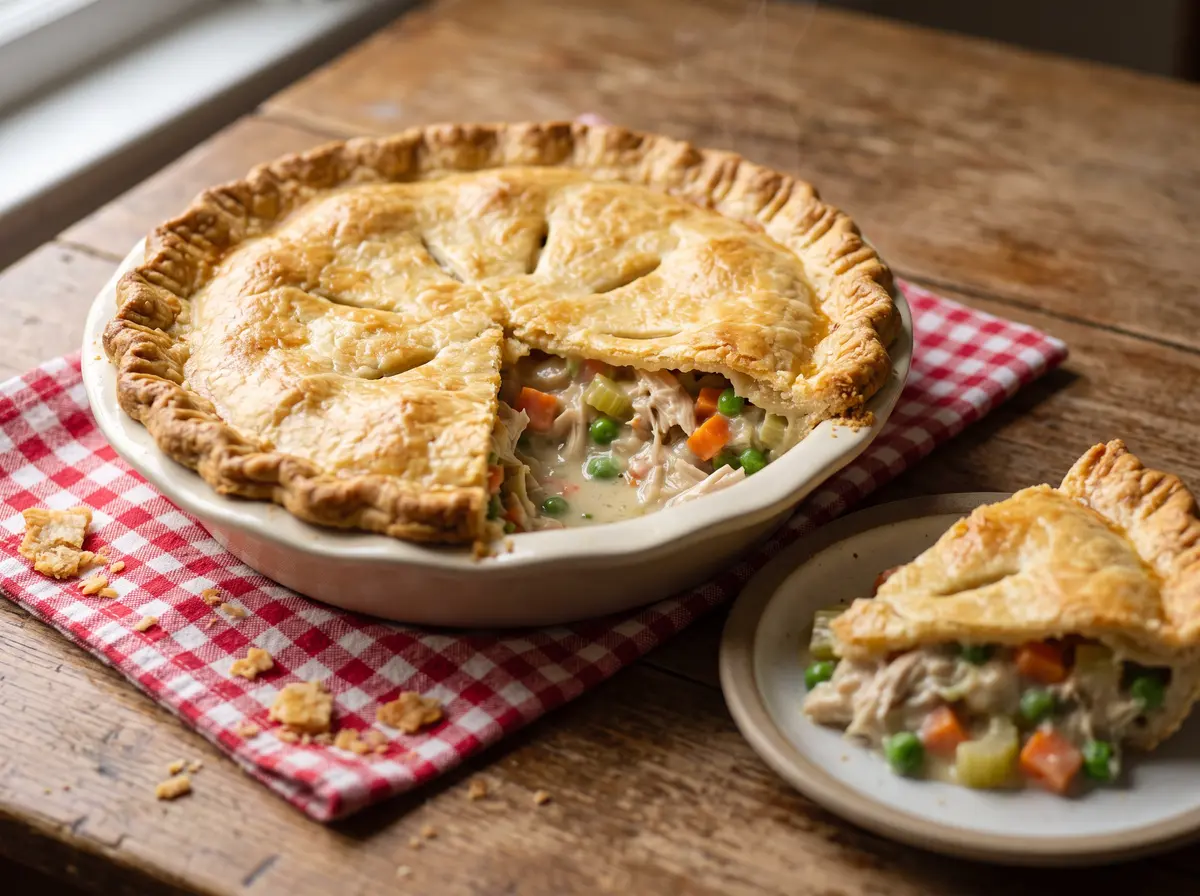
Chicken Pot Pie
Chicken pot pie is an American savory pie: chicken, carrot, celery, onion and peas in a creamy sauce of butter, flour, broth and milk, baked under a pastry crust. In Japan it goes by チキンポットパイ, and Japanese recipe sites also call it パイシチュー, a stew under a pastry lid. Here the chicken thighs are poached in the broth that later becomes the sauce, and the all-butter crust goes straight onto the hot filling, the way American test kitchens make it. From the first cube of butter to the first slice takes just over 2 hours, including 15 minutes of rest after baking.
What chicken pot pie is
Chicken pot pie is a savory pie from the American home kitchen. The filling is chicken with carrot, celery, onion and peas in a sauce made from butter and flour cooked together, then thinned with chicken broth and milk until it is creamy. A pastry crust goes on top, and the pie is baked until the crust is golden and the sauce bubbles through the slits.
Most recipes put pastry on top only, while some line the dish as well and bake a double crust. Unlike shepherd's pie, which is topped with mashed potato, a pot pie is covered with pastry.
Chicken pot pie in Japan
In Japan, KFC has sold a chicken cream pot pie every winter since 1996, in limited quantities each season: a cream stew of chicken, potato, carrot, corn and onion under a 24-layer pastry lid. Japanese home recipes follow the same idea. They put a frozen pie sheet over a creamy chicken stew, brush it with egg and bake it at 200 to 220 °C.
Japanese recipe sites cool the stew well before the pastry goes on, because on a warm stew the sheet can go limp and may not bake up crisp. That is why the puff pastry version of this recipe cools the filling first, while the pie-crust version goes straight onto the hot filling.
Ingredients
- 150 gwheat flour
- 0.5 tspsalt
- 115 gbutter
- 60 mlwater
- 600 gchicken thighs
- 500 mlchicken broth
- 60 gbutter
- 150 gonion
- 150 gcarrot
- 100 gcelery
- 0.5 tspsalt
- 60 gwheat flour
- 250 mlmilk
- 0.5 tspthyme
- 150 gpeas
- 0.5 tspsalt
- 0.5 tspground black pepper
- 20 gwheat flour
- 1 egg
- 1 tbspwater
Method
- Make the crust first. Whisk 150 g wheat flour with 0.5 tsp salt in a large bowl. Cut 115 g cold unsalted butter into small cubes and rub it into the flour with your fingertips until the butter is spread through but pea-sized pieces are still visible. Drizzle in 45 ml of the ice-cold water and toss with a fork. If the mixture still looks dry, add the remaining 15 ml (1 tbsp) only if needed. Squeeze a handful: when it holds together without crumbling, it is ready. Many American recipes mix butter with shortening, and this crust uses butter only. Press the dough into a flat disk, wrap it and chill it for 30 minutes for a better texture.
- While the dough chills, put 600 g boneless, skinless chicken thighs and 500 ml chicken broth in a 4 to 5 litre pot. Cover and bring to a simmer over medium heat, then turn the heat down and keep it at a gentle simmer until the thickest piece reads 74 °C on a thermometer, 12 to 15 minutes. The broth comes only partway up the chicken, so keep the lid on and turn the pieces once halfway through. Lift the chicken out onto a plate and pour the broth into a jug. You will need all of it for the sauce.
- Put the empty pot back over medium heat and melt 60 g unsalted butter in it. Add 150 g onion, finely diced, and 150 g carrot and 100 g celery, both cut into 6 mm pieces, plus 0.5 tsp salt. Cook for 6 to 8 minutes, stirring now and then, until the vegetables are soft at the edges and the onion is translucent but not browned. While they cook, shred or cut the chicken into bite-size pieces.
- Take the dough out of the fridge so it softens a little while you make the sauce, and turn the oven on to 200 °C (400 °F). Sprinkle 60 g wheat flour over the vegetables and stir for 1 to 2 minutes, so the flour loses its raw taste. Pour in the broth from the jug slowly, whisking as you go so no lumps form, then add 250 ml milk and 0.5 tsp dried thyme. Bring to a simmer and cook for 3 to 5 minutes, stirring, until the sauce coats the back of a spoon and a finger drawn through it leaves a clean line. Take the pot off the heat and stir in the chicken with any juices from the plate, 150 g frozen peas straight from the freezer, 0.5 tsp salt and 0.5 tsp ground black pepper. Taste and add more salt if your broth was unsalted.
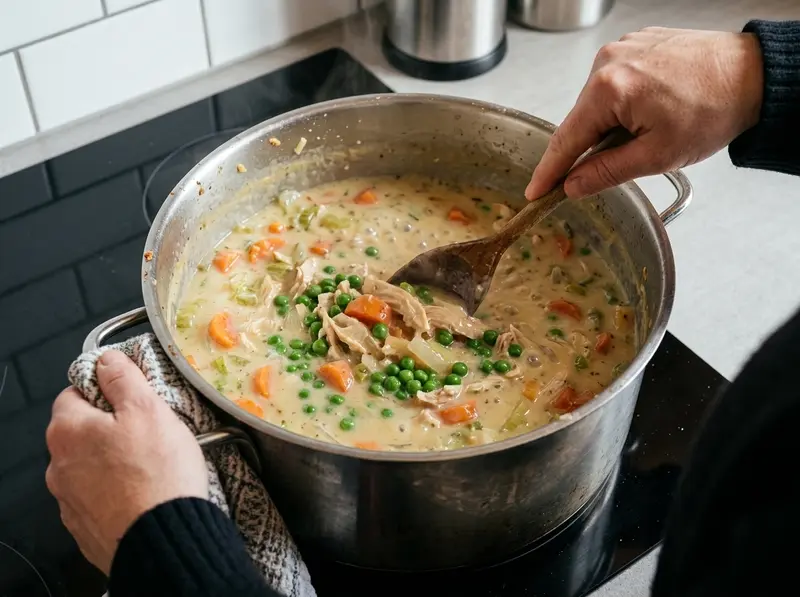
- Spoon the hot filling into a deep ceramic pie dish, 25 cm across and 5 cm deep (about 2 litres). It can wait there while you roll the crust. Dust the counter with some of the 20 g flour and roll the dough into a 32 cm circle, about 3 mm thick.
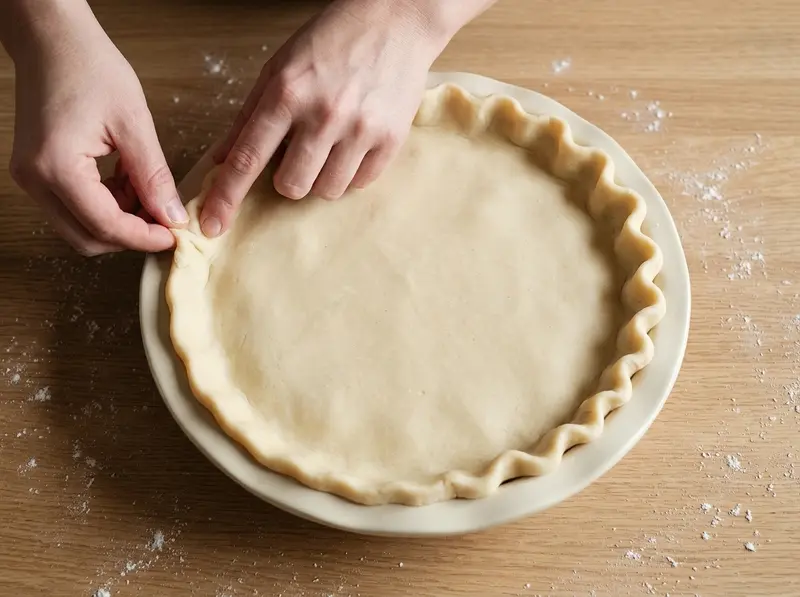
- Lay the dough over the filling, trim it to 1.5 cm beyond the rim of the dish and tuck the edge under itself so the fold sits on the rim. Crimp it all the way around with your fingers. Cut 4 slits, each 2.5 cm long, in the middle so steam can escape. Beat the egg with 1 tbsp water and brush it over the top. Set the dish on a rimmed baking sheet to catch any sauce that bubbles over and put it in the oven straight away.
- Bake on the middle rack for 35 to 45 minutes, until the crust is deep golden and the sauce is bubbling up through the slits. A thermometer pushed into the centre should read 74 °C. If the crimped edge browns before the middle, cover it loosely with a ring of foil. If the whole top is already deep golden but the centre is still below 74 °C, lay a sheet of foil loosely over the pie and keep baking, checking every 10 minutes.
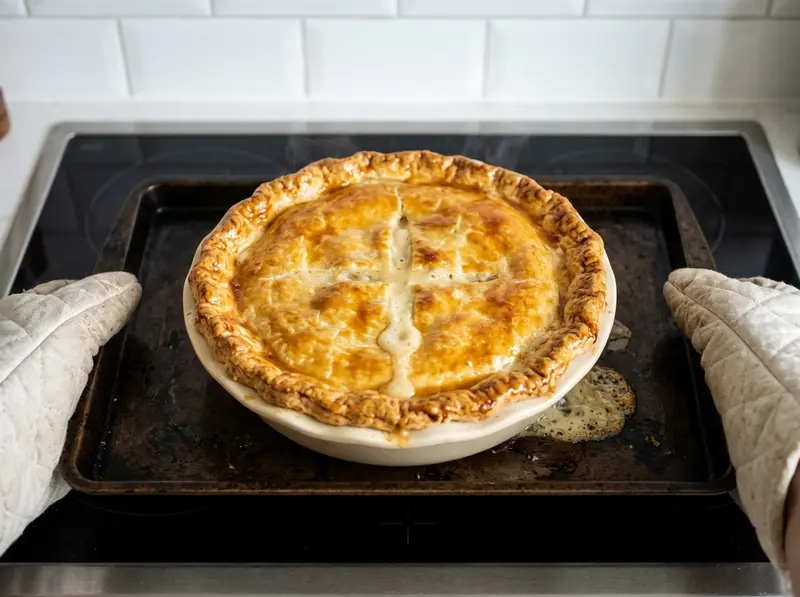
- Let the pie rest for 15 minutes before you cut it. The sauce thickens a little as it cools, and the slices hold together on the plate instead of running. Put leftovers in the fridge within 2 hours and eat them within 3 to 4 days. Reheat them until they reach 74 °C in the middle.
Cooked it? Rate the recipe
FAQ
Runny filling usually means the sauce went into the dish too thin. This recipe uses 60 g flour for 750 ml of broth and milk, cooked with the butter for 1 to 2 minutes and then simmered for 3 to 5 minutes. At that point the sauce coats the back of a spoon and a finger drawn through it leaves a clean line. A pie straight from the oven always looks looser than it is, so give it the full 15 minutes of rest before cutting.
Yes. Thaw one sheet of puff pastry, about 24 × 23 cm, in the fridge overnight or on the counter for 30 to 60 minutes, then roll it into a 30 cm square. The filling has to cool first, for at least 30 minutes until the surface is barely warm: a hot filling melts the butter layers and the pastry rises less. If it is still warm after an hour, put it in the fridge, and don't leave it out longer than 2 hours. Lay the sheet over the filling, let the edges hang over the rim, cut 4 vents, brush with the egg beaten with 1 tbsp water and bake at 200 °C (400 °F) for 35 to 45 minutes, until the top is golden, the filling bubbles and the centre reads 74 °C. Japanese frozen pie sheets are smaller, for example 18 × 18 cm, so Japanese home recipes divide the filling between individual ovenproof bowls and cover each with its own piece of sheet, rolled a little larger than the bowl.
Both exist, but top crust only is the more common way. Of the 10 recipes we compared, 8 put pastry on top only, every Japanese one among them, and 2 used two crusts. For a double crust you need twice the dough, 300 g flour and 230 g butter, and one test kitchen bakes it at 230 °C (450 °F) on the lowest rack for 18 to 20 minutes, then at 190 °C (375 °F) for 12 to 15 minutes, and lets it rest for 45 minutes. With a top crust only, the pastry never sits in the sauce and the pie is simpler to make.
Freeze it unbaked, in a dish that is safe to go from freezer to oven. For freezing, the filling has to be cold before the crust goes on: chill it in the fridge until fully cold, about 1½ hours, then top it with the crust and cut the slits, but skip the egg. Wrap the dish in plastic wrap and then foil and freeze for up to 1 month. To bake, don't thaw it: unwrap, cover with foil, set it on a rimmed baking sheet in a cold oven and turn the oven to 190 °C (375 °F). Bake for 75 minutes, then uncover, brush with egg and bake about 55 to 75 minutes more. These times are America's Test Kitchen's for a smaller 9-inch pie, so go by the thermometer: keep baking until the centre reads 74 °C, even past that window, and cover the edge or the whole top loosely with foil if it browns first.
Yes, and it saves the poaching step. You need about 450 g of cooked meat without skin or bones, shredded into bite-size pieces. Skip step 2, pour the 500 ml chicken broth straight into the sauce in step 4 and stir the cooked chicken in at the end with the peas. Leftovers from a roast chicken work well, and so does cooked turkey.
Keep browsing
More dishes from the American archive — picked by overlap with what you're cooking now.





Recipes by email
One letter a week: a recipe picked for your taste, plus whatever is new on the site. You can stop the letters in one click.
Welcome gift: Sergei's cookbook (e-book).
By signing up for the newsletter you agree to the privacy policy.
Tell us what you like to cook (30 seconds) →
Join the conversation
Comments
No comments yet — be the first!