

Spätzle
Soft egg-and-flour dumplings pressed through a grater or colander into simmering salted water, then finished in brown butter until lightly crisp at the edges. Spätzle (pronounced SHPETS-luh, meaning 'little sparrows') comes from Swabia in southern Germany and is the region's equivalent of pasta — served alongside schnitzel and goulash, or layered with melted cheese to make Käsespätzle. The batter is thicker than pancake batter but thinner than a dough; it falls through the holes under its own weight when pushed with a spatula. The butter finish in the pan is what elevates them from simple boiled dumplings to something worth eating on their own.
Ingredients
- 300 gplain flour
- 4 eggs
- 100 mlcold water or whole milk
- 1 tspfine salt
- 0.25 tspfreshly grated nutmeg
- 50 gunsalted butter
- 2 tbspfresh flat-leaf parsley
Method
- Make the batter. Combine the flour and salt in a large bowl. Make a well in the center and add the beaten eggs. Beat together with a wooden spoon, then gradually add the cold water or milk, mixing until you have a smooth, thick, elastic batter with no lumps. Beat vigorously for 2 to 3 minutes until small air bubbles appear in the batter — this develops the gluten slightly and improves texture. The consistency is correct when a spoonful of batter falls slowly and thickly, leaving a trail: thicker than pancake batter, looser than bread dough. Add more water a tablespoon at a time if too stiff, more flour if too runny. Cover and rest for 15 minutes.
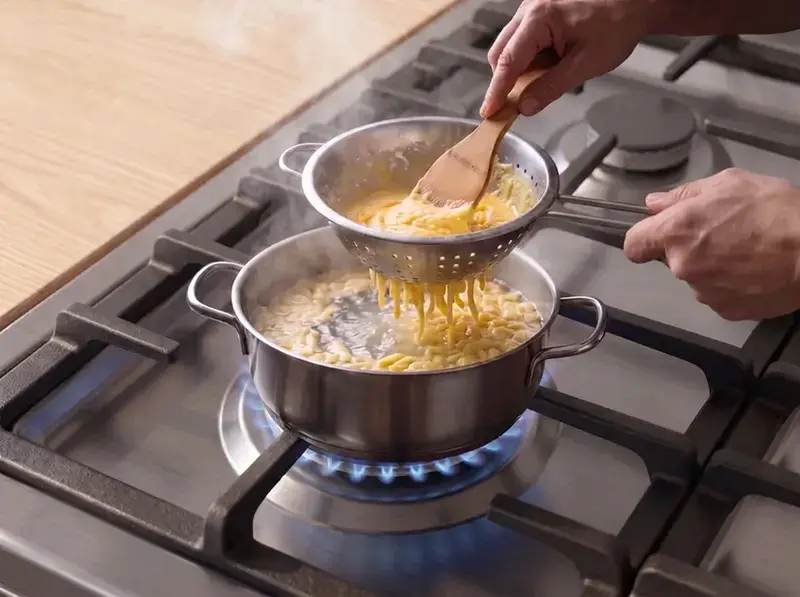
- Cook in batches. Bring a large pot of well-salted water to a boil, then reduce to a steady simmer. Work in two batches. Place a large-holed colander, Spätzle press, or cheese grater over the pot. Spoon half the batter into the colander and press through the holes using a silicone spatula or the back of a spoon — the batter falls as irregular short strands into the water. Simmer for 2 to 3 minutes until the Spätzle float to the surface. Remove with a slotted spoon and transfer to a bowl of cold water for 1 minute to stop cooking and prevent sticking. Drain. Repeat with the remaining batter.
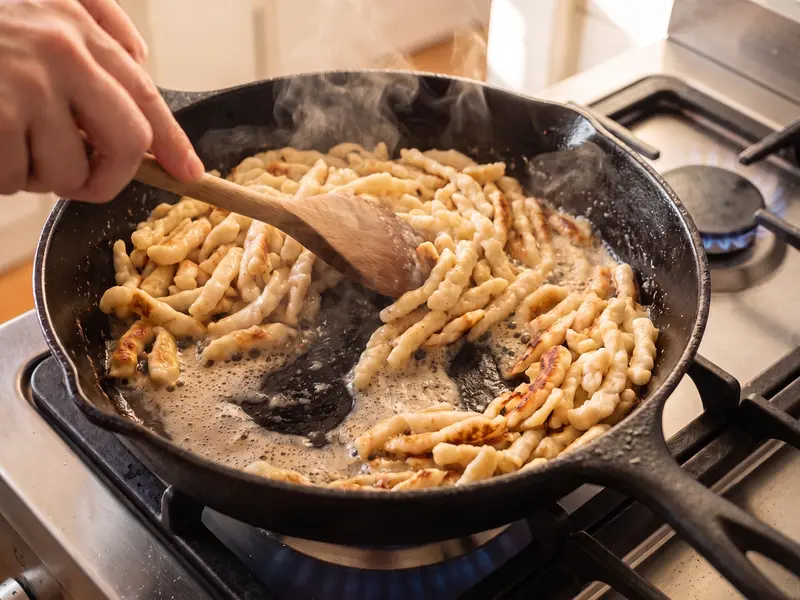
- Finish in butter. Melt the butter in a large wide pan over medium-high heat until it foams, then subsides and turns a pale gold with a faint nutty smell — this is beurre noisette, brown butter, which takes about 2 minutes. Add the drained Spätzle. Toss to coat and cook, stirring occasionally, for 3 to 4 minutes until the Spätzle are heated through and lightly golden at the edges. Season with salt and a small grating of nutmeg if desired. Remove from heat and scatter over the parsley. Serve immediately.
FAQ
Thicker than pancake batter, looser than bread dough. The clearest test: hold a spoon loaded with batter at shoulder height and let it fall. It should drop in a slow, thick ribbon — not run freely like water, not fall in a solid chunk. When you stir the batter, small air bubbles should appear and the trail from the spoon should close slowly. If the batter runs through the colander holes on its own without being pushed, add flour a tablespoon at a time. If it barely moves when pressed, add water or milk a tablespoon at a time. Different flours absorb liquid differently, so the exact quantities always vary slightly.
A dedicated Spätzle press (Spätzlepresse) or scraper (Spätzlehobel) gives the most uniform results and is worth buying if you make Spätzle regularly. Without one, the simplest substitute is a large-holed colander — place it over the pot, add batter, and push through with a silicone spatula. A potato ricer with large holes works well. A box grater with large holes held over the pot can also work. The traditional method requires no equipment: scrape small pieces of batter off the edge of a wet cutting board with a long knife directly into the water. This produces irregular, rustic shapes that are arguably the most authentic.
The cold water bath stops the cooking immediately. Without it, the Spätzle continue cooking in their residual heat and can become mushy by the time the whole batch is done. More practically, the bath rinses off surface starch that makes them stick together, and the cold temperature slightly firms the exterior, giving them better texture when they go into the butter pan. If you are serving immediately and pan-frying right away, the cold bath can be skipped for the last batch — but for anything made in advance or where batches sit waiting, it matters.
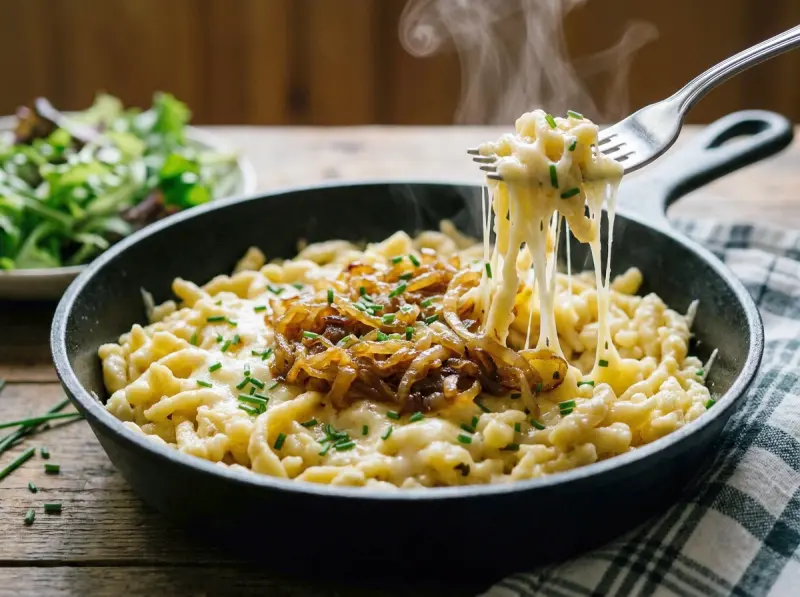
Käsespätzle is the most beloved Spätzle dish: freshly cooked Spätzle layered with generous amounts of grated Emmental or Gruyère cheese, then finished with deeply caramelized onions on top. It is essentially the Swabian equivalent of macaroni and cheese — richer, more intense, and arguably better. It is baked for 10 minutes to melt the cheese into every layer. Regular buttered Spätzle is a side dish; Käsespätzle is a complete main course. The caramelized onions are not optional — their sweetness and slight bitterness balance the richness of the cheese and egg.
Spätzle as a side dish: schnitzel, Jägerschnitzel with mushroom sauce, rouladen (stuffed beef rolls), goulash, pork roast with gravy, sauerbraten. Any German dish that produces a sauce or gravy pairs well because the soft porous Spätzle soak it up. As a main dish: Käsespätzle with caramelized onions is the most famous version. Simpler: Spätzle pan-fried in butter with bacon and onions (Schupfnudeln style). With fried egg on top (Verlorene Eier über Spätzle) is another traditional Swabian meal. Spätzle also make a fine soup noodle in beef or chicken broth.
Rate this
Recipes by email
One letter a week: a recipe picked for your taste, plus whatever is new on the site. Unsubscribe in one click.
Welcome gift: Sergei's cookbook (e-book).
By subscribing you agree to the privacy policy.
Tell us what you like to cook (30 seconds) →Keep browsing
More dishes from the German archive — picked by overlap with what you're cooking now.
Join the conversation
Comments (5)
Wie bei Oma! Ich benutze nen Spätzlehobel das geht schneller als mit dem Brett. Mit viel Butter und Käse überbacken — Käsespätzle sind das beste
Klassiker aus der schwäbischen Küche. Bei uns daheim gibts das jeden Sonntag mit Linsen. Meine Oma würde es gut finden denke ich.
Klassiker! Bei uns in Schwaben machen wir das jeden Sonntag. Ich benutze aber keine Reibe sondern den Spätzlehobel, geht schneller und die Form wird schöner. Mit Linsen und Saitenwürstchen serviert = Himmel.
The batter consistency is everything. It should be thick enough to hold its shape for a second when dropped from a spoon, but thin enough to drip. If it sits in a blob, add milk. If it runs like water, add flour. I push it through a colander with large holes directly into boiling salted water. They float in about 30 seconds — fish them out and toss in browned butter. Spätzle without browned butter is just boiled dough.
Шпецле — это немецкие клёцки по сути. Тесто должно быть довольно жидким, почти как на блины. Я продавливаю через дуршлаг с крупными дырками прямо в кипящую воду. Всплыли — готовы. Потом обязательно обжарить на сливочном масле с луком. Без обжарки они пресные.