
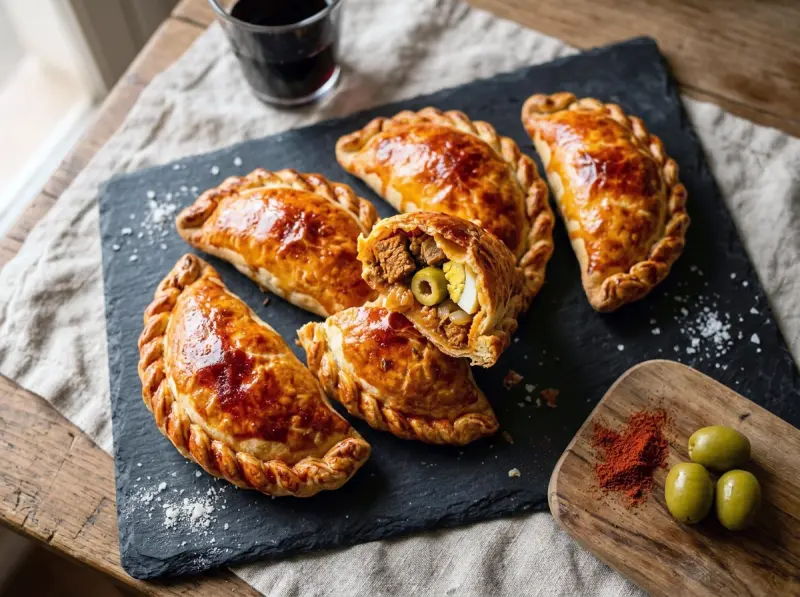
Empanadas Mendocinas (Argentine Baked Beef Empanadas)
Mendocinas are Mendoza's version of the empanada — baked, never fried, and distinguished by a milk dough that bakes softer than the standard. The filling is spiced ground beef with smoked paprika, cumin, green olives, and hard-boiled egg. No raisins. The paprika turns the filling and crust an orange-red that identifies these across Argentina. Made in batches, best eaten warm, and freezable before baking.
Ingredients
- 450 gground beef
- 2 large white onions
- 2 tspsmoked paprika
- 1 tsphot paprika or cayenne
- 1 tspground cumin
- 1 tspdried oregano
- 80 ggreen olives
- 2 hard-boiled eggs
- 400 gall-purpose flour
- 80 glard or cold unsalted butter
- 1 egg yolk
- 150 mlwhole milk
- 1.5 tspsalt
- 1 egg for egg wash
Method
- Make the filling. Dice the onions finely. Cook them in a dry pan over medium-low heat with a pinch of salt for 15 minutes, stirring occasionally, until soft and translucent. Add the ground beef, smoked paprika, hot paprika, cumin, and oregano. Cook over medium heat, breaking the meat up, for 8 to 10 minutes until no pink remains. The mixture should be fragrant and deeply orange-red from the paprika. Drain off excess fat if needed. Taste and adjust salt.
- Cool the filling. Transfer the filling to a flat dish and spread it out. Leave at room temperature for 20 minutes, then refrigerate for at least 1 hour. The filling must be cold before assembly. Warm filling makes the dough sticky, prevents a clean seal, and causes the empanadas to burst in the oven. While the filling cools, quarter the olives and slice the hard-boiled eggs into rounds.
- Make the dough. Combine the flour and salt in a large bowl. Add the cold lard or butter in small pieces and rub into the flour with your fingertips until the mixture resembles coarse crumbs. Mix the egg yolk into the milk. Add the milk mixture to the flour gradually, mixing with a fork, until a soft dough comes together. Do not overwork. Form into a ball, wrap, and refrigerate for 30 minutes.
- Roll and cut. On a lightly floured surface, roll the dough out to 3 mm thickness. Cut circles approximately 12 cm in diameter using a cutter, bowl, or glass. Re-roll the scraps once. You should get 14 to 16 discs.
- Fill and seal. Place 1 heaped tablespoon of cold filling in the centre of each disc. Add one olive piece and a slice of hard-boiled egg. Moisten the edge of the disc with water or egg white. Fold over into a half-moon and press the edges firmly together. Seal with a fork pressed twice along the edge, or crimp by folding the border into a braid — the repulgue. No air pockets inside.
- Bake. Preheat the oven to 200 C. Arrange the empanadas on a baking sheet lined with parchment paper. Beat the egg with a teaspoon of water and brush the tops lightly. Bake for 20 to 22 minutes until the crust is deep golden and the surface is glossy. Cool on a rack for 5 minutes before serving. The filling is very hot inside.
FAQ
Yes, cold unsalted butter is the closest substitute at a 1 to 1 ratio by weight. The dough made with butter will be slightly flakier and have a richer flavour than lard, which is more neutral. For a vegan version, cold plant-based margarine works. The key function of lard in the dough is texture: it produces a softer, slightly crumbly crust that is characteristic of mendocinas. Whichever fat you use, it must be cold and cut into small pieces before rubbing into the flour.
Mendocinas are always baked, not fried. The filling contains ground beef with smoked paprika, cumin, hot pepper, sliced green olives, and hard-boiled egg. There are no raisins or sweet additions — those belong to empanadas from Cordoba and Tucuman. The dough is made with milk, which produces a softer crumb than a water-based dough. The signature colour is orange-red from the paprika, which goes into both the filling and visibly stains the crust. In Argentina, an experienced cook can identify a region's empanada by its shape and filling alone.
Three common causes. First, warm filling: the steam from hot filling builds pressure inside the sealed dough and forces it open. The filling must be refrigerated until completely cold before assembly. Second, a weak seal: the edges need to be moistened with water or egg white and pressed firmly with no gaps or air pockets inside. Press with a fork twice, or use the repulgue crimp. Third, overfilling: no more than 1 heaped tablespoon of filling for a 12 cm disc. More than that and the dough cannot stretch enough to seal properly.
Freeze before baking for the best result. Assemble the empanadas, lay them flat on a tray without touching, freeze for 2 hours until solid, then transfer to a freezer bag. They keep for up to 3 months. Bake directly from frozen at 200 C for 25 to 28 minutes without thawing. If you freeze them already baked, reheat in the oven at 180 C for 10 to 12 minutes. The microwave works but makes the crust soft. For a crispy result, use the oven or an Air Fryer at 180 C for 5 to 7 minutes.
Yes, the Air Fryer works well and gives a crispier, more golden crust than the oven. Preheat to 190 C. Lightly oil the basket or line with parchment. Place empanadas in a single layer without touching. Cook for 12 to 14 minutes, flipping on the 7th minute. Cooking time depends on size — smaller empanadas will be ready closer to 12 minutes. Do not overcrowd the basket: the hot air needs to circulate around each empanada.
Keep browsing
More dishes from the Argentinian archive — picked by overlap with what you're cooking now.
Recipes by email
One letter a week: a recipe picked for your taste, plus whatever is new on the site. Unsubscribe in one click.
Welcome gift: Sergei's cookbook (e-book).
By subscribing you agree to the privacy policy.
Tell us what you like to cook (30 seconds) →
Join the conversation
Comments
No comments yet — be the first!