
Insalata di Finocchi e Arance (Sicilian Fennel and Orange Salad)
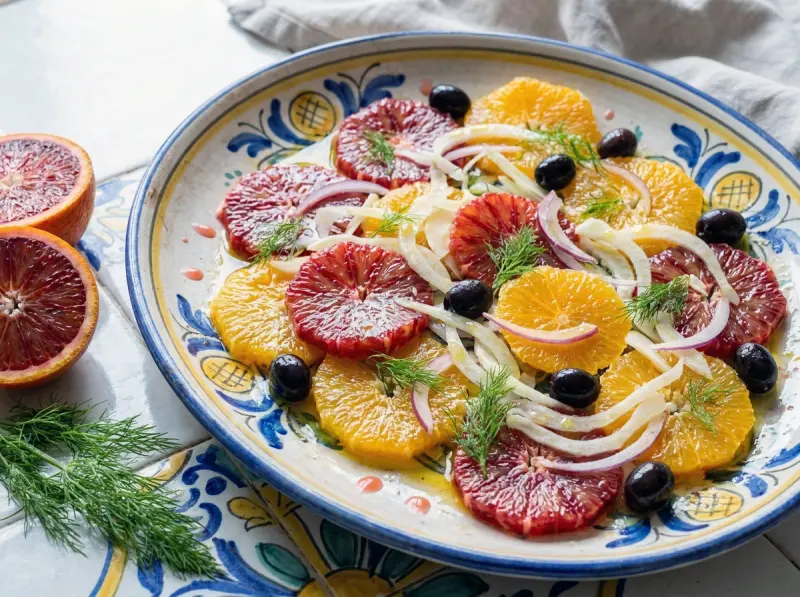
Insalata di finocchi e arance is a classic Sicilian salad of thinly sliced fennel and oranges, dressed with olive oil, salt, and black pepper, with black olives. It is the contrast of sweet, juicy orange and crisp, anise-scented fennel — bright and refreshing. It comes from Sicily, where most of Italy's citrus is grown, and the orange salad is a legacy of the Arab rule of the island (9th-11th centuries): it was the Arabs who brought citrus into Sicilian cooking. It is a winter dish, since oranges (especially blood oranges, tarocchi) are in season in winter, served as an antipasto or contorno through the cold months. The salad is a fine example of Sicilian agrodolce, sweet and salty: the sweetness of the orange balanced by salty black olives and crisp fennel. Technical keys: peel the oranges to the flesh, cutting away the bitter white pith; slice the fennel very thinly; let the acidity come from the orange, not vinegar; black olives for the agrodolce contrast; blood oranges for the classic Sicilian version; and good fruity olive oil, since there are few ingredients. Save the orange juice that runs out — it is the base of the dressing. Serve at room temperature, the best winter citrus, sliced thin, with excellent oil.
Ingredients
- 2 fennel
- 4 oranges
- 1 red onion
- 60 gblack olives
- 4 tbspextra virgin olive oil
- 0.5 tspsalt
- 0.25 tspblack pepper
Method
- Prepare the fennel. Trim the stalks and any damaged outer layers from 2 fennel bulbs, and cut off the base. Save the green feathery fronds — they are the ideal garnish. Halve each bulb lengthwise, remove the tough core if you like, and slice very thinly, ideally on a mandoline or with a very sharp knife. Thin slicing is the key: thick fennel is tough and too aniseedy, thin fennel is tender and crisp. For a milder, crisper bite, hold the sliced fennel in ice water for 10 minutes, then drain.
- Peel the oranges to the flesh. Cut the top and bottom off 4 oranges (blood oranges if you can get them) so they stand steady. Stand each on a cut end and slice away the peel and all the white pith from top to bottom, following the curve of the fruit — the pith is bitter and would spoil the salad. Slice the oranges into thin rounds about ½ cm thick, or cut out segments between the membranes. Save all the juice that runs out, and squeeze the juice from the leftover trimmings and membranes — this is the base of the dressing.
- Slice the onion and olives. Peel 1 red onion and slice it very thinly. If the onion is sharp, soak the slices in cold water for 10 minutes and drain — this softens the bite. Pit 60 g of black olives if needed and chop them roughly. The salty olives are the Sicilian agrodolce touch, the contrast to the sweet orange.
- Make the dressing. In a bowl, whisk the reserved orange juice with 4 tablespoons of extra virgin olive oil, ½ teaspoon of salt, and a few grinds of black pepper into a light citrus emulsion. This is the authentic Sicilian dressing — the acidity comes from the orange itself, with no vinegar or lemon. If the oranges are very sweet, a small splash of wine vinegar is allowed but not traditional. Use the best fruity olive oil, ideally Sicilian, since there are so few ingredients.
- Assemble and serve. Arrange the orange rounds on a platter, slightly overlapping. Scatter the thinly sliced fennel, onion, and black olives over the top. Spoon over the dressing and finish with the chopped fennel fronds. Let the salad rest at room temperature for 30 minutes to 2 hours, so the flavors come together and the fennel softens slightly. Serve at room temperature, not chilled — cold mutes the aroma of the orange and oil. Best eaten the day it is made; the fennel softens by the next day.
FAQ
Insalata di finocchi e arance is a classic Sicilian salad of thinly sliced fennel and oranges, dressed with olive oil, salt, and black pepper. It is sometimes called simply insalata siciliana. It is the contrast of sweet, juicy orange and crisp fennel with an anise note — a bright, refreshing dish. Origin — Sicily, where most of Italy's citrus is grown. What the Arabs have to do with it: the history of the orange salad is closely tied to the Arab rule of the island (9th-11th centuries). It was the Arabs who brought citrus into Sicilian cooking and culture, and the orange salad is a legacy of that period. When it is eaten: this is a winter dish — oranges (especially blood oranges, tarocchi) are in season precisely in winter, and the salad is served all through the winter and into March. It is eaten as an antipasto (starter) or contorno (side). The Sicilian agrodolce (sweet and salty): the salad is a fine example of the Sicilian pairing of sweet and salty — the sweetness of the orange balanced by salty black olives and crisp fennel. Variations: every family and region has its own; common additions are toasted nuts (walnuts, pistachios), raisins, olives, capers, and in coastal towns sometimes pieces of cured fish. But the basic canon is simple: fennel + oranges + olive oil + salt + pepper.
The authentic choice is blood oranges (in Sicilian tarocchi or sanguinello). They are the Sicilian classic: a deep ruby-red color and a slightly more complex, berry-like flavor with a gentle tartness. They are grown around Etna, where the volcanic soil and temperature swings give the characteristic color. There is even a Sicilian saying (in one writer's grandmother's words): 'when there was nothing to eat in Sicily, there were always tarocchi.' The blood orange season is winter and early spring (December to April in Italy). If you cannot get blood oranges: regular navel oranges work beautifully — sweet, seedless, easy to peel. You can mix varieties for color. What to avoid: very tart varieties (for juicing), dried-out or out-of-season oranges — the salad rests on the quality and sweetness of the citrus. How to choose: an orange heavy for its size (it is juicy), with firm skin and no soft spots. Important about preparation: the oranges must be peeled to the flesh (a vif) — cut away not only the peel but all the white pith, which is bitter. Stand the orange on a cut end and slice the peel away from top to bottom following the shape of the fruit, then cut into rounds or segments. Save the juice that runs out — it becomes the base of the dressing.
Texture decides everything in this simple salad. Fennel — slice thin: (1) Trim the stalks and damaged outer layers from the fennel bulb, and cut off the base. Save the green feathery fronds — they are the ideal garnish. (2) Halve the bulb lengthwise and remove the tough core if you like. (3) Slice very thinly — best on a mandoline or with a very sharp knife. Thin slicing is the key: thick fennel is tough and its anise flavor is too assertive; thin is tender, crisp, refreshing. (4) For an even milder flavor, hold the sliced fennel in ice water for 10 minutes — it will be crisp and less sharp. A note on fennel types: there are two kinds of bulb — rounder ('male') and flatter, oval ('female'). For raw salads the rounder are better — they are juicier; the elongated flat ones are better for roasting or braising. Oranges — peel to the flesh: (1) Cut off the top and bottom of the orange so it stands steady. (2) Stand it on a cut end and with a sharp knife slice the peel away along with the white pith from top to bottom, following the shape of the fruit — the pith (white membrane) is bitter and spoils the flavor. (3) Slice into thin rounds (~½ cm) or cut out segments between the membranes (supreme). (4) Save all the juice that runs out and squeeze the juice from the leftover trimmings and membranes — that is the base of the dressing.
Here is the main secret of the authentic Sicilian version: the acidity comes from the orange itself, NOT from vinegar or lemon. (1) The most traditional dressing (per Sicilian sources) is just the orange juice + excellent extra virgin olive oil + salt + freshly ground black pepper. No vinegar. The tang a salad usually needs is given here by the sweet-tart orange — and that is the charm of the dish. (2) How to make it: whisk the reserved orange juice (from the trimmings and membranes) with olive oil, salt, and pepper to a light citrus emulsion. (3) Can you add vinegar or lemon? Some modern versions add a drop of wine vinegar or lemon juice for brightness — that is allowed but not required and not authentic. If the oranges are very sweet, a small tart note can help, but the classic does without it. Ratio: about 3 parts oil to the juice of one orange, adjust to taste. Black olives — the Sicilian agrodolce: add a handful of black olives (pitted, roughly chopped) — their saltiness creates the classic Sicilian contrast to the sweet orange. This is a traditional addition, though optional. Extra: toasted walnuts or pistachios for crunch, thinly sliced red onion for bite, fennel fronds for aroma. The oil's quality is critical: there are few ingredients, so use the best fruity EVOO, ideally Sicilian.
This is an elegant, refreshing salad, and the serving is simple. How to serve: (1) Arrange the orange rounds on a platter, slightly overlapping, and scatter the thin fennel, olives, and (if using) onion and nuts over the top. (2) Spoon over the dressing of orange juice and oil, and sprinkle with fennel fronds. (3) Serve at room temperature or slightly cool — but not ice-cold, as cold mutes the aroma of the orange and oil. Can you make it ahead? (a) Yes, and it even helps to let it rest. By traditional recipes (Ciao Italia), the salad is covered and left at room temperature for several hours — the flavors come together, the fennel softens a little, the orange releases its juice. (b) But not too long — the fennel loses its crunch over time and the orange releases a lot of liquid. It is best assembled 30 minutes to 2 hours before serving. (c) The components (sliced fennel in water, peeled oranges) can be prepared ahead and assembled before serving. What to pair it with: (a) As a contorno (side) to rich meat — pork, lamb — the fennel and citrus cleanse the palate. (b) With fish, especially oily fish (sardines, mackerel) — a Sicilian classic. (c) As a light antipasto in winter, part of a larger Italian spread. (d) For the Christmas and winter table — many Sicilian families serve it at the holidays. Storage: best eaten the day it is made; leftovers in the fridge until the next day, but the fennel will soften. Key principle: freshness, quality of citrus and oil, thin slicing — and the contrast of sweet orange, salty olives, and crisp fennel.
Keep browsing
More dishes from the Italian archive — picked by overlap with what you're cooking now.
Recipes by email
One letter a week: a recipe picked for your taste, plus whatever is new on the site. Unsubscribe in one click.
Welcome gift: Sergei's cookbook (e-book).
By subscribing you agree to the privacy policy.
Tell us what you like to cook (30 seconds) →
Join the conversation
Comments
No comments yet — be the first!