
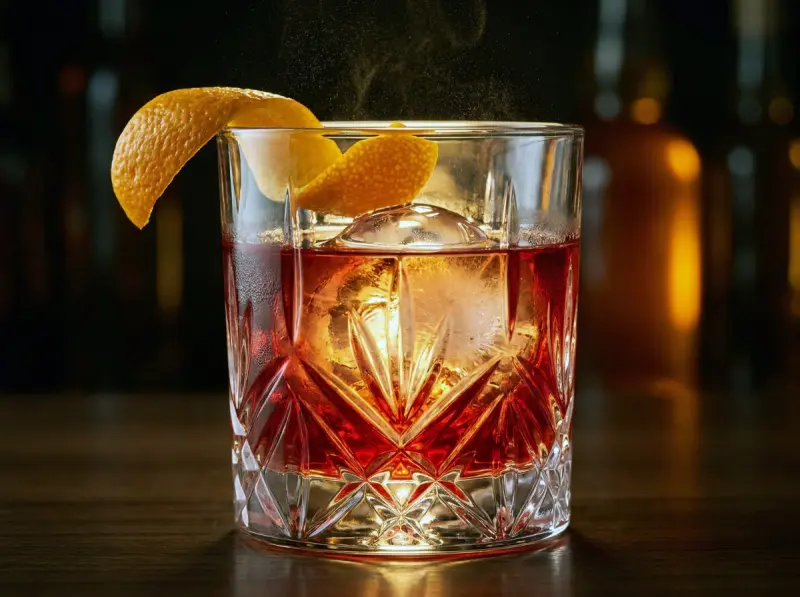
Negroni (Classic Italian Aperitivo Cocktail)
The Negroni is a classic Italian cocktail made with equal parts gin, Campari, and sweet red vermouth, stirred over ice and garnished with an orange peel. One of the world's most iconic drinks, it's the cornerstone of Italian aperitivo culture — the tradition of a light, bitter drink before dinner that wakes the palate and stirs the appetite. Created around 1919 at Caffè Casoni in Florence, when Count Camillo Negroni asked bartender Fosco Scarselli for a stronger version of the Americano, replacing soda water with gin. Its ruby-red color, bittersweet flavor, and spirit-forward strength made it an icon of la dolce vita. The drink is a direct descendant of the Americano (Campari, vermouth, soda), which itself came from the Milano-Torino. The sacred formula is 1:1:1 — equal parts of all three ingredients. Key technique: stir, never shake (a spirit-only cocktail without juice should be gently chilled, not aerated and over-diluted), and quality matters because there are only three ingredients. Campari is the one irreplaceable soul of the drink. Served in a rocks glass over a large ice cube or straight up, it's sipped slowly as an aperitivo between 6 and 8 PM, paired with olives, taralli, or salty snacks. Recently revived worldwide through Negroni Week and ambassadors like Stanley Tucci, it remains one of the top three most-ordered cocktails in bars globally. Yields 1 cocktail in 5 minutes.
Ingredients
- 30 mlgin
- 30 mlCampari
- 30 mlsweet vermouth
- 1 orange peel
- 1 cupice cubes
1 cup = 240 ml
Method
- Chill the glass. Place a rocks glass (also called an Old-Fashioned glass) in the freezer for a few minutes, or fill it with ice and a splash of water to chill while you prepare the drink, then discard. A cold glass keeps this strong, spirit-forward cocktail from warming too fast. If serving straight up, chill a coupe or cocktail glass instead.
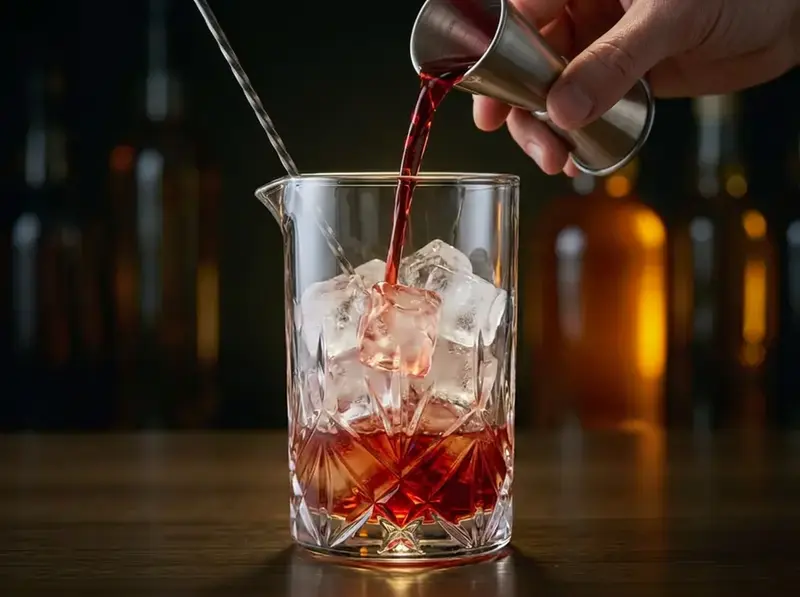
- Build over ice. Fill a mixing glass (or simply the serving glass itself) about two-thirds full with fresh, dry ice cubes — not ice that has already started melting, which would dilute the drink prematurely. Pour in 30 ml gin, 30 ml Campari, and 30 ml sweet red vermouth, in equal parts. There is nothing to strain out of a Negroni, so building directly in the serving glass is perfectly acceptable and saves washing up.
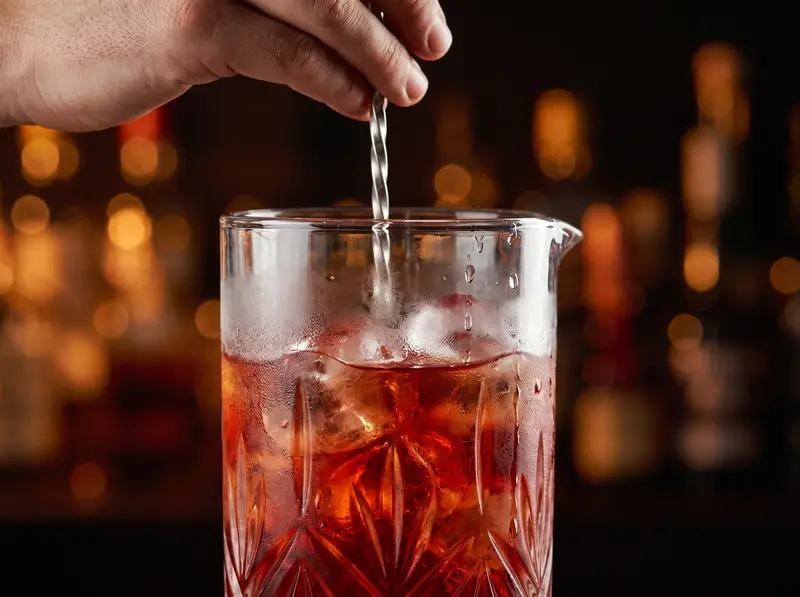
- Stir, never shake. Stir the mixture with a bar spoon for 20-30 seconds, using smooth circular motions, until the outside of the vessel fogs up — the sign it has chilled to around 0°C. This is the critical rule: a Negroni contains only spirits and no juice, so shaking would over-dilute it with ice shards and cloud it with air bubbles, destroying its silky texture and crystal clarity. Stirring chills it gently while keeping it clear and properly strong.
- Serve over a large cube. If you stirred in a mixing glass, strain the cocktail into the chilled rocks glass over one large ice cube or sphere — a big cube melts slowly and dilutes the drink minimally as you sip. If you built it directly in the serving glass, simply leave it as is. For a straight-up serve, strain into the chilled coupe with no ice.
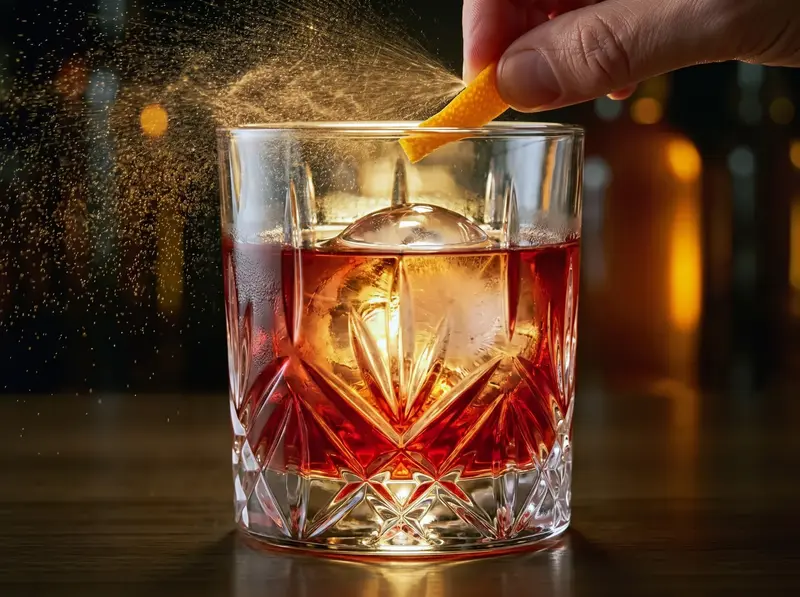
- Express the orange peel. Cut a strip of orange peel with a vegetable peeler, taking only the orange layer and avoiding the bitter white pith. Hold the peel skin-side down over the surface of the cocktail and pinch it firmly — the essential oils will spray across the surface, adding a bright citrus aroma. This step is not decoration; it is a real aromatic component of the drink.
- Garnish and rest. Rub the peel around the rim of the glass, then drop it into the drink. Optionally, for a dramatic touch, hold a lit match between the peel and the cocktail as you express the oils for a flamed orange peel. Let the Negroni rest for a moment so the ice begins its slow work, then serve. Sip slowly as an aperitivo, ideally with olives, taralli, or salty snacks alongside.
FAQ
The Negroni is a classic Italian cocktail of equal parts gin, Campari, and sweet (red) vermouth, stirred over ice and garnished with a twist of orange peel. It's one of the most famous and beloved cocktails in the world, the cornerstone of Italian aperitivo culture — the tradition of a light, bitter drink before dinner that wakes the palate and stirs the appetite. Its ruby-red color, bittersweet flavor, and strength made it an icon of la dolce vita. History: the Negroni was created around 1919 at Caffè Casoni in Florence. The most widely accepted version holds that Count Camillo Negroni — an avid traveler and, by legend, a genuine cowboy who spent time in the American West — asked bartender Fosco Scarselli to make him a stronger version of the then-popular Americano (Campari + sweet vermouth + soda water), replacing the soda with gin. The resulting drink quickly became popular, and patrons began asking for a 'Negroni' — 'like the count's.' By a well-known anecdote, Scarselli later sent the count a letter with friendly advice not to drink more than 20 a day. Alternative version: there's also a French origin theory involving General Pascal Olivier de Negroni, and a version about the Milano-Torino cocktail (Campari from Milan + vermouth from Turin) that predated the Americano. As with most classic cocktails, the exact origin is blurry. The Americano as ancestor: the Negroni is a direct descendant of the Americano, which in turn came from the Milano-Torino. Replacing the soda with gin transformed a light, refreshing drink into a strong, spirit-forward cocktail. Aperitivo culture: the Negroni is the quintessence of the Italian aperitif. In Italy it's drunk between 6 and 8 PM, before dinner, often with light snacks (olives, chips, nuts, mini-panini). Campari's bitterness stimulates gastric juices and stirs the appetite — that's the physiological point of an aperitivo. Milan and Turin are the historical homelands of vermouth (Carpano invented sweet vermouth in Turin in 1786) and Campari (created by Gaspare Campari in Milan in 1860), so the Negroni is deeply rooted in northern Italian bar tradition. Modern popularity: over the past decade the Negroni has undergone a global renaissance. There's an annual Negroni Week (a charity initiative launched in 2013 by Imbibe magazine and Campari), and actor Stanley Tucci became an unofficial ambassador for the cocktail, popularizing it with social media videos. Today the Negroni consistently ranks in the top three most-ordered cocktails in bars worldwide. Family of riffs: the Negroni has spawned dozens of variations: Negroni Sbagliato ('mistaken' Negroni — with sparkling wine instead of gin), Boulevardier (with bourbon), Kingston Negroni (with Jamaican rum), White Negroni (with Suze and Lillet instead of Campari and vermouth), Mezcal Negroni. But the classic remains unchanged: 1:1:1.
The classic Negroni is equal parts (1:1:1) of three ingredients: 30 ml gin + 30 ml Campari + 30 ml sweet red vermouth. It's one of the easiest-to-remember formulas in the cocktail world, and that's its genius. Why 1:1:1 works: it balances three forces — the strength and juniper botanicals of gin, the bitterness and citrus-spice notes of Campari, the sweetness and herbaceousness of vermouth. Equal parts create perfect equilibrium between bitter, sweet, and spirit. Changing any component shifts the balance. Standard proportions (per cocktail): 30 ml (1 oz) gin + 30 ml Campari + 30 ml sweet vermouth — about 90 ml of liquid before ice dilution. Acceptable adjustments: (a) Boosted gin (1.5:1:1) — some bars (like Sipsmith) slightly increase the gin for a more sippable, less sweet result: 45 ml gin + 30 ml Campari + 30 ml vermouth. (b) Less bitter — increase the vermouth or reduce the Campari (25 ml) for beginners not used to bitterness. (c) Drier — reduce the vermouth to 20-25 ml. (d) Sweeter — add a drop of simple syrup (untraditional, but acceptable for those who dislike bitterness). Key rule of ingredient choice: since there are only three components, the quality of each is critical. Gin: London Dry (Tanqueray, Beefeater, Bombay Sapphire) — the classic juniper-forward choice giving clear structure; or citrus-herbal gins (Hendrick's, Plymouth, St. George Botanivore) for a softer, more aromatic profile. The main thing is to use a gin you enjoy on its own. Campari is irreplaceable. It's the one mandatory, unchanging ingredient that makes a Negroni a Negroni. A bright-red Italian bitter liqueur (created in 1860) with a bittersweet flavor, notes of bitter orange, cinnamon, clove, and herbs. Replace it and you get a different cocktail (with Aperol — a lighter 'Negroni-style' but not a true Negroni). Sweet vermouth — choose a quality red (rosso) vermouth: Cocchi Vermouth di Torino, Carpano Antica Formula (richer, vanilla), Martini Rosso (classic budget option), Punt e Mes (more bitter). Since it's a third of the drink, cheap vermouth noticeably worsens the result. Batch proportions (for 8 party servings): 240 ml gin + 240 ml Campari + 240 ml vermouth, mixed in a bottle or container, chilled in the freezer, poured over ice as needed. The Negroni batches beautifully.
The key technical rule: a Negroni is stirred, NOT shaken. This isn't snobbery, it's technique. Why stir, not shake: shaking is for cocktails with juice, cream, egg white, or other 'emulsifiable' components that need aeration and strong chilling. A Negroni consists only of spirits (gin, Campari, vermouth) with no juice — shaking would (a) over-dilute the drink with fine ice shards, (b) cloud it with air bubbles, (c) destroy its silky texture. Stirring chills it gently, keeps it crystal clear, and preserves its proper strength. Stirring technique: (1) Fill a mixing glass (or just a glass) two-thirds with ice. (2) Pour in 30 ml gin, 30 ml Campari, 30 ml vermouth. (3) Stir with a bar spoon for 20-30 seconds in smooth circular motions until the vessel walls fog up (the sign of chilling to around 0°C). (4) Strain through a julep or hawthorne strainer into the prepared glass. Simplified home method: since there's nothing to strain out of a Negroni (no sediment), many people simply pour the ingredients directly into the glass over ice and stir in place — this is acceptable and saves washing up. Ice: (a) One large cube (or sphere) in a rocks glass — the ideal. Big ice melts slowly, minimally diluting the drink as you sip. (b) Regular ice cubes — acceptable, but melt faster. (c) Never use crushed ice for serving — it melts instantly and floods the cocktail with water. For stirring, the ice should be fresh and dry (not melting). Glass: (a) Rocks glass / Old-Fashioned glass (low, wide tumbler) over ice — the most traditional serve. (b) Straight up — stirred and strained into a chilled coupe or cocktail glass with no ice (more elegant, for an aperitivo). (c) The glass should ideally be pre-chilled (held in the freezer or filled with ice for a minute, then emptied). Garnish — orange peel: this is the critical final touch. (1) Cut a strip of orange peel with a peeler (only the orange layer, no bitter white pith). (2) Express it skin-side down over the surface of the cocktail — the essential oils spray onto the surface, adding bright citrus aroma (you can even briefly flame the oils with a match for flair — a flamed orange peel). (3) Run the peel around the rim of the glass and drop it in. This step isn't decoration but a full aromatic component. Alternative: an orange slice — less aromatic, but traditional (Saveur/Rivoire use a slice). Preparation time: about 5 minutes, including chilling the glass.
The Negroni is one of the most 'modular' cocktails: by changing one of the three components, bartenders have created a whole family of classic riffs. By replacing the gin: (a) Negroni Sbagliato ('mistaken Negroni') — gin replaced with sparkling wine (prosecco or spumante). Legend: a bartender at Milan's Bar Basso in the 1960s accidentally grabbed a bottle of sparkling wine instead of gin. The result is a lighter, refreshing, fizzy aperitif. It went viral in 2022 after actress Emma D'Arcy's interview ('Negroni... sbagliato... with prosecco in it'). (b) Boulevardier — gin replaced with bourbon or rye whiskey. A warmer, richer, 'wintery' variant. Created in the 1920s in Paris. Often made with an increased whiskey proportion (1.5:1:1). (c) Kingston Negroni — gin replaced with strong Jamaican rum (Smith & Cross). Created by bartender Joaquín Simó. Tropical, funky, with notes of banana and molasses. (d) Mezcal Negroni / Oaxaca Negroni — gin replaced with mezcal. Smoky, earthy. (e) Vodka Negroni — gin replaced with vodka (for those who dislike juniper). By replacing the Campari: (f) White Negroni — Campari replaced with Suze (a bitter gentian liqueur), vermouth with Lillet Blanc. Created in 2001. Pale yellow, more subtle, floral-bitter. (g) Negroni with Aperol — lighter, less bitter, orange (technically closer to an 'Aperol-style' drink). By replacing the vermouth: (h) Negroni with sherry or other fortified wines — experimental versions. By strength and format: (i) Negroni Week special — charity author versions. (j) Frozen Negroni — blended with ice, summery. (k) Batched and bottled Negroni — made in advance, aged. (l) Barrel-aged Negroni — aged in an oak barrel for several weeks, picking up vanilla-wood notes, more rounded flavor. Cousin cocktails: Americano (the ancestor: Campari + vermouth + soda, no gin — lighter and lower in strength), Milano-Torino (Campari + vermouth, no soda), Old Pal (with rye whiskey and dry vermouth), Cardinale (with dry vermouth instead of sweet). What is NOT a Negroni: any cocktail without Campari (or a related Italian bitter) is no longer a Negroni but a different drink. Campari is the mandatory, unchanging soul of the cocktail. Tip for experimenting: start with the classic 1:1:1, master the balance, and only then try the riffs. Each variation is a window into a different flavor universe while keeping the same elegant three-part structure.
The Negroni is first and foremost an aperitivo, and its serving is deeply tied to the Italian pre-dinner ritual. When to drink it: the classic time is between 6 and 8 PM, before dinner. Campari's bitterness stimulates the appetite and prepares the palate for food — that's the physiological and cultural point of an aperitivo. The Negroni is not a digestif (after-dinner) nor a 'party cocktail'; it's a thoughtful, unhurried drink for the start of the evening. How to drink it: the Negroni is a strong, spirit-forward cocktail (~24-28% before ice dilution). It's drunk slowly, in small sips, letting the ice gradually melt and slightly open up the drink. Not in one gulp — that would ruin both the pleasure and the effect. By legend, bartender Scarselli advised Count Negroni not to drink more than 20 a day (a joke, but it reflects the cocktail's drinkability). Glass: rocks/Old-Fashioned glass over a large ice cube (classic) or coupe/cocktail glass straight up (elegant). What to serve it with (aperitivo snacks): (a) Olives (green Castelvetrano, black Taggiasche) — the classic. (b) Chips, taralli, grissini (breadsticks). (c) Nuts — almonds, pistachios. (d) Stuzzichini (Italian mini-snacks) — bruschetta, mini-panini, crostini. (e) Cheese and cured meats — Parmigiano, prosciutto, mortadella, salame. (f) Patatine (potato chips) — a simple but traditional companion in Italian bars. Why bitter snacks + bitter cocktail work: the Negroni's bitterness contrasts with the saltiness and fattiness of snacks, cleansing the palate between bites and stimulating appetite. Pairing with food (if served as part of dinner): the Negroni goes well before Italian cuisine — pasta, risotto, meat dishes. Its bitterness 'cuts' fattiness. Less successful with delicate fish or sweet dishes. Seasonality: (a) Summer — over ice, on the terrace, as a refreshing bitter aperitif; the summer variant is the Negroni Sbagliato (lighter) or Frozen Negroni. (b) Autumn/winter — straight up or over a large cube, as a warming aperitif; the winter variant is the Boulevardier (with whiskey). Etiquette: (a) Always serve with orange peel or a slice — it's part of the aroma, not optional. (b) Don't dilute a Negroni with soda (that turns it into an Americano or Negroni Sbagliato). (c) Don't use cheap ingredients — in a three-component cocktail each one is noticeable. (d) Serve cold, but not numbingly icy — an overly cold drink loses its aroma. Modern context: the Negroni has become a symbol of the 'cocktail connoisseur' — ordering one in a bar signals confident taste. Its 'bitter complexity' is appreciated by those who've outgrown sweet cocktails. Batch storage: a pre-mixed Negroni (without ice) keeps in a sealed bottle in the fridge for up to a month — spirits don't spoil. Before serving, just pour over ice and add the peel.
Rate this
Recipes by email
One letter a week: a recipe picked for your taste, plus whatever is new on the site. Unsubscribe in one click.
Welcome gift: Sergei's cookbook (e-book).
By subscribing you agree to the privacy policy.
Tell us what you like to cook (30 seconds) →Keep browsing
More dishes from the Italian archive — picked by overlap with what you're cooking now.
Join the conversation
Comments
No comments yet — be the first!