
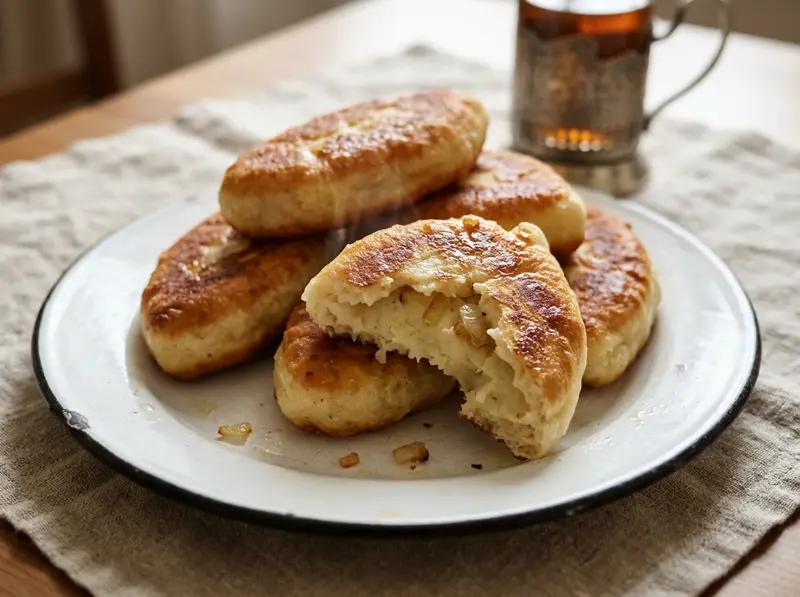
Piroshki with Potato (Russian Potato Pies)
Piroshki with potato are small Russian pies of soft yeast dough wrapped around mashed potato and fried onion, then cooked in a pan of oil that comes about halfway up them. In Russian they are пирожки с картошкой (pirozhki s kartoshkoy; one is a pirozhok) and in Japanese ピロシキ. Most of the Russian home recipes we read fry them, and they can also be baked in the oven. The dough here is a lean one, just water, oil, yeast, sugar, salt and flour, with no egg or dairy. That makes these piroshki vegan. The doughs of the meat piroshki on this site are richer: sour cream and eggs for the fried ones, milk, butter and egg for the baked ones. Allow about 2½ hours in all. For an hour of that the dough rises, and you make and cool the filling while it does.
What are piroshki with potato?
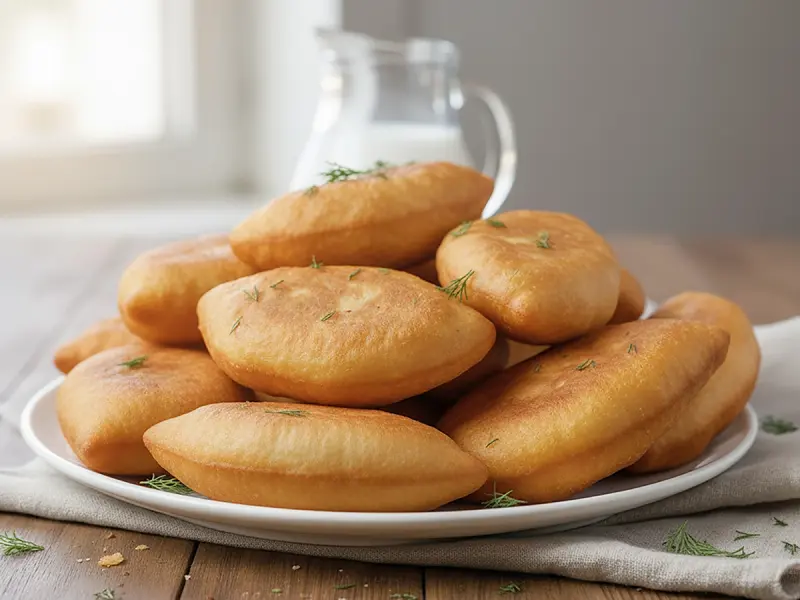
A pirozhok (plural pirozhki, usually written piroshki in English) is a small Russian pie: yeast, unleavened or puff dough with a filling sealed inside, then baked or fried. Russian Wikipedia, citing Soviet trade and catering reference books, describes fried pirozhki as oval and flattened or shaped like a half-moon. The same books put a pirozhok at up to 100 g, with the filling making up 25–35 % of the weight for most fillings, potato among them.
The home recipes we read fill them more generously than that catering norm. Ours weighs about 106 g before frying, and nearly half of that is filling.
Fried in a pan or baked?
Both are made at home. Of the five Russian recipes we read for this page, four fry the piroshki in a pan with the oil about halfway up and one bakes them, so frying is the main method here. You don't need a deep fryer: 800 ml of oil in a 26 cm pan makes a layer 1.5–2 cm deep.
The oven method is in the FAQ below. For meat piroshki the site has both versions, fried and baked.
Ingredients
- 500 gwheat flour
- 310 mlwater
- 7 gdry yeast
- 15 gsugar
- 2.5 tspsalt
- 95 mlvegetable oil
- 750 gpotatoes
- 1 lwater
- 150 gonion
- 0.5 tspground black pepper
- 800 mlvegetable oil for frying
Method
- Pour 310 ml of warm water (about 37 °C, comfortably warm on your wrist, not hot) into a large bowl. Stir in 15 g of sugar and 7 g of dry yeast and leave for 10 minutes, until a foamy cap forms on top. The foam tells you the yeast is alive. Add 50 ml of the vegetable oil and 1 tsp of the salt, then the 500 g of flour in three additions, stirring after each. Turn the dough out and knead it for 8 minutes, until it is smooth and soft and sticks to your hand only lightly. Don't work in extra flour, because a soft dough gives soft piroshki.
- Rub 1 tsp of the oil around the bowl, put the dough back in and cover it. Leave it in a warm place out of drafts for 1 hour, until it has doubled in size.
- As soon as the dough is covered, peel 750 g of floury potatoes (you will have about 640 g), cut them into 4 cm chunks and put them in a 20 cm saucepan with 1 l of cold water. Bring to the boil over high heat, add 1 tsp of salt, cover and turn the heat down to medium. Cook for 20 minutes, until a knife slides into a chunk without resistance. Meanwhile, finely chop 150 g of onion (one large onion). Heat 30 ml of the oil in a 26 cm sauté pan or deep frying pan with straight sides at least 6 cm high over medium heat, and cook the onion for 8 minutes, stirring, until it is soft and golden brown at the edges.
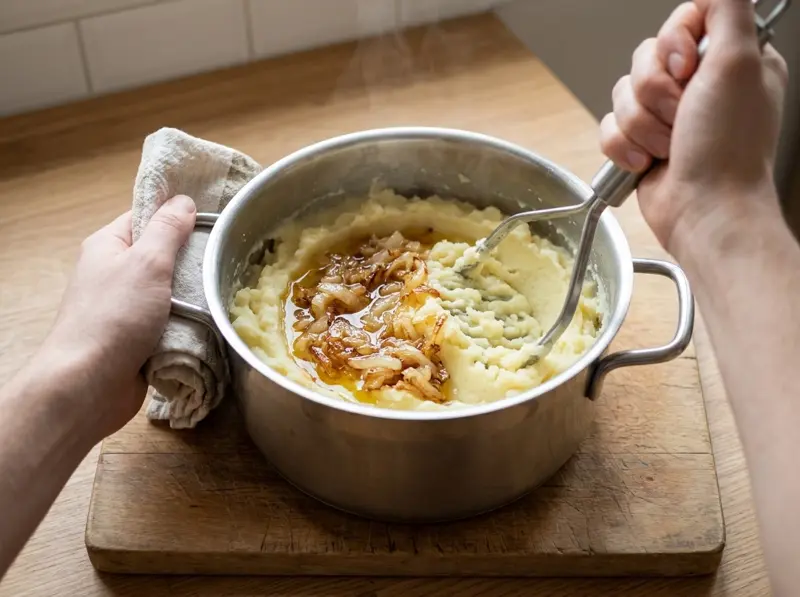
- Ladle out 50 ml of the cooking water, then drain off the rest. Mash the potatoes while they are hot until there are no lumps left. Stir in the onion with its oil, the 50 ml of cooking water, ½ tsp of salt and ½ tsp of ground black pepper. Taste and add salt if it needs it. The mash should be soft but hold its shape on a spoon, because a runny filling leaks out of the dough. Spread it in a wide dish and let it cool for about 20 minutes, until it no longer feels warm. Warm filling softens the dough, and the seam then opens in the pan. Wipe the frying pan clean with paper towel.
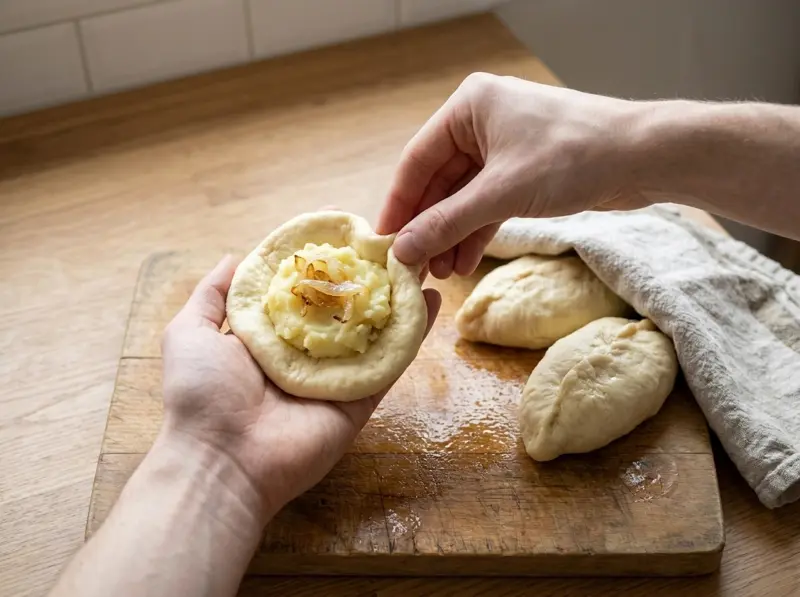
- Knock the air out of the dough. Rub the board and your hands with the last 10 ml of oil instead of flouring them, since flour on the edges stops them from sealing. Divide the dough into 16 pieces of about 55 g and roll each into a ball. Press or roll a ball into a round about 11 cm across and 5 mm thick. Put about 51 g of filling (2 heaped tablespoons) in the middle, leaving a clean 1 cm border. Lift the edges over the filling and pinch the whole seam firmly shut, then shape the pirozhok into an oval about 10 × 6 cm and flatten it slightly. Set it seam side down on the board. Shape the rest the same way, 2 cm apart, and cover them with a clean kitchen towel.
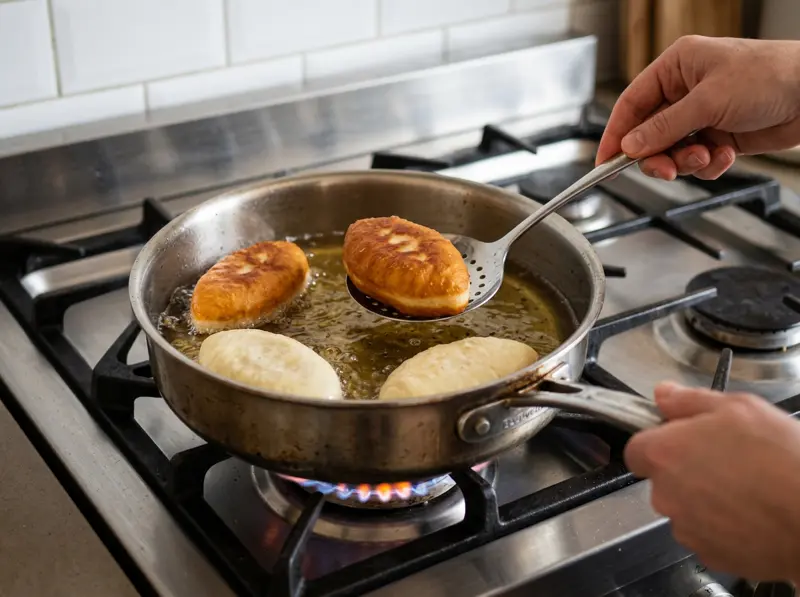
- Before you pour in the oil, put a lid that fits the pan within reach. Pour 800 ml of oil for frying into the wiped 26 cm pan. That makes a layer 1.5–2 cm deep, enough to come halfway up the piroshki. Heat it over medium heat to 170 °C, which takes about 8 minutes, while the shaped piroshki rest for 10 minutes. Without a thermometer, drop in a scrap of dough. It should sizzle at once and bubble steadily, and the oil must not smoke. Keep the piroshki and your hands dry, because water makes hot oil spit, and do not leave the stove. If the oil catches fire, cover the pan with a lid and turn off the heat. Never pour water on it.
- Lay in 4 piroshki seam side down, so the seam sets first and stays shut. Fry them over medium heat for 3 minutes, until deep golden underneath, then turn them with a slotted spoon and fry for 3 minutes more. They are done when both sides are deep golden and the piroshki have puffed up and spring back when pressed. If a side goes dark brown in less than 2 minutes, the oil is too hot and the dough will stay raw inside, so turn the heat down. Fry the rest in 3 more batches, and check with a scrap of dough that the oil is hot again before each one.
- Lift the piroshki onto a tray lined with paper towels and leave them for 5 minutes to drain. Serve them warm. Put any leftovers in the fridge within 2 hours.
FAQ
Usually the filling was too warm or too wet, or the edge never sealed. Let the mash cool until it no longer feels warm, and keep it firm enough to hold its shape on a spoon: 50 ml of cooking water is plenty for 640 g of peeled potatoes. Leave a clean 1 cm border and oil your hands and the board instead of flouring them, because flour on the edge stops the dough from sticking to itself. Pinch the seam along its whole length, then fry the piroshki seam side down first so the seam sets before you turn them.
Yes. Put the shaped piroshki seam side down on a baking tray lined with oiled baking paper, cover them and let them rise for 20 minutes while the oven heats to 180 °C. Brush them with 1 beaten egg yolk and bake at 180 °C for 20–25 minutes, until golden. The yolk means they are no longer vegan. The baked piroshki with meat on this site follow the same method, so you can use that page as a guide.
The usual causes are water at the wrong temperature or a cold, drafty spot. The water should be about 37 °C, warm on your wrist but not hot. After 10 minutes with the sugar and yeast there should be foam on top, and if there is none, the yeast is not working and the dough will not rise. Leave the dough covered in a warm place out of drafts for 1 hour, until it has doubled. Extra flour makes the dough stiff and the piroshki tough, so keep it soft and only slightly sticky.
Let them cool, then cover them and put them in the fridge within 2 hours of frying. They keep there for 3–4 days. To reheat, put them in the oven at 160 °C for 10–15 minutes, until they are hot all the way through (74 °C) and the crust is crisp again. Check the middle of one before serving.
This version is vegan. The dough is flour, water, vegetable oil, yeast, sugar and salt, and the onion for the mash is fried in oil, not butter. RussianFood.com lists lean piroshki like these as Lenten (постные). The fried piroshki with meat on this site use a richer dough with sour cream and eggs, and the baked ones use milk, butter and an egg. Some recipes stir 30 g of butter into the mash, which makes the piroshki vegetarian rather than vegan.
Keep browsing
More dishes from the Russian archive — picked by overlap with what you're cooking now.
Recipes by email
One letter a week: a recipe picked for your taste, plus whatever is new on the site. Unsubscribe in one click.
Welcome gift: Sergei's cookbook (e-book).
By subscribing you agree to the privacy policy.
Tell us what you like to cook (30 seconds) →
Join the conversation
Comments
No comments yet — be the first!