
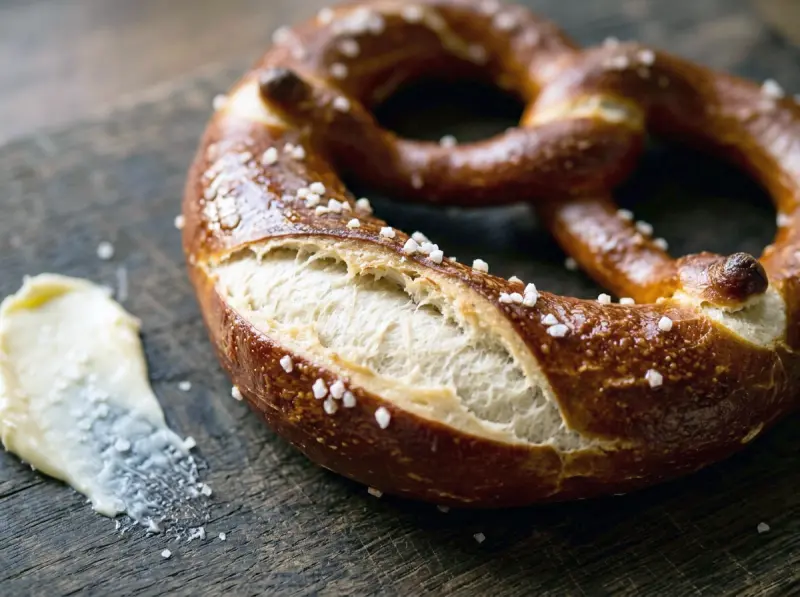
Pretzel (Brezel)
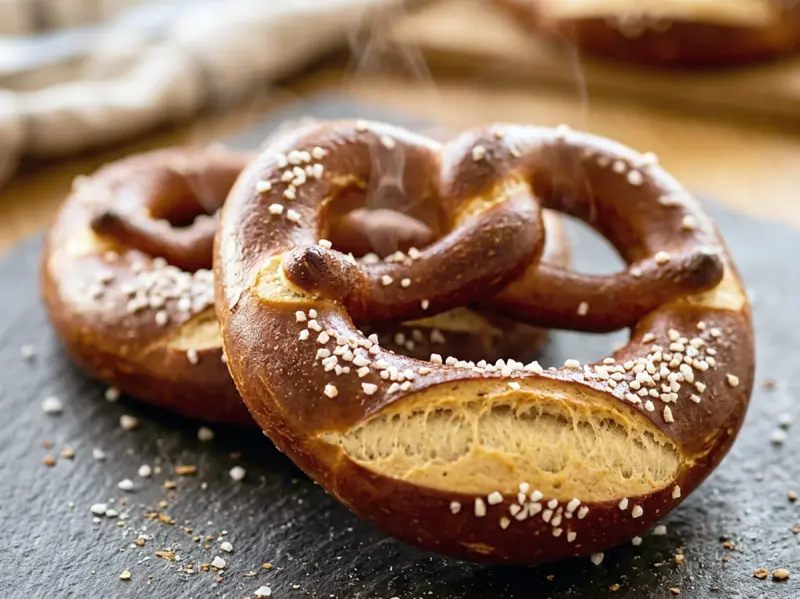
A pretzel (German Brezel, Laugenbrezel) is a knot of yeast dough from southern Germany and Austria, dipped in an alkaline bath before baking so the crust turns shiny mahogany brown. That bath is what gives a pretzel its dark crust and slightly bitter edge. German bakeries use food-grade lye; this recipe uses baked baking soda, a home alternative with a higher pH than regular baking soda. The belly is thick and soft; the twisted arms are thin and chewy-crisp. Hands-on work takes about 55 minutes. The baking soda needs an hour in the oven (it can bake while the dough rises), the dough rises for 1 hour and chills for 30 minutes, so allow about 2 hours 40 minutes from start to finish. Served warm, spread with butter, with a cold beer.
Ingredients
- 500 gbread flour or plain flour
- 7 ginstant or active dry yeast
- 1 tspfine salt
- 1 tspsugar
- 300 mlwarm water
- 30 gunsalted butter
- 100 gbaking soda
- 1 lwater
- 2 tbspcoarse pretzel salt or flaky sea salt
Method
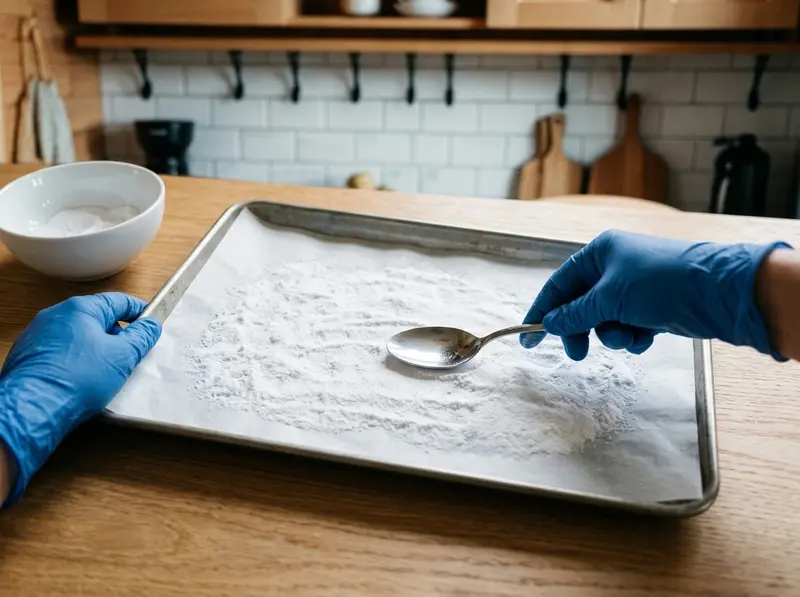
- Bake the baking soda (do this first). Spread the baking soda on a tray lined with baking paper and bake at 120°C for 1 hour. This converts sodium bicarbonate into sodium carbonate, a stronger alkali that gives pretzels a darker crust and more authentic flavor than regular baking soda. Cool and store in an airtight jar. Wear gloves when handling it: sodium carbonate irritates the skin.
- Make the dough. Dissolve the yeast and sugar in the warm water and leave for 5 to 10 minutes until foamy. Combine the flour and salt in a large bowl. Add the yeast mixture and softened butter. Knead by hand for 8 to 10 minutes, or with a stand mixer for 5 to 6 minutes, until the dough is smooth, elastic, and slightly tacky — not sticky. It should spring back when poked. Cover and let rise in a warm place for 1 hour until doubled.
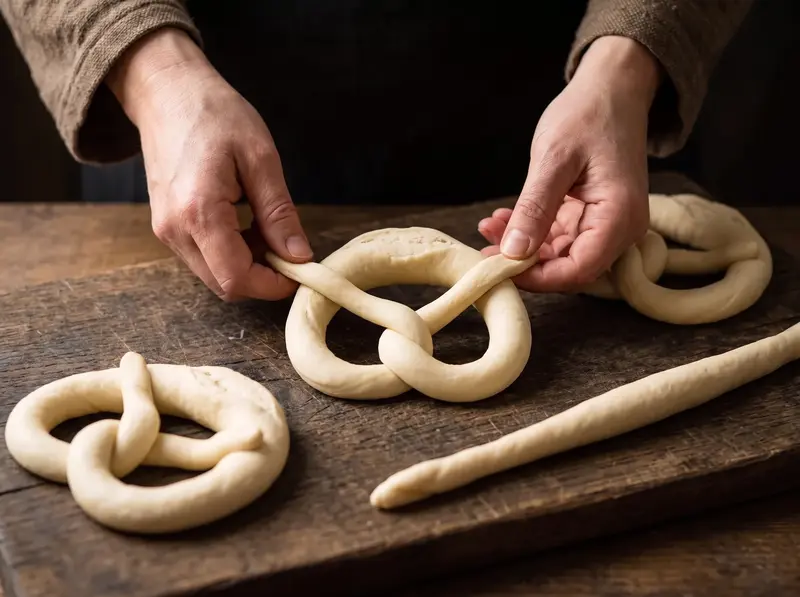
- Shape the pretzels. Turn the risen dough out and divide into 8 equal pieces (about 100 g each). Roll each piece into a rope about 50 cm long — thicker in the middle, much thinner at the ends. To shape: form a U, cross the two ends over each other twice creating a twist, then bring the twisted ends down and press firmly onto the bottom curve of the U. Place on oiled baking paper. Refrigerate uncovered for 30 minutes — this firms the dough so it holds its shape in the bath. Preheat the oven to 220°C while they chill.
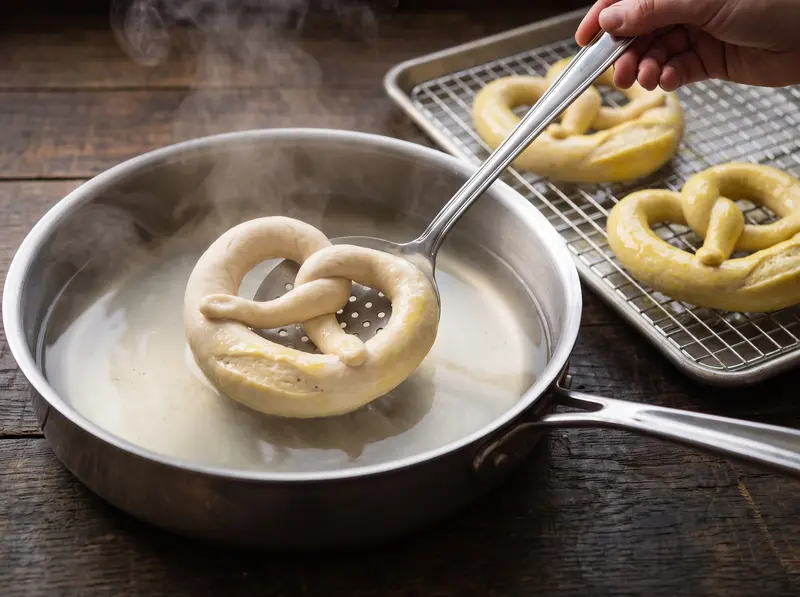
- Dip in the alkaline bath and bake. Dissolve the baked baking soda in 1 liter of boiling water in a wide, stainless steel or ceramic pan (do not use aluminium — the alkali will react). Wearing gloves, lower the pretzels into the bath one at a time with a slotted spoon, gently, so the hot alkaline water doesn't splash, and leave each for 20 to 30 seconds per side. Transfer to a lined, oiled baking tray. Score the thick belly of each pretzel with a sharp knife or blade — a deep horizontal slash that will open during baking. Sprinkle generously with coarse salt. Bake for 12 to 15 minutes until a deep mahogany brown.
- Serve warm. Transfer to a wire rack for 5 minutes. Pretzels are best eaten within 2 hours of baking, while the crust still has crackle. To serve in the Bavarian style: cut horizontally through the belly and spread generously with cold, salted butter. Do not store in a plastic bag — the salt draws moisture and the crust softens. A paper bag or cloth for up to one day.
FAQ
The alkaline bath is the entire reason a pretzel tastes like a pretzel rather than a dinner roll made from identical dough. It changes the surface of the dough so that it browns fast and deep in a hot oven, which gives the shiny mahogany crust and the slightly bitter flavor you only get from a pretzel. Bake the same dough without the bath and you get a nice soft roll, but not a pretzel. The stronger the alkali (baked baking soda is stronger than regular baking soda, food-grade lye is stronger still), the darker and more intense the result.
Regular baking soda (sodium bicarbonate): pH ~8. Produces light browning and a faint pretzel note. The most accessible option. Baked baking soda (sodium carbonate): pH ~11. Achieved by baking baking soda for 1 hour at 120°C. Produces noticeably darker, more authentic pretzels. The best practical home option. Food-grade lye (sodium hydroxide): pH 13 to 14. The traditional professional method, and it gives the deepest mahogany crust and the most intense pretzel flavor. Bakers use it as a 3–4% solution and work in rubber gloves and goggles, because even at that strength it burns skin and eyes. Once baked, the crust is safe to eat. This recipe doesn't use lye.
Roll the dough rope to about 50 cm, thicker in the middle, much thinner at the ends. The thin ends are what become the twisted arms; the thick middle is the soft belly. Lay the rope in a U shape. Take the two ends, cross them over each other away from you, then cross them again — this creates the double twist. Bring the two twisted ends down and press them firmly onto the bottom curve of the U at roughly the 4 o'clock and 8 o'clock positions. The pretzel should look symmetrical from above. The shaping takes practice; the first two will look wrong and the rest will improve quickly. Chilling the shaped pretzel before the bath firms it and makes it easier to transfer without losing the shape.
Scoring creates a controlled weak point in the thick belly where the pretzel will open as it bakes. Without scoring, the belly expands randomly during baking and the surface cracks unevenly. A deep slash across the belly ensures it opens into a clean split — this is the visual signature of a proper German Brezel and also affects texture, as the scored interior stays softer and more open while the scored edge crisps. The slash should be confident and deep, made with a sharp knife or blade just before the salt goes on and the pretzels go into the oven.
The coarse salt on the surface is hygroscopic: it draws moisture from the air and transfers it into the crust. This is why a pretzel stored in a plastic bag turns completely soft within a few hours. Wrap in a paper bag or loose cloth instead, which allows moisture to escape. Pretzels are at their best within 2 hours of baking. After that, reheat in a preheated oven at 200°C for 5 minutes — this revives the crust. Do not microwave, which steams the pretzel and destroys what little crispness remains. Day-old pretzels, while softer, are still delicious buttered and are excellent as bread for a Bavarian Obazda (cheese spread) sandwich, and they go well with bratwurst.
Keep browsing
More dishes from the German archive — picked by overlap with what you're cooking now.
Recipes by email
One letter a week: a recipe picked for your taste, plus whatever is new on the site. Unsubscribe in one click.
Welcome gift: Sergei's cookbook (e-book).
By subscribing you agree to the privacy policy.
Tell us what you like to cook (30 seconds) →
Join the conversation
Comments (3)
Die Natronlauge macht mir ehrlich gesagt etwas Angst. Hab stattdessen Natron im Wasser aufgelöst, Ergebnis ist ok aber nich so dunkel wie beim Bäker
Super Rezept! Die Laugenbrezel sind fast wie vom Bäcker geworden. Nur die Form muss ich noch üben haha
Frage an die community: benutzt ihr wirklich Natronlauge oder geht auch Backpulver im Wasser? Ich hatte Angst vor der Lauge und hab Natronlösung genommen. Das Ergebnis war okay aber nicht so dunkel wie beim Bäcker.