
Ribollita (Tuscan Reboiled Bread and Bean Soup)
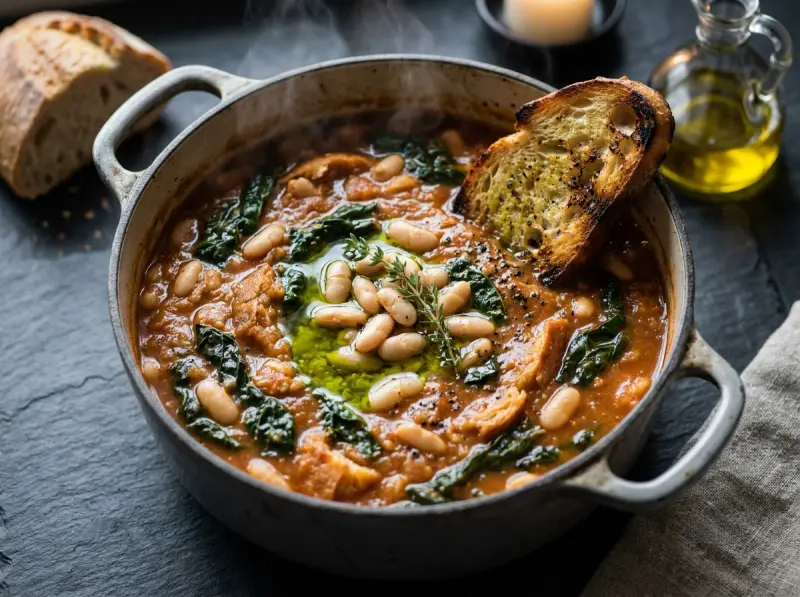
Ribollita is a thick Tuscan soup of cannellini beans, cavolo nero (black kale), and stale bread — one of the central symbols of cucina povera (peasant cooking). The name means 'reboiled' (from the Italian ribollire), and that is the whole point of the dish: it is born from leftovers. Tuscan peasants would cook a simple vegetable soup called minestra early in the week, then the next day reheat what remained with the addition of stale bread, turning minestra into ribollita. The paradox of the dish is that it gets better the longer it sits and the more times it is reboiled. On day one it is still a brothy minestra di pane; on day two, after reboiling, it becomes true ribollita — dense and almost semi-solid. Its roots reach back to the Middle Ages in the plain of Pisa and the lands of Arezzo and Florence, where it was the main winter nourishment of the poorest. The three non-negotiable elements are cannellini beans, cavolo nero, and saltless Tuscan bread (pane sciocco), which stales within a day. By tradition the cavolo nero should have 'taken the frost,' which makes its leaves sweeter and more tender. Key techniques: blend half the beans for a creamy base without any cream, tear the stale bread by hand, and use potato plus bread as a double thickener until the soup is dense enough to serve almost on a plate. Yields 6 servings in about 2 hours of active and simmering time. Best the next day, served hot over garlic-rubbed toast with a generous pour of extra virgin olive oil and a glass of Chianti.
Ingredients
- 250 gcannellini beans
- 300 gcavolo nero
- 200 gSavoy cabbage
- 250 gstale bread
- 2 potatoes
- 1.5 yellow onion
- 2 carrots
- 2 celery stalks
- 4 clovesgarlic
- 400 gcanned whole tomatoes
- 1.5 lvegetable broth
- 5 tbspextra virgin olive oil
- 1 sprigrosemary
- 2 sprigthyme
- 1 tspsalt
- 0.5 tspblack pepper
Method
- Soak and cook the beans. The night before, cover 250 g dried cannellini beans with plenty of cold water and soak overnight. (If short on time, use the quick method: pour boiling water over them and let stand 1 hour.) Drain, then simmer in fresh salted water with half an onion, a clove of garlic, and a sprig of thyme for about 45 minutes, until just tender but not falling apart. Half an onion and one clove of garlic from the ingredient list go here; the rest goes into the soffritto. Drain, reserving the cooking liquid — that starchy water is liquid gold and goes back into the soup. If using canned beans, use 2 cans (about 800 g drained) and skip this step, but you lose the bean broth.
- Build the soffritto. Finely chop 1 onion, 2 carrots, and 2 celery stalks. Heat 4 tablespoons of extra virgin olive oil in a large heavy pot over medium heat and add the chopped vegetables with a pinch of salt. Cook for 8-12 minutes, stirring often, until soft and starting to take on golden color and a browned patina forms on the bottom of the pot. This fond is the flavor foundation. Add 3 cloves of minced garlic and the rosemary in the last minute, until fragrant.
- Add tomatoes and potatoes. Crush 400 g of canned whole tomatoes by hand and add them to the pot with their juices, along with 2 peeled and diced potatoes. Season with salt and pepper and cook for 5 minutes, stirring, so the tomatoes lose their raw edge and the soffritto and tomato meld. The potato is not just for flavor — it is a second thickener that, together with the bread, gives ribollita its dense, semi-solid texture.
- Add the greens. Strip the cavolo nero leaves from their tough stems and chop roughly (300 g). Shred half a small Savoy cabbage (200 g). Add both to the pot — they will look like too much, but they wilt down dramatically. Stir for 4-5 minutes until the greens collapse into the soup.
- Blend half the beans, then build the soup. Blend half the cooked cannellini beans with 2 cups of their reserved cooking liquid (or broth) until smooth — this creates the velvety base without any cream. Add the bean purée and the remaining whole beans to the pot, along with the thyme. Pour in enough vegetable broth (about 1.5 litres total liquid) to cover everything generously — you need plenty, because the bread will soak up a lot. Bring to a boil, lower the heat, cover, and simmer for about 1 hour 30 minutes, adding water if it gets too thick.
- Add the bread (day one). Tear 250 g of stale saltless bread into rough chunks by hand — do not cut it with a knife, torn bread dissolves better into the soup. Stir the bread into the pot and simmer 10-15 minutes more, until it begins to break down. At this point you have minestra di pane — a brothy bread soup that is already good. Taste and adjust salt and pepper. You can eat it now, but for true ribollita, do the next step.
- Reboil (day two). Let the soup cool, then refrigerate overnight. The next day the flavors will have deepened and the bread will have thickened the soup considerably. Reheat over medium heat, adding water or broth to loosen it back to a soupy (or thick semi-solid) consistency to your liking, and let it come back to a gentle boil — this is the ribollire, the reboiling that gives the dish its name and its character. Taste and re-season; reboiled soup often needs a little more salt.
- Serve. Place a slice or two of toasted bread rubbed with raw garlic in the bottom of each bowl, then ladle the hot ribollita over it. Finish each bowl with a generous pour of good extra virgin olive oil — ideally a peppery Tuscan one — and a few grinds of black pepper. The olive oil is not optional; it is part of the dish. Serve hot, with extra garlic toasts on the side for crunch, and a glass of Chianti. For very thick leftovers, form patties and pan-fry them in olive oil to make ribollita refritta.
FAQ
Ribollita is a thick Tuscan soup of cannellini beans, cavolo nero (black kale), and stale bread, one of the main symbols of cucina povera (peasant cooking). The name translates literally as 'reboiled' (from the Italian ribollire), and that is no accident but the essence of the dish: ribollita is born from leftovers. Originally, Tuscan peasants cooked a simple vegetable soup called minestra at the start of the week, and the next day reheated what was left with the addition of stale bread — so minestra became ribollita. The paradox of the dish is that it becomes tastier the longer it sits and the more times it is reboiled. On the first day it is still a minestra di pane (a brothy bread soup); on the second day, after reboiling, it becomes true ribollita. History: the roots reach back to the Middle Ages, in the plain of Pisa and the lands of Arezzo and Florence. It was the main food of the poorest layers of the Tuscan population — a winter, warming, filling dish, a direct descendant of vegetable-and-bread soup. Cucina povera role: ribollita is a model of the 'waste nothing' philosophy, where even stale bread (and Tuscan pane sciocco is saltless, so it stales within a day) becomes the base of a new dish. By tradition the cavolo nero should have 'taken the frost' (preso il ghiaccio) — a light winter frost makes the leaves sweeter and more tender. Regional context: ribollita is a Florentine-Tuscan dish, related to other Tuscan bread soups (pappa al pomodoro, panzanella). There is no single 'official' recipe — every nonna has her own, and the composition was determined by whatever was on hand. But three elements are non-negotiable: cannellini, cavolo nero, and saltless bread. A curious detail: in enotecas (wine bars) you can find ribollita refritta — leftover ribollita so thick it is pan-fried in olive oil like a pancake.
An authentic ribollita rests on three mandatory elements plus a vegetable base. For 6 servings: a soffritto (1 onion + 2 carrots + 2 celery stalks), 3 cloves garlic, 400 g cannellini beans (or 250 g dried, soaked overnight), 300 g cavolo nero, half a small Savoy cabbage, 2 medium potatoes, 400 g tomatoes (canned whole, hand-crushed), 200-250 g stale bread, 1.2-1.5 l vegetable broth, rosemary and thyme, extra virgin olive oil. The three irreplaceable elements: (1) Cannellini — white beans with a creamy texture. Blend half (creates a velvety base without cream), keep half whole (texture). Better from dried, soaked overnight, but quality canned is a working substitute. Substitutes: any white bean (great northern, navy) or borlotti. (2) Cavolo nero (black/Tuscan kale, also lacinato/dinosaur kale) — dark almost-black dense leaves, mandatory for authenticity. Substitutes: curly kale, chard, Savoy cabbage. Spinach does not work — too delicate, it disintegrates. (3) Stale saltless bread (pane sciocco) — torn by hand into chunks. Substitutes: country bread, ciabatta, sourdough baguette. If the bread is fresh, dry it in a 180C oven for 10-20 minutes. Tuscan locals argue that non-saltless bread changes the flavor and texture, but in practice rustic bread works. Additional: potato is not for flavor but a second thickener (with the bread it gives the semi-solid consistency). Tomatoes — San Marzano or canned whole, hand-crushed for rustic texture. What NOT to add: pasta (this is not minestrone), cream (the creaminess comes from the bean purée), low-quality bouillon cubes. Broth-to-solids ratio — you need plenty of liquid, because the bread will soak up a large part. Samin Nosrat notes in 'Salt Fat Acid Heat' that her favorite Tuscan ribollita is so thick it is served on a plate, not in a bowl.
Reboiling (ribollire) is not a marketing gimmick but the defining technique of the dish, written into its very name. What happens during reboiling: (1) The flavor deepens — overnight in the fridge the vegetables, beans, herbs, and olive oil exchange aromas and the soup matures. Every source agrees unanimously: ribollita is noticeably better on the second day. (2) The texture thickens — the bread and bean purée keep binding the liquid, turning the brothy minestra of day one into a dense, almost semi-solid ribollita. (3) The bread fully dissolves into the base, releasing starch and creating the characteristic porridge-like velvetiness. Two-day method: Day 1 — cook the vegetable-and-bean soup (minestra), which is already edible but still brothy. Cool and refrigerate overnight. Day 2 — layer stale bread and soup in a pot (bread-soup-bread), bring back to a boil and simmer — this is ribollita, reboiled. Can you eat it right away? Yes — on day one it is an honest minestra di pane (bread soup), perfectly good. But purists (both Ciao Toscana and Great Italian Chefs) insist the true character emerges only after resting and reheating. Modern cooks sometimes skip the wait for convenience, claiming the difference is minimal — this is an ongoing debate. Practical tip: if you cook in advance, this is the ideal dish. Make a big batch, eat it all week, it gets better each day. Important when reheating: bread and beans keep absorbing liquid, so add water or broth when reheating and adjust the salt to keep a soup consistency rather than paste. Storage: up to 5 days in the fridge, up to 3 months in the freezer.
Tuscany is the homeland of a whole family of cucina povera bread and vegetable soups, and they are easy to confuse. Ribollita vs minestra di pane: this is the same dish at different stages. Minestra di pane (bread soup) is day one, more brothy. Ribollita is the same soup reboiled the next day, thick. Ribollita vs minestrone: minestrone is a pan-Italian vegetable soup, often with pasta or rice, stays brothy, eaten right away. Ribollita is specifically Tuscan, without pasta, thickened with bread and beans, reboiled. Minestrone is more varied in vegetables; ribollita strictly requires cavolo nero and cannellini. Ribollita vs pappa al pomodoro: both Tuscan, both on stale bread, but pappa al pomodoro is tomato-based (tomatoes + bread + basil + garlic), summery, simpler, porridge-like; ribollita is bean-and-cabbage-based, wintery, multi-component. Ribollita vs panzanella: panzanella is a cold summer salad of stale bread, tomatoes, and cucumber (not a soup). The only thing in common is using up stale bread. Ribollita vs acquacotta: acquacotta ('cooked water') is an even poorer Tuscan-Maremma soup of water, bread, and egg, without beans. Ribollita refritta: not a separate soup but a way to finish leftovers — ribollita so thick it is pan-fried in olive oil like a pancake (found in wine bars). Regional relatives: in Campania the equivalent would be made with friarielli (rapini) instead of cavolo nero; in Garfagnana there is minestra di farro (with spelt); Lombardy's zuppa alla pavese is a different principle (broth + egg + bread). The key difference of ribollita: precisely the reboiling (ribollire) and the mandatory trio of cannellini + cavolo nero + saltless bread make it recognizable and set it apart from all its neighbors.
Ribollita is a winter, warming dish, and the serving underlines its rustic essence. How to serve: (1) Classically — ladled into a bowl (or, per Samin Nosrat, even onto a plate, it is so thick) over a base of 1-2 slices of toasted bread rubbed with garlic. (2) The mandatory finish — a generous pour of quality extra virgin olive oil straight into the bowl (ideally Tuscan, which is sharp and peppery) and freshly ground black pepper. This is not optional but part of the dish. (3) Optionally — grated Parmesan or pecorino romano on top (skip for the vegan version — the creaminess is there from the beans), chili flakes for heat, separate garlic toasts on the side for crunch (a textural contrast to the soft soup). Temperature: hot, especially in cold weather. What to pair (wine): a simple Tuscan red — Chianti, Montepulciano, or Sangiovese. Their acidity and tannins balance the earthy, rich base of the soup. Contrast: a small arugula salad with lemon dressing gives a bright fresh counterpoint to the heavy, earthy soup. Seasonality: ribollita is an autumn-winter dish. Cavolo nero is best after the first frosts (sweeter, more tender). In summer Tuscans switch to cold panzanella and pappa al pomodoro. Storage: (a) Fridge — up to 5 days in an airtight container; the flavor improves for the first 2-3 days. (b) Freezer — up to 3 months. (c) When reheating, the bread soaks up liquid — add water or broth and adjust salt to bring back a soup consistency. (d) Ribollita refritta — for very thick leftovers: form a 'patty' and pan-fry in olive oil until crusted (the Tuscan way to finish it). Key rule: do not rush it. Ribollita is a hymn to slow food and thrift, a dish that rewards patience.
Keep browsing
More dishes from the Italian archive — picked by overlap with what you're cooking now.
Recipes by email
One letter a week: a recipe picked for your taste, plus whatever is new on the site. Unsubscribe in one click.
Welcome gift: Sergei's cookbook (e-book).
By subscribing you agree to the privacy policy.
Tell us what you like to cook (30 seconds) →
Join the conversation
Comments
No comments yet — be the first!