
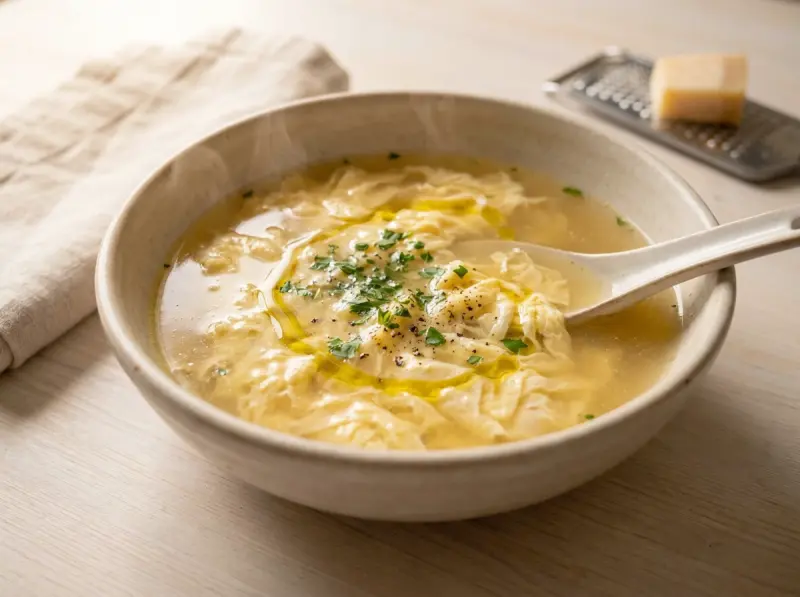
Stracciatella alla Romana (Roman Egg Drop Soup)
Stracciatella alla romana is a Roman egg drop soup: hot chicken or meat broth into which a mixture of beaten eggs and grated Parmigiano-Reggiano is streamed, forming delicate little 'rags' of egg. It is the Italian version of egg drop soup, but unlike the Chinese one, which is often thickened with cornstarch, the Italian stays clear and brothy — the richness comes from the egg and cheese themselves. The name comes from straccetti or stracce, meaning 'little rags,' an apt description of how the beaten egg looks when it hits the simmering broth and breaks into tiny clouds. It is a first course (primo) of the Roman tradition and of central Italy more broadly, especially Marche and Abruzzo. Despite humble peasant origins, today stracciatella often opens holiday banquets at Easter and Christmas, and it is the classic comfort food many Italians remember their grandmother making at the first sign of a cold. The single technical key is heat: the broth must be at a gentle simmer, never a rolling boil, or the egg scrambles into clumps instead of forming silky rags. Stream the egg-and-cheese mixture slowly into the swirling broth, stirring in one direction. Authentic alla romana contains zero semolina — that is a northern variation that turns the delicate rags into porridge. Salt goes in at the very end because Parmigiano already brings its own. Four ingredients, ready in about 15 minutes, served immediately with olive oil, pepper, and parsley.
Ingredients
- 1 lchicken broth
- 2 eggs
- 40 gparmesan
- 1 pinchnutmeg
- 0.5 tspblack pepper
- 1 tbspparsley
- 1 tbspextra virgin olive oil
Method
- Bring the broth to a gentle simmer. Pour about 1 litre of good chicken or meat broth into a saucepan and warm it over medium heat until it reaches a gentle simmer — tiny bubbles only at the edges, the surface almost still. The quality of the broth carries the whole dish, since there are so few ingredients, so use homemade if you can. Just before adding the egg, lower the heat to its lowest setting; a rolling boil is the single thing that ruins this soup.
- Make the egg-and-cheese mixture. While the broth heats, crack 2 eggs into a bowl and add 40 g of finely grated Parmigiano-Reggiano, a pinch of freshly grated nutmeg, and a few grinds of black pepper. Whisk thoroughly until completely smooth and homogeneous, with no lumps. Room-temperature eggs blend in more evenly. Hold off on salt — the Parmigiano brings plenty of its own, and you can adjust at the end.
- Stream in the egg, stirring in one direction. With the broth at its lowest simmer, slowly pour the egg-and-cheese mixture into the pot in a thin stream while stirring the broth continuously in a single direction with a whisk or wooden spoon. The egg sets on contact with the hot broth and breaks into the little rags that give the soup its name. The broth will look cloudy at first but clears as it warms.
- Choose your texture. Stir vigorously with a whisk for fine, wispy threads and a cloudier soup; stir slowly with a spoon for larger, softer egg flakes. Both are correct — it is purely a matter of taste. Let the soup simmer gently for 1 to 2 minutes more so the egg cooks through, without ever letting it come to a hard boil.
- Season and serve. Taste and add salt only if needed — remember the cheese. Ladle the hot soup into bowls and finish each with a drizzle of extra virgin olive oil, a little more black pepper, a scattering of minced parsley, and extra grated Parmigiano if you like. Add the parsley only now, at serving — stirring it in during cooking turns the broth muddy. Serve immediately; stracciatella does not wait.
FAQ
Stracciatella alla romana is a Roman egg drop soup: hot meat or chicken broth into which a mixture of beaten eggs and grated Parmigiano-Reggiano is streamed, forming delicate little rags of egg. It is the Italian version of egg drop soup, but unlike the Chinese one, which is often thickened with cornstarch, the Italian stays clear and brothy — the richness comes from the egg with cheese itself. Name: stracciatella comes from the Italian straccetti / stracce, meaning 'little rags.' It is an apt description of how the beaten egg looks when it hits the boiling broth, breaking into many little clouds that resemble tiny torn rags. Important not to confuse: in Italy the word stracciatella also names a gelato (with chocolate shavings — 'rags' of chocolate, not egg), a cheese (the soft heart of burrata), and a Roman beef dish, straccetti. When ordering the soup in Italy, specify. History and place: stracciatella is a first course (primo) of the Roman tradition and of central Italy as a whole, especially the regions of Marche and Abruzzo. Despite humble peasant origins, today stracciatella cannot be missing from the tables of central Italy at the most important holidays — it often opens holiday banquets at Easter and Christmas. It is a classic comfort food: light, warming, nourishing, gentle on the stomach. Many Italians remember their grandmothers making stracciatella at the first sign of a cold or cough — 'the broth that heals.' Related dishes: in Emilia-Romagna there is Minestra del Paradiso (Paradise Soup) — similar but with added breadcrumbs and thicker; Zuppa Imperiale (Lazio) or Pasta Reale (Marche) — based on broth, eggs, and cheese, but with semolina, where the egg mixture is first baked, cut into cubes, and dropped into the broth; Passatelli, of the same origin. In Sicily there is a more elaborate relative, sciusceddu.
Basic stracciatella is just four ingredients: broth, eggs, grated Parmigiano-Reggiano, and pepper. Proportions (for 4 servings): about 1 litre (4 cups) of good chicken or meat broth, 2 eggs (the rule is 1 egg per 2 cups / ~500 ml of broth, or roughly one egg per person for a heartier version), 30-40 g grated Parmigiano per egg (about a third of a cup for 2 eggs). Optional flavorings: a pinch of nutmeg, freshly ground black pepper, grated lemon zest (a Lazio/Marche regional touch), minced parsley for serving. Do you need semolina? Absolutely not — for authentic alla romana. Semolina is a northern variation that turns the delicate rags into a porridge-like texture. Real Roman stracciatella has zero semolina — the whole point is the egg-and-cheese ribbon effect. Dishes with semolina are different recipes: Minestra del Paradiso (Emilia-Romagna, with breadcrumbs), Zuppa Imperiale / Pasta Reale (with baked egg and semolina). They share the same origin but they are not stracciatella. Choice of broth: since there are only four ingredients, the quality of the broth is everything. Homemade chicken or meat broth gives a depth that store-bought will not. If you use store-bought, choose the best. Salt: add at the very end and cautiously — Parmigiano already brings its own salt and it is easy to over-salt. Cheese: only real Parmigiano-Reggiano, finely grated (for smooth incorporation). Some add a little pecorino for sharpness, but the classic is pure Parmigiano.
This is the only technically important moment in stracciatella, and most mistakes happen here. The main rule: the broth must be at a GENTLE simmer, not a rolling boil. If the broth boils hard, the egg sets instantly into clumps and you get scrambled egg in broth instead of delicate threads. The broth should 'barely shiver' — tiny bubbles only at the edges, the surface almost still. Before streaming in the egg, lower the heat to its minimum. Step by step: (1) Bring the broth to a gentle simmer, then lower it to the lowest setting. (2) In a bowl, whisk the eggs with grated Parmigiano, pepper, and (optionally) nutmeg and lemon zest until completely smooth — no lumps. Room-temperature eggs blend better. (3) Slowly stream the egg-and-cheese mixture into the broth in a thin stream while stirring the broth in one direction (with a whisk or wooden spoon). (4) The egg sets on contact with the hot broth, forming the rags. Texture is a matter of taste: vigorous whisking gives fine, thin threads (a more 'cloudy' texture); slow stirring with a spoon gives larger, softer flakes. (5) Let the soup simmer 1-2 minutes more. The soup is cloudy at first but clears as it warms. Main mistakes: too much heat (scrambled egg); pouring all the egg in at once without stirring (big clumps); adding parsley during cooking (muddies it — add only at serving). Recovery: if large clumps form when reheating leftovers, break them up with a wooden spoon, without bringing it back to a boil.
Egg soups exist in many cultures, but stracciatella is unique in technique and flavor. Stracciatella vs Chinese egg drop soup: the Chinese soup is often thickened with cornstarch (a thicker, silkier texture) and the egg is streamed in a thin ribbon into swirling broth. Italian stracciatella stays clear and brothy — no cornstarch, the richness comes from egg with grated Parmigiano (not in the Chinese version). The cheese is the key difference, giving a salty, nutty depth. Stracciatella vs the Indian version: the Indian egg soup often includes tomatoes and spices. Stracciatella vs Greek avgolemono: the Greek egg-lemon soup uses raw egg beaten with lemon juice, tempered into the broth for a creamy, un-curdled texture — there the egg does not form rags but thickens the soup to velvetiness. Stracciatella, by contrast, deliberately lets the egg curdle into threads. Stracciatella vs its Italian relatives: Minestra del Paradiso (Emilia-Romagna) is thicker, with breadcrumbs; Zuppa Imperiale / Pasta Reale bake an egg-and-semolina mixture first, cut it into cubes, then drop them into the broth (a completely different texture); Passatelli push an egg-cheese-breadcrumb dough into the broth as little 'worms'; sciusceddu (Sicily) is more elaborate, with meatballs and ricotta. The key difference of stracciatella: precisely the combination of clear broth + egg + Parmigiano + the forming of delicate rags (no cornstarch, no semolina, no lemon thickening) makes it recognizable. It is the simplest, purest egg soup in the world — Rome in a bowl.
Stracciatella is a 'here and now' dish, and the serving underlines that. How to serve: (1) Immediately, hot — this dish does not wait. Ladle into bowls, add a drizzle of extra virgin olive oil, freshly ground pepper, minced parsley, and (optionally) a little more grated Parmigiano. (2) As a primo (first course) before a meat second — especially at Easter before the roast lamb: stracciatella is light and leaves room for the main. (3) As a standalone light supper, when you are not very hungry or feeling unwell. Storage: stracciatella should not be frozen and is best eaten right away. Leftovers keep up to 1 day in the fridge in a covered container. When reheating, the egg clumps together — break up the clumps with a wooden spoon and only warm it through, NOT to a second boil (re-boiling makes the egg rubbery). Variations: (a) Vegetarian — use a quality vegetable broth instead of chicken (choose Parmigiano made with microbial/vegetable rennet). (b) With greens — add tender kale or spinach to the broth (kale, simmer until soft first; spinach, 30-60 seconds before the end). (c) Pastina stracciatella — add small pasta (stelline, ditalini) to the broth for a heartier version, the Italian 'chicken noodle soup' for children and the unwell. (d) Lemon — more zest in the egg mixture plus a squeeze of lemon juice at the finish (a bright Lazio/Marche variant). (e) With pecorino — replace part of the Parmigiano with pecorino for a sharper, saltier flavor. What to serve with: crusty bread, a glass of light white (Frascati from Lazio), or simply as is — it is a self-sufficient, healing soup. Key principle: simplicity. Do not complicate or overload it — stracciatella is beautiful precisely for its minimalism.
Keep browsing
More dishes from the Italian archive — picked by overlap with what you're cooking now.
Recipes by email
One letter a week: a recipe picked for your taste, plus whatever is new on the site. Unsubscribe in one click.
Welcome gift: Sergei's cookbook (e-book).
By subscribing you agree to the privacy policy.
Tell us what you like to cook (30 seconds) →
Join the conversation
Comments
No comments yet — be the first!