
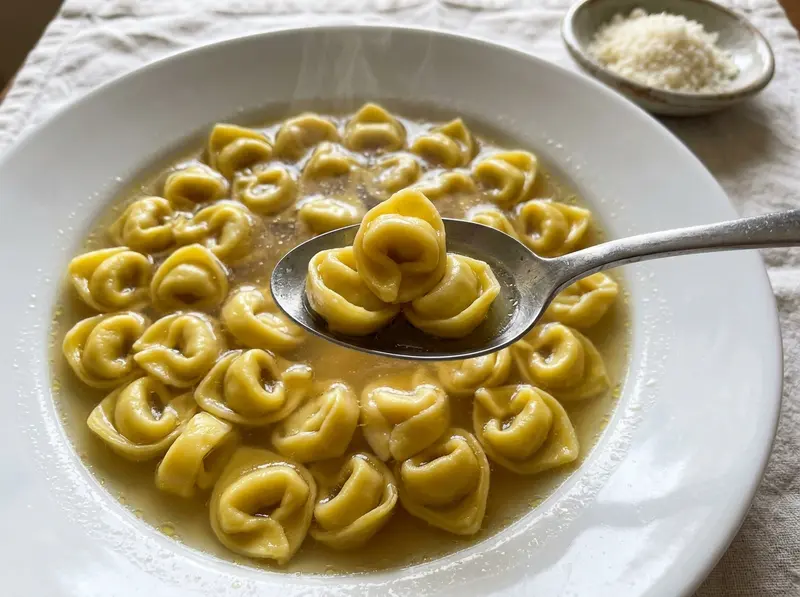
Tortellini in Brodo (Bologna's Filled Pasta in Broth)
Tortellini in brodo are small rings of fresh egg pasta filled with pork loin, prosciutto, mortadella and Parmigiano Reggiano, cooked and served in a clear broth of beef and chicken: the holiday first course of Bologna and Modena, traditionally served for Christmas lunch or New Year's Eve dinner. You will also see them called tortellini bolognesi or Tortellini di Bologna, and in dialect turtlén in Bologna and turtlèin in Modena. Bologna and Modena argued for centuries over who invented it. The filling was deposited at the Bologna Chamber of Commerce on 7 December 1974 by the Bologna delegation of the Accademia Italiana della Cucina together with the Dotta Confraternita del Tortellino, and the full recipe, dough and shape included, followed in 2008. We stay close to the registered proportions of the filling, with a little more egg, and put more of it in each tortellino than Bologna's 1,000-piece batch does; we also skip the two-day cure of the pork that the registered recipe asks for. The broth goes on first and simmers on its own for 3½ hours; the pork, the filling and the pasta all fit inside that time, so the whole dish takes about 4½ hours. Bologna's deposited recipe rests the filling for 12 to 24 hours; ours chills for an hour, or you can make it the day before and leave it in the fridge overnight.
Ingredients
- 800 gbeef brisket
- 700 gchicken
- 1 onion
- 1 carrot
- 1 stalkcelery
- 3.5 lwater
- 10 gsalt
- 70 gpork loin
- 10 gbutter
- 1 sprigrosemary
- 1 clovegarlic
- 70 gprosciutto
- 70 gmortadella
- 120 gparmesan
- 3 eggs
- 0.125 tspnutmeg
- 240 gflour
- 1 tbspwater
- 1 tbspflour
Method
- Start the broth. Put the 800 g of bone-in beef brisket and the 700 g of chicken (half a bird, legs and back with the bone; a stewing hen if you can get one) in a 6 l stockpot (8 l is better, it leaves room for the foam) and cover with 3.5 l of cold water. Bring to the boil over medium-high heat, about 25 minutes, and skim off the grey foam as it rises until the surface is clear. Add the halved onion, the carrot, the celery stalk and about 9 g (1½ tsp) of the 10 g of salt. Turn the heat to low and simmer uncovered for 3½ hours, so that only a few lazy bubbles break on the surface. Steps 2 to 6 fit inside this time if you work steadily.
- Cook the pork. While the broth simmers, cut the 70 g of pork loin into 2 cm cubes and season them with a pinch of the salt. Melt the 10 g of butter in a 20 cm frying pan over medium heat with the rosemary sprig and the smashed garlic clove. Brown the cubes, turning them, for 6 to 8 minutes, until golden on all sides. Cut the largest cube open: it should be white-beige right through with clear juices, and 71 °C in the centre if you check with a thermometer. Take out the rosemary and garlic and let the pork cool in the pan for 10 minutes. The filling is only boiled for 3 to 4 minutes inside the pasta, so the pork has to be fully cooked before it goes in.
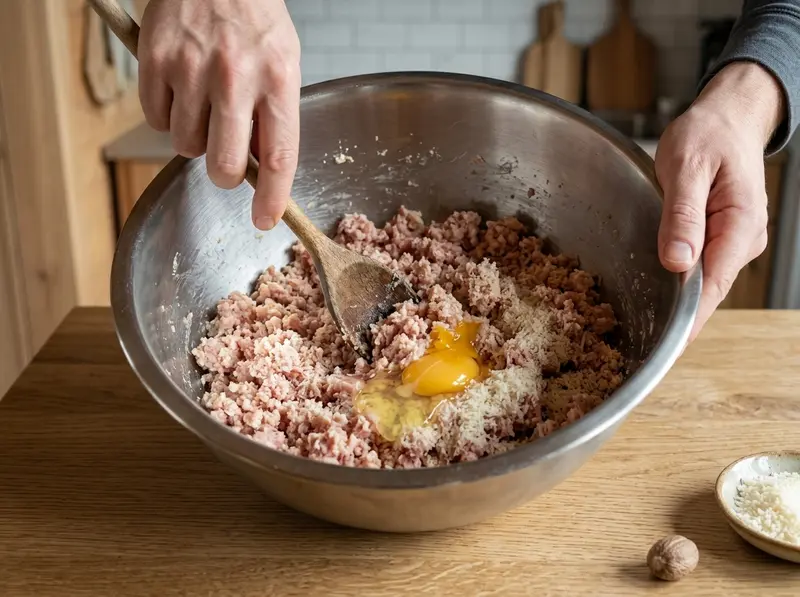
- Make the filling. Put the pork with the butter from the pan, the 70 g of prosciutto and the 70 g of mortadella (both roughly cut) in a food processor and pulse until finely chopped but not a paste; without a processor, chop them together on the board with a large knife until just as fine, as the Bologna recipe does. Tip into a mixing bowl, add 100 g of the 120 g of Parmigiano Reggiano, finely grated, 1 of the 3 eggs and ⅛ tsp of freshly grated nutmeg. Mix with a spoon or your hand until it holds together in one smooth, pink-beige mass with fine flecks and no lumps of ham. Drop a pea-size ball into the simmering broth for 1 minute and taste it: the ball should be firm, and because the cured meats are salty, add salt only if it really needs it. Cover the bowl and chill for at least 1 hour, or make the filling the day before and leave it in the fridge overnight (no longer than a day).
- Make the dough. Heap the 240 g of flour (Italian tipo 00 or plain wheat flour) on a wooden board and make a well in the middle. Break in the remaining 2 eggs, add 1 tbsp of water and a pinch of the salt. Beat with a fork, slowly drawing in the flour from the sides, then knead with your hands for 10 minutes, until the dough is smooth and elastic, not sticky, and springs back slowly when you press it. Wrap it in film and leave it at room temperature for 30 minutes.
- Roll and cut. Cut the dough into 4 pieces and keep three of them wrapped, because rolled pasta dries quickly. Dust the board with a little of the 1 tbsp of flour and roll one piece with a rolling pin into a sheet 1 mm thick, about 31 cm across. Cut it into 4 cm squares with a knife or a pastry wheel, using a ruler.
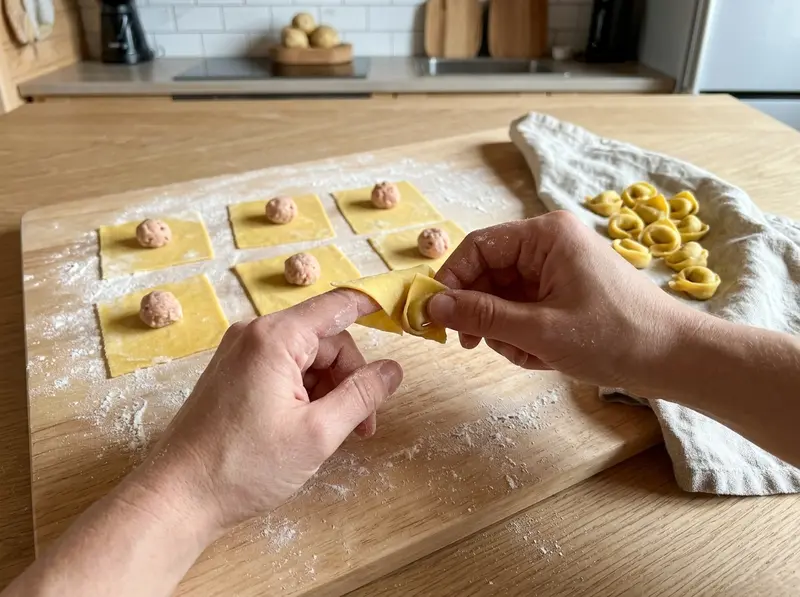
- Fill and shape. Keep the bowl of filling covered in the fridge and take out only what you need for one sheet. Put a scant ½ tsp of filling (about 2 g, a little more than a hazelnut kernel) in the centre of each square. Fold the square into a triangle, press out the air around the filling and seal the edges firmly. Wrap the triangle round your index finger, overlap the two bottom corners and press them together. You get a sealed ring with a small navel in the middle, with no air pocket and no cracks. Lay the tortellini, not touching, on a tray lined with a cloth dusted with the rest of the 1 tbsp of flour, and keep the flour on them light, because loose flour clouds the broth. Re-roll the scraps once; cut the last scraps into small pieces and keep them on the tray for the pot. Repeat with the other 3 pieces of dough. When a tray is full, let it dry for 15 minutes until the tortellini are dry to the touch, then cover it and put it in the fridge until the broth is strained. If you are not cooking them today, keep the covered tray in the fridge for up to 1 day, or freeze them on the tray until hard and then bag them for up to 3 months. Never leave them at room temperature overnight: the filling holds raw egg and cooked pork.
- Strain the broth. When the 3½ hours are up, the broth is golden and the beef is tender to a fork. Lift out the beef and the chicken and keep them for another meal (they are not part of this dish); refrigerate them within 2 hours and eat within 3–4 days. Strain the broth through a fine sieve lined with paper towel into a large bowl and discard the vegetables. You should have about 2 l of clear golden broth with no specks. Taste it for salt. Rinse the stockpot, pour the broth back in and bring it to the boil over high heat.
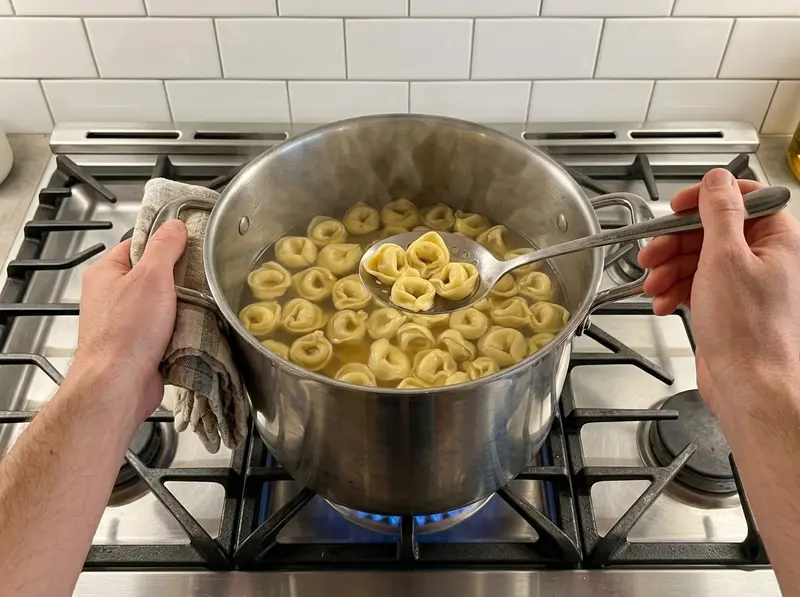
- Cook and serve. Take the tortellini and the scrap pieces out of the fridge, drop them all into the boiling broth over high heat and stir once. As soon as it boils again, turn the heat to medium and cook for 3 to 4 minutes at a gentle boil; from frozen, cook them 6 to 8 minutes. They are ready when they float and the pasta edge is tender with a slight bite. Cut one open: it should be hot through, with a steaming centre and a filling that has lost its raw look and shows no runny egg, because the egg in the filling must set. Ladle into 4 warm bowls, about 40 tortellini and 350 ml of broth each, and pass the remaining 20 g of grated Parmigiano at the table. Cool any leftover broth quickly by standing the pot in a sink of ice water and stirring, and put it in the fridge within 2 hours; it keeps 3–4 days.
FAQ
Both are filled pastas from Emilia-Romagna, but the Italian food site Scatti di Gusto describes them differently. Tortellini are smaller and more regular, shaped like a little hat with two overlapping points, and are eaten mainly in broth. Cappelletti look like a priest's hat, are usually filled with cheese, typically ricotta and Parmigiano (meat in some areas), and are mostly served asciutti, that is, without broth. Ours are cut from 4 cm squares and weigh about 3.9 g each, against the 5 g the registered Bologna recipe sets; Russian pelmeni are another filled pasta often served with broth.
The filling deposited at the Bologna Chamber of Commerce on 7 December 1974 uses 300 g of pork loin, 300 g of prosciutto crudo, 300 g of mortadella, 450 g of Parmigiano Reggiano (Linkiesta prints 400 g), 3 eggs and nutmeg for about 1,000 tortellini; the full recipe, with the dough and the shape, was registered in 2008. Those three pork products are simply what the registered recipe names, and older versions differ: Linkiesta quotes Artusi's 1891 recipe, which used ox marrow and no pork loin. Our recipe keeps close to that ratio: 70 g each of pork loin, prosciutto and mortadella with 100 g of Parmigiano and 1 egg. The loin is always browned in butter to 71 °C in the centre before mincing, never added raw. For Bologna's other famous dish, try spaghetti bolognese.
Yes: raw tortellini keep for up to 1 day in the fridge on the floured tray, covered. To freeze, spread them on the tray so they do not touch and freeze until hard, 30 minutes to 1 hour, then tip them into a bag; they keep up to 3 months. Cook them straight from frozen in boiling broth, without thawing, for about twice the time, 6 to 8 minutes, and check that they float and that a cut one is firm inside. Never leave raw tortellini out overnight at room temperature: put them in the fridge within 2 hours. The broth can be made ahead too and keeps 3–4 days in the fridge or 2–3 months in the freezer; bring it to the boil before you cook the tortellini in it.
You can, but it will not taste like the Bologna broth, which is made from beef and capon or hen. Ours simmers 800 g of beef brisket and 700 g of chicken in 3.5 l of water for 3½ hours, and that depth is what the tortellini are cooked and eaten in. America's Test Kitchen has a shortcut: simmer store-bought chicken broth for 15 minutes with ground chicken, onion, garlic and parsley stems, then strain it. It is a reasonable weeknight compromise, but call it a shortcut rather than tortellini in brodo the Bologna way. If you have time on a weekend, make the real broth ahead and keep it in the fridge for 3–4 days or freeze it for 2–3 months.
Tortellini usually open when air is left inside or the seal is weak, so press the air out around the filling, seal the triangle firmly and press the overlapped corners hard together. Let them dry for 15 minutes until dry to the touch before cooking, and keep the flour on them light, because loose flour clouds the broth. Mushy tortellini have usually boiled too long or too hard: fresh ones need only 3 to 4 minutes at a gentle boil over medium heat, frozen ones 6 to 8 minutes. Because we cook them in the broth they are served in, the broth turns a little cloudy; for a clearer bowl, GialloZafferano boils them in a second pot of broth and serves them with fresh hot broth.
Keep browsing
More dishes from the Italian archive — picked by overlap with what you're cooking now.
Recipes by email
One letter a week: a recipe picked for your taste, plus whatever is new on the site. Unsubscribe in one click.
Welcome gift: Sergei's cookbook (e-book).
By subscribing you agree to the privacy policy.
Tell us what you like to cook (30 seconds) →
Join the conversation
Comments
No comments yet — be the first!