
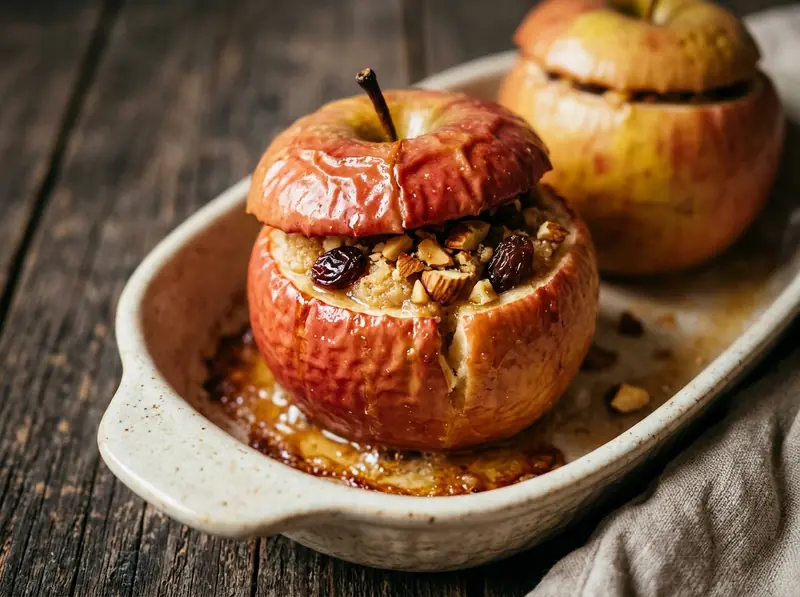
Bratapfel (German Baked Apples)
A Bratapfel is a German baked apple: a whole apple, cored, filled with marzipan, toasted almonds and rum-soaked raisins, and baked until soft. In Germany it is a winter dessert, traditionally made at Christmas time from firm, tart apples that keep well, such as Boskoop. One is a Bratapfel, several are Bratäpfel, Dr. Oetker also calls them Puttäpfel, and in English they are simply German baked apples. This is the filling essen & trinken and LECKER use, here with a little brown sugar and cinnamon. A little apple juice goes into the dish, and you spoon it over the apples when they come out. They are usually served warm with vanilla sauce, which is not part of this recipe. The raisins soak in rum for 2 hours beforehand. After that the apples take about 70 minutes, 35 of them in the oven.
What is a Bratapfel?
A Bratapfel is a whole apple, cored and baked in the oven. The plural is Bratäpfel, and Dr. Oetker also uses the name Puttäpfel. In the simplest form the apple goes into the oven whole and is served with sugar and cinnamon. Most German recipes cut out the core and fill the hole with nuts, raisins, marzipan, jam or spices.
It is a winter dessert, made in Germany at Christmas time from firm, tart apples that store well. The filling in this recipe, marzipan with nuts and raisins (almonds here), is the one LECKER calls a classic.
How to tell when a Bratapfel is done
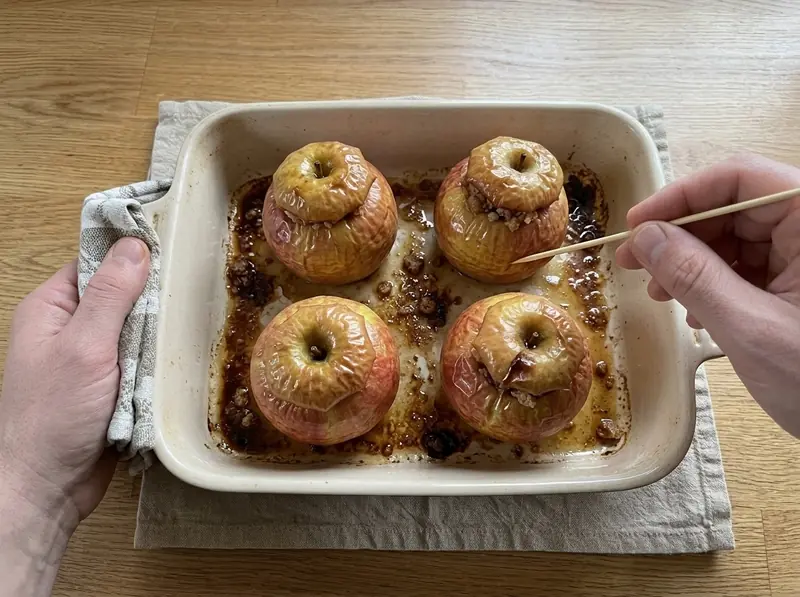
Go by the apple, not the clock. Recipes give anything from 25 to 45 minutes, because the time depends on the variety and the size of the apple. A done Bratapfel lets a wooden skewer slide into the flesh with no resistance, its skin has wrinkled and started to split, and it still stands up on the plate.
If it slumps into a heap, it has gone too far or the apple was too soft for baking. A firm Boskoop of about 200 g needs around 35 minutes at 180 °C with top and bottom heat.
Ingredients
- 4 apples
- 40 graisins
- 2 tbspdark rum
- 40 galmonds
- 80 gmarzipan
- 15 gbrown sugar
- 0.5 tspcinnamon
- 1 tbsplemon juice
- 30 gbutter
- 150 mlapple juice
Method
- Put the 40 g of raisins in a small bowl, pour over the 2 tbsp of dark rum, cover with a plate and leave at room temperature for 2 hours. They are ready when they look plump and glossy and have soaked up most of the rum. Soft raisins stay juicy in the oven instead of drying out.
- Heat the oven to 180 °C (conventional, top and bottom heat; 160 °C fan), with the rack in the middle. Grease a baking dish of about 20 × 30 cm with 5 g of the butter. Roughly chop the 40 g of almonds and toast them in a small dry frying pan over medium heat for 3 to 4 minutes, stirring, until they are golden and smell toasted. Tip them onto a plate straight away, because in the hot pan they keep browning. Toasting brings out their flavour.
- Pinch off a piece of the 80 g of marzipan the size of a hazelnut and set it aside for step 4. Coarsely grate or crumble the rest into a mixing bowl. Use the plain block of marzipan sold for baking (Marzipanrohmasse in Germany). Add the toasted almonds, the raisins with any rum left in their bowl, 15 g of brown sugar and ½ tsp of cinnamon. Work it together with your fingers into a crumbly mixture that holds together when you squeeze it. If you cook for someone with coeliac disease, check the label of the marzipan.
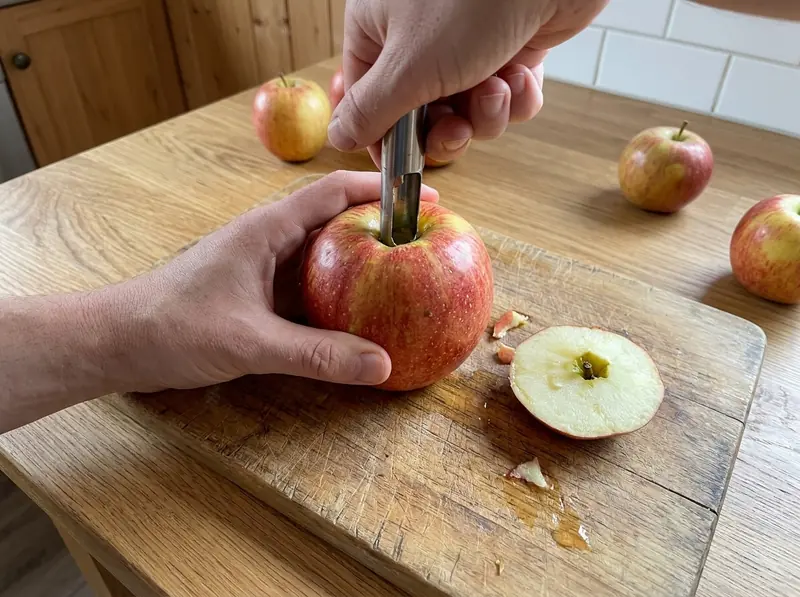
- Wash and dry the 4 apples, each about 200 g and 8 cm across. Good varieties are Boskoop, Cox Orange, Elstar or Jonagold, or Braeburn, Granny Smith or Fuji where those are easier to find. Cut a lid about 1.5 cm thick off the stem end of each apple and keep it. Cut a thin slice off the bottom so the apple stands up, without reaching the core. Push an apple corer down from the top and stop about 1 cm above the bottom, then widen the hole with a teaspoon to about 3 cm across. Keep the bottom closed, or the filling runs out in the oven. If you do pierce it, plug the hole with the piece of marzipan you set aside. Brush all the cut surfaces and the inside of each hole with the 1 tbsp of lemon juice so they don't turn brown, and stand the apples in the dish about 3 cm apart.
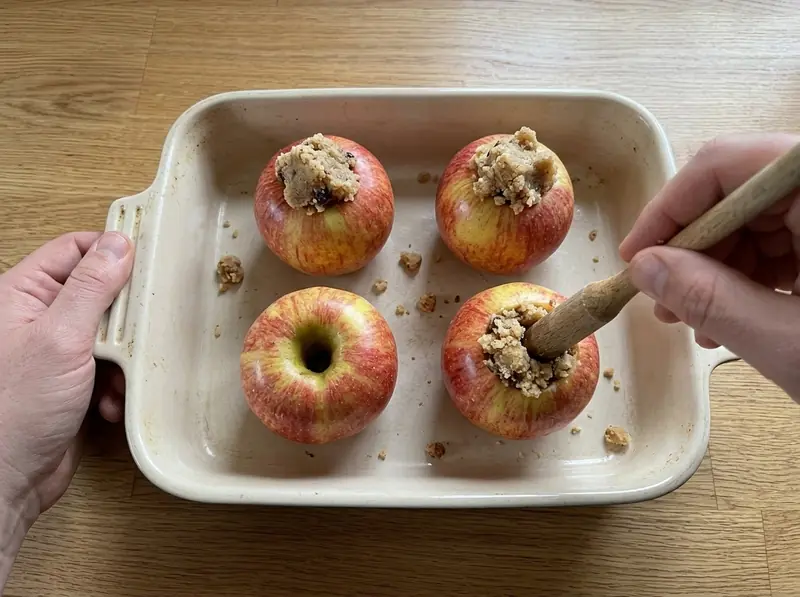
- Spoon the filling into the apples with a teaspoon and push it down with the handle of a wooden spoon so there are no air pockets. Pile the rest of the filling on top in a small mound, then press any raisins that show on the surface down into it, because raisins on top burn and taste bitter. Dot the remaining 25 g of butter over the tops, then pour the 150 ml of apple juice into the dish around the apples, so it forms a thin layer on the bottom.
- Bake for 25 minutes. Then put the lids on, spoon a little juice from the dish over the apples and bake for another 10 minutes, 35 minutes in all. They are done when a wooden skewer slides into the flesh with no resistance and the skin has wrinkled and started to split in places, while the apple still holds its shape. Very large Boskoop apples can take up to 45 minutes, so test them every 5 minutes after the first 35. If the filling darkens too quickly, cover the dish loosely with foil.
- Let the apples stand in the dish for 5 minutes, as the filling is very hot straight from the oven. Lift each one onto a deep plate and spoon the juices from the dish over it. Serve warm. Put any leftovers in the fridge within 2 hours.
FAQ
A little splitting is normal: German recipes treat a skin that has wrinkled and started to crack as the sign that the Bratapfel is done. If it turned to mush, the variety was too soft or it baked too long. Firm, tart apples such as Boskoop hold their shape, and in an American test Fuji held up best. At 180 °C with top and bottom heat, test with a wooden skewer after 35 minutes and stop as soon as it slides in without resistance.
Look for firm, tart apples that keep well. In Germany that means Boskoop first, then Cox Orange, Elstar and Jonagold, which don't fall apart while they bake. Outside Germany, Braeburn and Granny Smith are good choices, and Fuji held its shape best when Saveur tested baked apples. Pick apples of about 200 g each so four of them fit in a 20 × 30 cm dish and bake in the same 35 minutes. Soft apples fall apart in the oven.
Yes. Soak the 40 g of raisins in 2 tbsp of apple or orange juice instead of rum, the same swap Dr. Oetker suggests for an alcohol-free version. Everything else stays the same, including the 150 ml of apple juice in the dish. If your raisins are very dry and you have no time to soak them for 2 hours, pour 2 tbsp of hot apple juice over them and let them stand while you prepare the apples.
They taste best warm from the oven, but leftovers keep for 1 to 2 days in the fridge. Put them in within 2 hours of baking, covered, with their juices. Reheat them in the oven or the microwave until they are hot all the way through. Freezing doesn't suit them: essen & trinken notes that the texture suffers once they thaw.
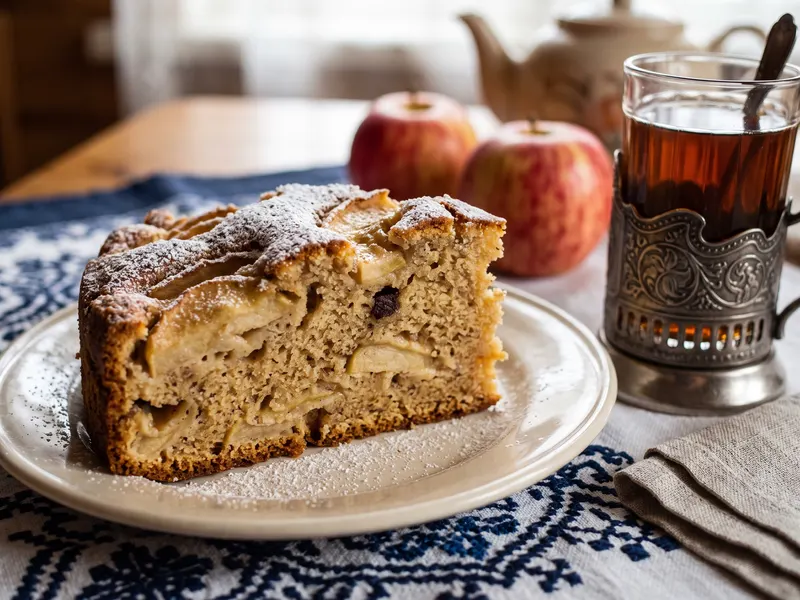
The usual partner is warm vanilla sauce, a thin custard poured over the apple and its juices. Vanilla ice cream and lightly whipped cream are the other common choices. Bratäpfel belong to the Advent and Christmas table, so for the same Advent table you could also make mulled wine. If you like apples, raisins and cinnamon baked together in pastry instead, try apple strudel. For another apple dessert from a different tradition, see sharlotka, a Russian apple sponge cake.
Keep browsing
More dishes from the German archive — picked by overlap with what you're cooking now.

Recipes by email
One letter a week: a recipe picked for your taste, plus whatever is new on the site. Unsubscribe in one click.
Welcome gift: Sergei's cookbook (e-book).
By subscribing you agree to the privacy policy.
Tell us what you like to cook (30 seconds) →
Join the conversation
Comments
No comments yet — be the first!