
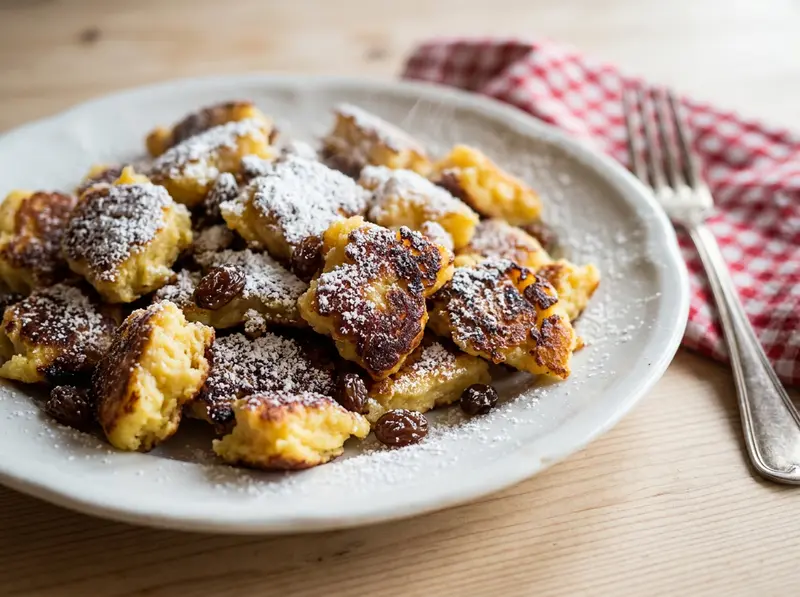
Kaiserschmarrn (Austrian Torn Pancake with Raisins)
Kaiserschmarrn, also spelled Kaiserschmarren and often just called Schmarrn, is an Austrian torn pancake, called a shredded or scrambled pancake in English: a thick, airy pancake of milk, flour and eggs with whipped egg whites, torn into bite-size pieces right in the pan, caramelised with a little sugar and dusted with icing sugar. Austrians eat it as a sweet main dish or as a dessert, traditionally with plum compote (Zwetschkenröster, also written Zwetschgenröster); apple sauce is the other common choice, and a jar of shop-bought apple sauce is fine when you want it quick. Schmarren, a simple pan dish of farmers, herders and woodcutters, is first mentioned in writing in 1563, and town kitchens took it up in the 18th century. This version is cooked on the stove only, with no oven finish, and the raisins are soaked in rum and go onto the pancake together with whatever liquid is left in the bowl. Start the raisins soaking first; they are ready by the time the batter goes into the pan, and the whole dish takes about 25 minutes.
Ingredients
- 30 graisins
- 1 tbspdark rum
- 3 eggs
- 150 mlmilk
- 8 gvanilla sugar
- 0.25 tspsalt
- 75 gflour
- 25 gsugar
- 30 gbutter
- 10 gicing sugar
Method
- Soak the raisins. Put the 30 g of raisins in a small bowl, pour over 1 tbsp of dark rum and stir. Leave them while you make the batter, about 15 minutes. By then they look plump and glossy and only a little liquid is left. Soaked raisins stay juicy in the hot pan instead of drying out.
- Make the yolk batter. Separate the 3 eggs (about 50 g each without the shell). Put the whites into a large, clean bowl with no trace of grease or yolk, and the yolks into a second large bowl. To the yolks add the 8 g of vanilla sugar, ¼ tsp of salt and 100 ml of the 150 ml of whole milk, and whisk. Add the 75 g of plain wheat flour (not self-raising) and whisk until smooth, then whisk in the remaining 50 ml of milk. You want no dry flour left and a batter like thick pouring cream. Mixing the flour into part of the milk first is what keeps it free of lumps.
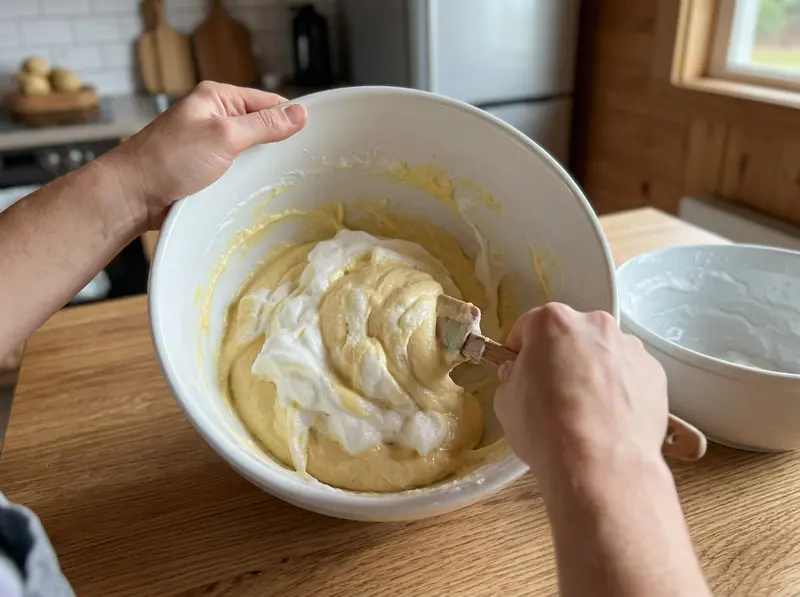
- Whip the whites and fold. Beat the whites with a hand mixer (or a balloon whisk) until foamy, then rain in 15 g of the sugar while you keep beating. Carry on until the whites stand in firm, glossy peaks when you lift the beaters, still smooth and not dry or grainy; the sugar steadies the foam. Fold a third of the whites into the yolk batter with a rubber spatula, then gently fold in the rest. A few white streaks are fine, but there should be no large lumps of foam. Stirring hard knocks the air out, and that air is what makes the pancake rise thick and light.
- Cook the first side. Melt 20 g of the 30 g of unsalted butter in a 26 cm nonstick frying pan with a lid over medium heat until it foams. Pour in all the batter and level it with the spatula. Scatter the raisins over the top together with any liquid left in their bowl. Put the lid on, turn the heat down to medium-low and cook for about 5 minutes. Lift an edge with a wide spatula: the underside should be evenly golden brown, and the top set at the edges but still moist in the middle. Low heat lets the thick layer set before the bottom burns, and the lid keeps the steam in so the top sets without an oven.
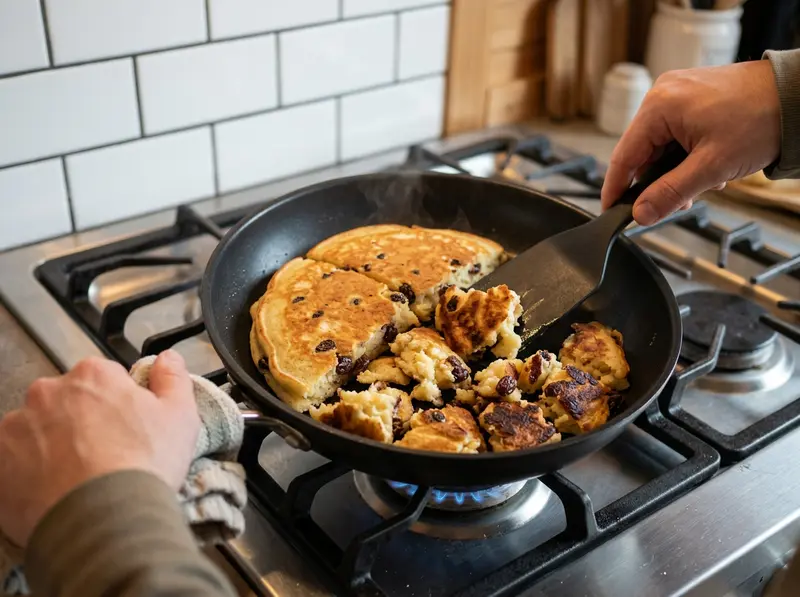
- Turn the pancake. Take off the lid. Cut the pancake into quarters with the wide spatula and turn each quarter over. Cook uncovered over medium-low heat for 3 to 4 minutes, until the second side is golden brown and the centre springs back when you press it. Four pieces are much easier to turn than one big pancake.
- Tear and caramelise. Tear the quarters into irregular bite-size pieces, about 3 cm, with the spatula. In a nonstick pan use the spatula and not forks, which scratch the coating. Add the remaining 10 g of butter at the edge of the pan, sprinkle the remaining 10 g of sugar over the pieces, raise the heat to medium-high and toss and turn them for 2 to 3 minutes. Stay at the pan: the sugar melts and the edges turn shiny and caramel brown, and it goes from caramel to burnt quickly, so stop before anything turns black. The caramel is very hot, so move the pieces with the spatula and keep your fingers out of the pan. Pull one piece apart to check: inside it should be moist but set, with no runny batter, because the eggs must be fully cooked.
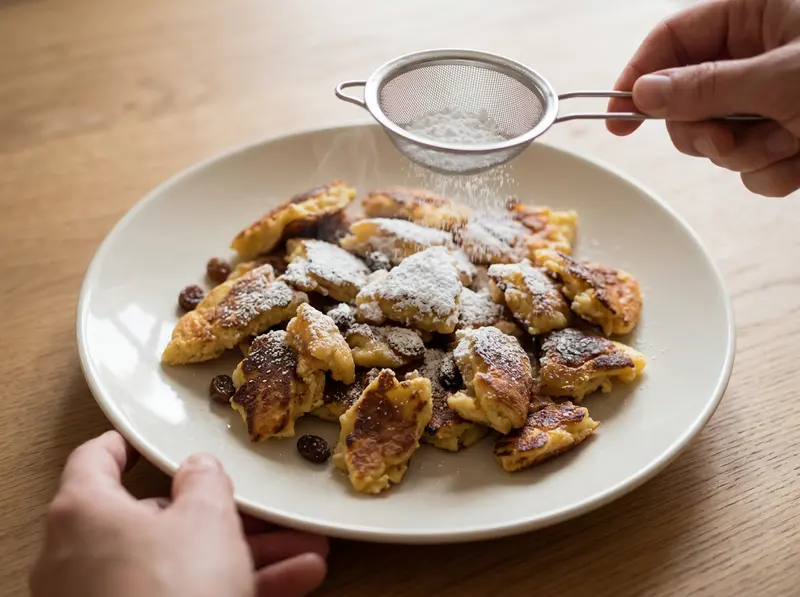
- Serve. Tip the Kaiserschmarrn onto two warm plates, or bring the pan to the table. Dust it with the 10 g of icing sugar through a fine sieve, so it lies white on the hot pieces, and serve at once, while the edges are still crisp.
FAQ
Kaiserschmarrn is one thick pancake cooked in a single pan and then torn into pieces, rather than several separate pancakes. Most Austrian recipes separate the eggs, beat the whites with sugar to firm peaks and fold them in, so the batter rises thick and airy (some versions use whole eggs and come out denser); this recipe uses 3 eggs to 75 g of flour. After tearing, the pieces are tossed with 10 g of butter and 10 g of sugar until the edges caramelise, which gives them crisp sweet edges and a soft inside. It is finished with icing sugar, and in Austria it is eaten as a sweet main dish or as a dessert.
Usually the egg whites are to blame. If the bowl had a trace of grease or yolk in it, the whites will not whip to firm peaks, and without that foam the batter cannot rise. Beat until the peaks stand when you lift the beaters, glossy and smooth, then fold them in gently in two additions; a few white streaks are better than a flat pancake. Heat matters too: cook the first side under the lid on medium-low for about 5 minutes, because on high heat the bottom browns before the thick layer can set. If you like the whipped-white idea taken further, try Japanese soufflé pancakes.
Either one. In Austria Kaiserschmarrn traditionally comes with Zwetschkenröster (written Zwetschgenröster in Germany), a plum compote; apple sauce is the other common choice. Serve it in a bowl on the side so everyone can spoon on as much as they like over the hot, sugared pieces. On a busy day a jar of shop-bought apple sauce works perfectly well. If plums are what you are after, the German plum cake Zwetschgendatschi is another way to use them.
Yes, both work. Without rum, soak the 30 g of raisins in 1 tbsp of apple juice instead, the same amount, and pour them onto the pancake with the juice just as you would with the rum; this is the version to make for children. Without raisins, leave them out together with the rum, and nothing else in the recipe changes. Austrian and German recipes go both ways: some use raisins with no rum at all, and some skip the raisins entirely.
It is at its best straight from the pan, while the caramelised edges are still crisp, so it is not really a make-ahead dish. Leftovers keep, though: let them cool, put them in the fridge within 2 hours and eat them within 3–4 days. Reheat the pieces in the frying pan with a little butter, turning them, until they are hot throughout, which is 74 °C in the middle if you check with a thermometer. Dust with fresh icing sugar just before serving.
Keep browsing
More dishes from the Austrian archive — picked by overlap with what you're cooking now.
Recipes by email
One letter a week: a recipe picked for your taste, plus whatever is new on the site. Unsubscribe in one click.
Welcome gift: Sergei's cookbook (e-book).
By subscribing you agree to the privacy policy.
Tell us what you like to cook (30 seconds) →
Join the conversation
Comments
No comments yet — be the first!