
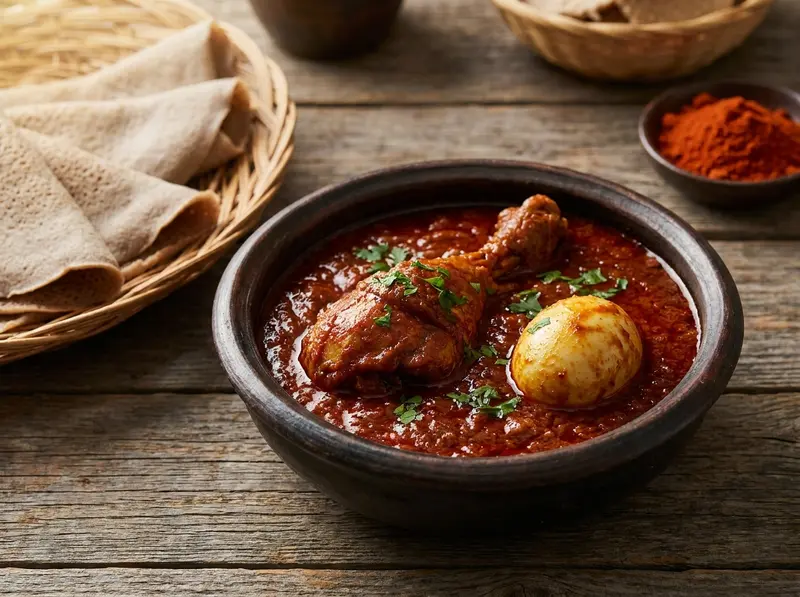
Doro Wat (Ethiopian Spiced Chicken Stew)
Doro wat is the Ethiopian holiday stew: a deep red, intensely spiced chicken stew built on a foundation of onions cooked down slowly until they melt into a rich paste. Fiery berbere and aromatic niter kibbeh, a spiced clarified butter, give it heat and depth, while whole hard-boiled eggs simmer in the sauce to soak up flavour. Slow-cooked and celebratory, it's traditionally scooped up with injera, the tangy teff flatbread, in a shared communal meal.
Ingredients
- 1000 gchicken drumsticks
- 700 gonion
- 4 tbspberbere
- 60 gniter kibbeh
- 5 clovesgarlic
- 40 gginger
- 2 tbsptomato paste
- 6 pcseggs, hard-boiled and peeled
- 2 tbsplemon juice
- 300 mlchicken stock
- to tastesalt
- 1 lemon wedge, to finish
Method
- Pat the chicken drumsticks dry with paper towels (don't rinse raw chicken; it only spreads bacteria around the sink), rub them with the lemon juice and a little salt, and keep them in the fridge while you build the sauce. Hard-boil the eggs now too: cover them with cold water, bring to the boil and simmer about 10 minutes until the yolks are firm, then cool them in cold water and peel.
- Cook the finely chopped onions in a dry pot over low heat (add a teaspoon of oil only if the onions start to catch), stirring often, for 20–30 minutes until deeply softened, collapsed, and jammy. This slow base is the soul of the dish — don't rush it.
- Stir in half the niter kibbeh, the minced garlic, and ginger, and cook a few minutes until fragrant.
- Add the berbere and tomato paste and fry gently 5–10 minutes, stirring, until darkened and glossy and the raw spice smell is gone. Loosen with a splash of stock if it sticks.
- Nestle in the chicken, turning to coat in the paste. Pour in the stock to almost cover, bring to a gentle simmer, cover and cook for 40–45 minutes, until the sauce is thick and the chicken is very tender: the meat pulls away from the bone, the juices show no pink and the thickest drumstick reads 74°C (165°F) next to the bone.
- Prick the peeled hard-boiled eggs a few times and submerge them in the sauce. Stir in the remaining niter kibbeh and simmer uncovered 10–15 minutes to reduce and let the eggs absorb the flavour.
- Taste for salt and finish with a squeeze from the lemon wedge. Serve hot on a large injera, with extra injera alongside for scooping.
FAQ
Berbere is the fiery, deep-red Ethiopian spice blend that defines doro wat. It typically combines chilies with paprika, fenugreek, ginger, cardamom, coriander, cloves, cinnamon, and more, toasted and ground. It's sold ready-made in many spice shops and online, and buying good-quality berbere is the single biggest factor in an authentic result. You can make your own from the component spices if you can't find it, but there's no simple one-ingredient swap — the complex blend is what gives the dish its character. Berbere also seasons misir wot, the Ethiopian red lentil stew.
Niter kibbeh is Ethiopian spiced clarified butter, made by gently simmering butter with aromatics like garlic, ginger, cardamom, fenugreek, and nigella, then straining. It adds a distinctive nutty, spiced richness that's central to the dish. Ghee is the closest easy substitute and works well; plain melted butter will do in a pinch but loses the spiced aroma. It's easy to make a batch ahead and keeps for weeks, and it's worth it for the authentic flavour.
The slow-cooked onions are the whole foundation of doro wat, not just a background note. Cooking a large amount of finely chopped onion low and slow — often with little or no fat at first — breaks it down into a thick, sweet, jammy paste that gives the stew its body and depth. Rushing or browning them too fast gives a thinner, harsher sauce. It genuinely takes 20–30 minutes or more; this patience is what separates a good doro wat from a mediocre one.
The stew itself is naturally gluten-free — it's chicken, onions, spices, and butter with no flour. Injera, the flatbread it's served on, is traditionally made from teff, a naturally gluten-free grain, so pure teff injera is gluten-free too. However, much restaurant and store-bought injera is made with a mix of teff and wheat flour, which is not gluten-free. If you need it strictly gluten-free, make or buy 100% teff injera, or serve the stew with rice.
Doro wat is meant to be quite spicy — the heat is central to the dish — but you control it entirely through the amount and type of berbere, so you can make a milder version and still get the deep flavour. For a gentler stew, use less berbere and add a little paprika for colour. Leftovers keep, covered in the fridge, for 3–4 days, and the flavour deepens overnight. It also freezes well for 2–3 months; reheat gently on the stovetop until piping hot (74°C).
Keep browsing
More dishes from the Ethiopian archive — picked by overlap with what you're cooking now.
Recipes by email
One letter a week: a recipe picked for your taste, plus whatever is new on the site. Unsubscribe in one click.
Welcome gift: Sergei's cookbook (e-book).
By subscribing you agree to the privacy policy.
Tell us what you like to cook (30 seconds) →
Join the conversation
Comments
No comments yet — be the first!