
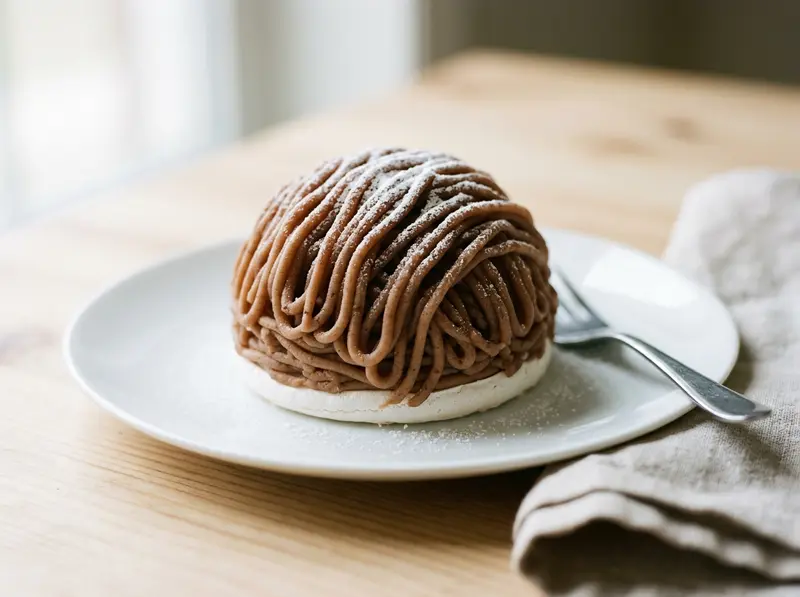
Mont Blanc (Chestnut Cream Dessert)
Mont Blanc is a cold autumn dessert: sweetened chestnut paste pressed into thin strands over a dome of whipped cream on a crisp meringue base, named after the mountain on the border between France and Italy. The French write it Mont-Blanc, Italians call it Monte Bianco (Montblanc in the Valle d'Aosta), and in Japan it is モンブラン. Nobody can say for certain who made it first. Its roots are linked to Piedmont and France, and the story that it was born in the royal kitchens of Savoy is a legend. Artusi's cookbook has a dessert of chestnuts pressed through a sieve into a ring and filled with whipped cream, and the Paris tea room Angelina, opened in 1903, made the Mont-Blanc its signature pastry. In Japan, a Tokyo pastry shop founded in 1933 is said to have made the first yellow, Japanese-style version. We use a French meringue, egg whites and sugar whisked without heat, instead of the Swiss meringue, which is whisked over a pan of hot water, because it is easier at home. For the chestnut part we use cooked, peeled chestnuts (vacuum-packed or from a jar) and sweetened chestnut spread (crème de marrons), so there are no raw chestnuts to boil and peel. The meringues bake for an hour and a half and then cool in the oven for another hour; after assembling, the desserts chill for 30 minutes. That is about 3½ hours in all, most of it hands-off.
Ingredients
- 130 gegg whites
- 240 gcaster sugar
- 200 gchestnuts
- 250 gsweetened chestnut spread
- 1 tbspdark rum
- 300 mlheavy cream
- 25 gicing sugar
- 1 tspvanilla extract
Method
- Heat the oven to 110 °C (conventional, top and bottom heat). Using an 8 cm glass or cutter and a pencil, draw 6 circles on a sheet of baking paper, 3 cm apart, then turn the paper over onto a baking tray of about 30 × 40 cm so the pencil side faces down. The circles should still show through the paper. A low oven dries the meringue without colouring it.
- Separate 4 large eggs and put the whites (130 g) in a large, clean bowl with no grease in it and no trace of yolk; keep the yolks for another dish. Fat or yolk stops the whites from foaming. Beat with a hand mixer on medium speed for 2 to 3 minutes, until foamy and just holding soft peaks. Switch to high and add the 240 g of caster sugar a tablespoon at a time, then keep beating for about 8 minutes. The meringue is ready when it is thick and glossy, holds stiff peaks that stand up, stays put when you tip the bowl, and a little rubbed between your fingers no longer feels gritty. Adding the sugar slowly keeps the foam stable.
- Spoon or pipe the meringue into the 6 circles, about 62 g each, so each round fills its circle and stands about 2.5 cm high. With the back of a spoon, press a shallow hollow into the middle of each one. The hollow is where the cream dome will sit.
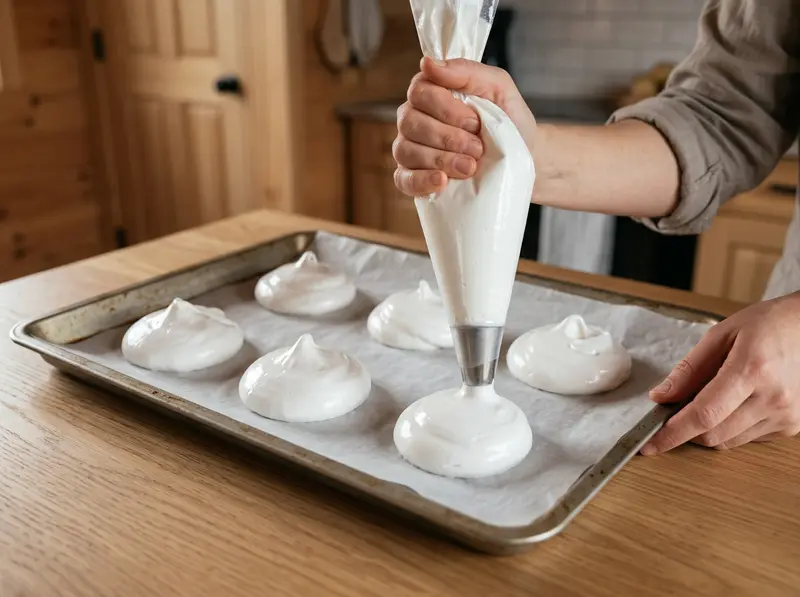
- Bake for 1 hour 30 minutes at 110 °C. Then switch the oven off and leave the meringues inside with the door closed for another hour. They are done when they are dry and firm, white to the palest cream colour, lift off the paper cleanly and sound hollow when you tap them. A thoroughly dried meringue stays crisp under the cream.
- While the meringues bake, make the chestnut paste. Put the 200 g of cooked, peeled chestnuts (vacuum-packed or from a jar), the 250 g of sweetened chestnut spread (crème de marrons) and 1 tbsp of dark rum in a food processor. Blend for 2 to 3 minutes, scraping down the sides, until the paste is completely smooth with no lumps, soft but able to hold its shape on a spoon. Any lump will block the ricer later. Cover and chill until you assemble.
- Once the meringues have cooled, pour 300 ml of cold heavy cream (at least 35% fat) into a second large bowl and add 20 g of the icing sugar and 1 tsp of vanilla extract. Whip for about 4 minutes, until the cream holds firm peaks and the surface is still smooth. Stop there: whipped any further, it turns grainy and heads towards butter. Firm cream is what keeps the dome standing under the chestnut strands.
- Set each meringue on a dessert plate. Spoon or pipe a dome of cream onto it, about 7 cm across, leaving a thin rim of meringue showing. Fill a potato ricer with chestnut paste and press it over the dome, moving round and turning the plate, until the cream is completely hidden under brown strands but the white edge of the meringue still shows. If you have no ricer, use a piping bag with a 3 to 4 mm plain tip. Dust the desserts with the remaining 5 g of icing sugar through a fine sieve.
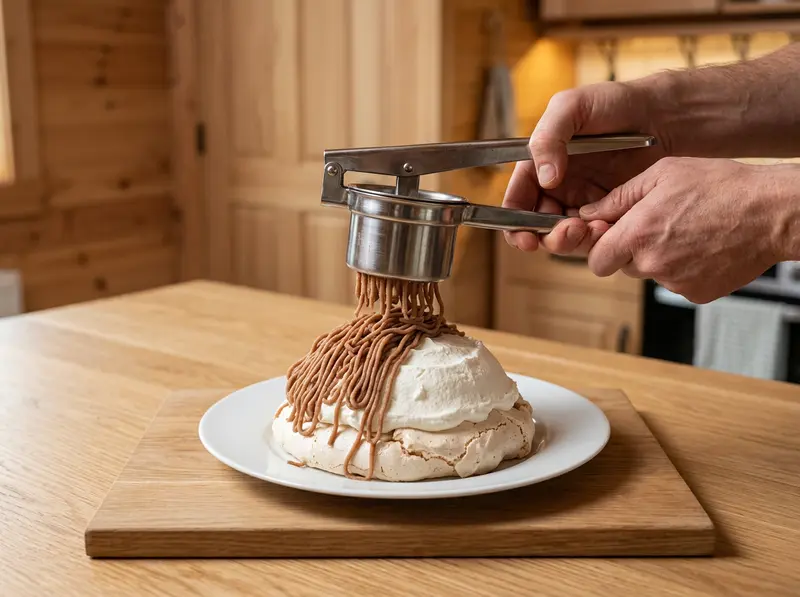
- Chill the Mont Blancs for at least 30 minutes, then serve them the same day; the meringue slowly softens under the cream. Keep them in the fridge until serving, and put any leftovers back within 2 hours, because whipped cream is perishable.
FAQ
Usually it wasn't dried long enough or it sat under the cream too long. Bake the rounds for 1 hour 30 minutes at 110 °C, then leave them in the switched-off oven with the door closed for another hour; done meringues lift off the paper cleanly and sound hollow when tapped. Beat the whites in a grease-free bowl with no trace of yolk, add the sugar a tablespoon at a time and beat until a pinch is no longer gritty between your fingers. Even a well-dried meringue softens under the cream with time, so chill the assembled Mont Blanc for 30 minutes and serve it the same day. If you would rather have a meringue that is crisp outside and soft inside, that is a different dessert: try pavlova.
Yes to both. The French pastry site Meilleur du Chef pipes the chestnut strands through a piping bag with a 3 to 4 mm plain tip, and in Japan there is a special Mont Blanc piping tip with holes about 2 mm across. An Italian version presses the chestnuts through a vegetable mill instead. The rum is only 1 tbsp for 6 servings and isn't cooked, so for children leave it out and blend the 200 g of chestnuts with the 250 g of chestnut spread on their own; Simon Hopkinson's recipe has no alcohol at all. Whatever you press it through, the paste has to be completely smooth, or lumps will block the holes.
Make the parts ahead and assemble on the day you serve. The baked meringues keep for a good couple of days in an airtight box. The chestnut paste can wait covered in the fridge, but whip the cream on the day. Once assembled, the Mont Blanc goes into the fridge for at least 30 minutes and is best eaten that same day, because the meringue softens under the cream. Whipped cream is perishable, so never leave the desserts out for more than 2 hours.
Our recipe has no flour or wheat: meringue made from egg whites and sugar, whipped cream, chestnuts, chestnut spread, rum and vanilla. The Clément Faugier crème de marrons label, for example, lists chestnuts, sugar, marrons glacés, glucose syrup, water and natural vanilla flavouring. Brands differ, though, so check the label of the chestnut spread and the cooked chestnuts you buy, especially if you are cooking for someone with coeliac disease. It is vegetarian, but not vegan, because of the egg whites and the cream.
The French and Italian dessert is brown chestnut paste pressed into strands over whipped cream, on or with meringue. Japanese home recipes usually build モンブラン on a sponge or cupcake base, with cream in the centre and chestnut cream piped over it, and some make that chestnut cream from candied chestnuts in syrup (栗の甘露煮). A Tokyo pastry shop founded in 1933 is said to have made the first yellow, Japanese-style version. This recipe is the meringue version with crème de marrons. For another autumn chestnut dish from Japan, try kuri gohan.
Keep browsing
More dishes from the French archive — picked by overlap with what you're cooking now.

Recipes by email
One letter a week: a recipe picked for your taste, plus whatever is new on the site. Unsubscribe in one click.
Welcome gift: Sergei's cookbook (e-book).
By subscribing you agree to the privacy policy.
Tell us what you like to cook (30 seconds) →
Join the conversation
Comments
No comments yet — be the first!