
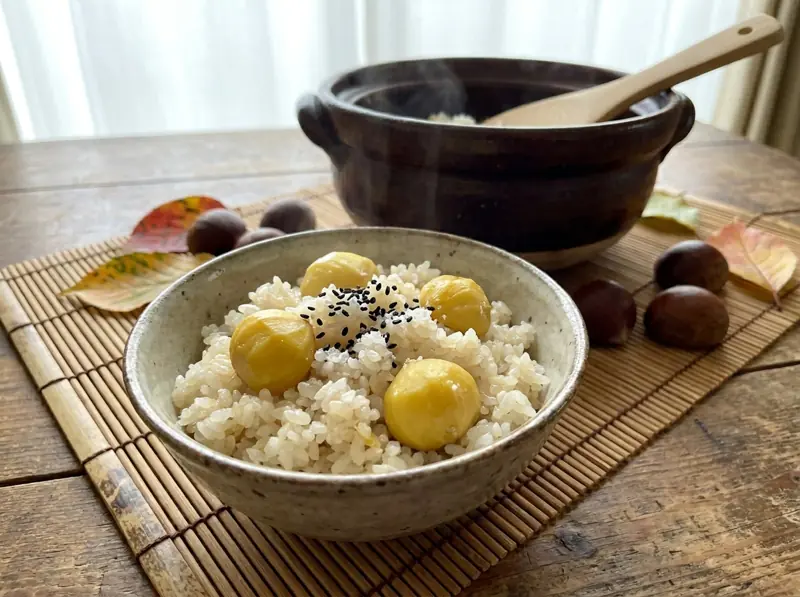
Kuri Gohan (Japanese Chestnut Rice)
Kuri gohan (栗ご飯) is a Japanese rice dish cooked with fresh chestnuts, made in home kitchens from September through October when kuri come into season. The name is just chestnut plus gohan, cooked rice; a version with more glutinous rice is sometimes called kuri okowa, and some families call the whole dish kurimeshi. Sake and salt do the seasoning instead of soy sauce, and a small share of mochigome mixed into the short-grain rice keeps the grains glossy and slightly chewy once they cool, so the chestnut's sweetness stays in front. The chestnuts steam directly on top of the rice and come out soft enough to break with chopsticks, closer in texture to a baked sweet potato than a raw nut. Active time here covers peeling and finishing the rice; the chestnuts need at least 20 minutes soaking before you can peel them and the rice needs another 30 minutes to soak before cooking, so budget closer to 90 minutes start to finish. Serves four alongside grilled fish, pickles and a bowl of miso soup.
Ingredients
- 225 gshort-grain rice
- 75 gglutinous rice
- 400 gchestnuts
- 1 piecekombu
- 4 gsalt
- 1 tbspsake
- 1 tbspblack sesame seeds for serving
Method
- Rinse the chestnuts and soak them in hot water, around 50°C, for at least 20 minutes; plain room-temperature water works too if you soak for 2 hours instead. The heat softens the tough outer shell just enough that a paring knife can slide underneath it rather than skate across the surface. While the chestnuts soak, put the short-grain rice and glutinous rice in a bowl, rinse briefly, and change the water three or four times until it runs close to clear, then drain.
- Peel the chestnuts one at a time. Set each one flat-side down and slice a thin disc off the pointed bottom, where the two halves of the shell meet, to create a flat edge. Wedge the knife under that cut edge and peel the hard outer shell off in a single strip, then work the thinner, papery, tannin-bitter inner skin free the same way, from the cut bottom up toward the tip. Drop each peeled chestnut straight into a bowl of cold water as you go, since bare chestnut flesh starts to oxidize within minutes.
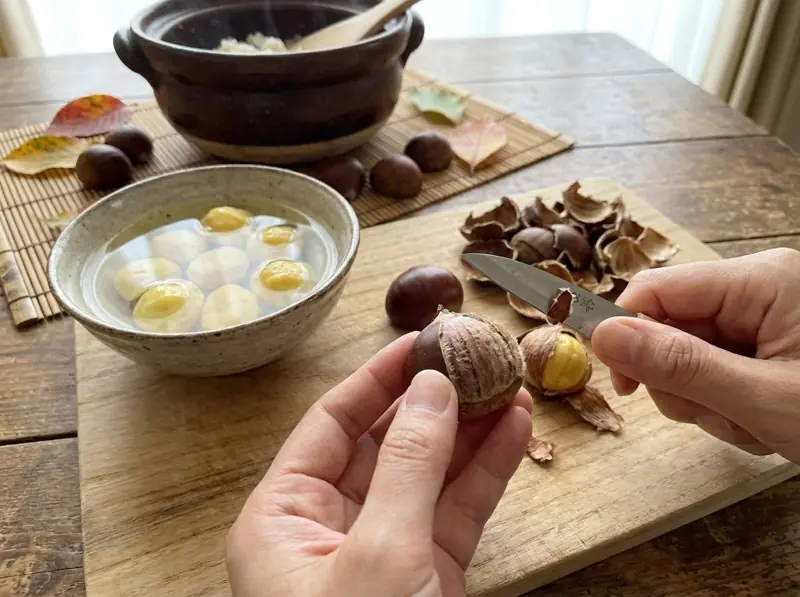
- Once every chestnut is peeled, drain the bowl and cover them again with fresh cold water, changing it two or three times over the next 30 minutes. This soak is what keeps the finished rice a clean pale yellow instead of a dull grey-brown; skip it and the surface starches darken before they ever hit the rice. Cut any chestnut larger than a walnut in half or into thirds so the pieces are close to bite-sized; small ones can stay whole.
- Drain the rice one more time and let it rest in the strainer for 10 minutes so the moisture inside the grains evens out. For a rice cooker: put the rice into the inner pot, pour in the sake, then fill with water up to the 2-gō line printed inside the pot, counting the sake as part of that liquid. Stir in the salt until it disappears, tuck the kombu against the side of the pot, then lay the chestnuts on top in a single layer, rounded side up, and let everything sit for 30 minutes before pressing start.
- For a heavy pot or donabe instead: combine the rinsed rice, sake, salt and 400 ml water in the pot, stir to dissolve the salt, and tuck in the kombu. Arrange the chestnuts on top rounded side up and let the pot sit uncovered for 30 minutes so the rice can soak. Cover, bring to a boil over medium heat, then drop to the lowest heat and cook for 12 to 13 minutes, until you can no longer hear bubbling and a quick peek shows the surface water gone.
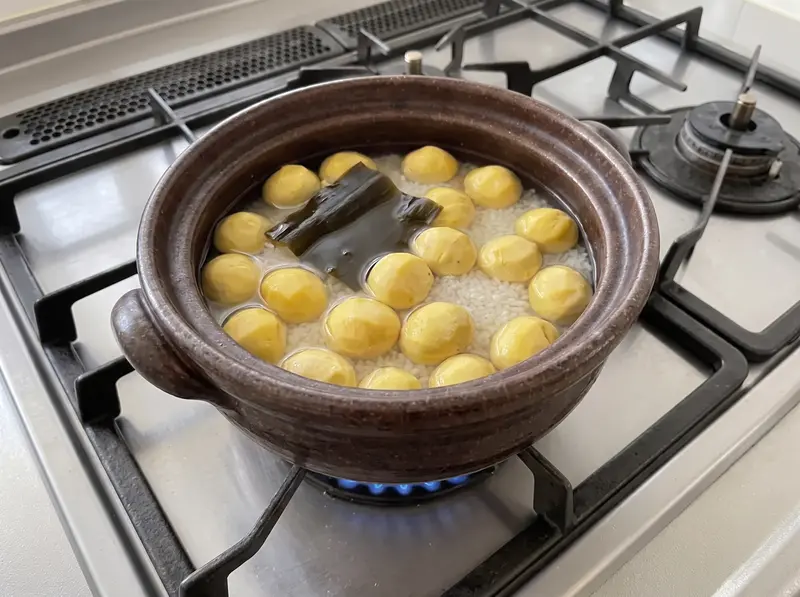
- Take the pot off the heat, or let the rice cooker finish its cycle, and leave the lid shut for 15 minutes of steaming without opening it. This rest finishes cooking the centre of the grains and firms up the chestnuts; opening the lid early lets steam escape and leaves the bottom layer undercooked. Fish out the kombu, which has done its job by now.
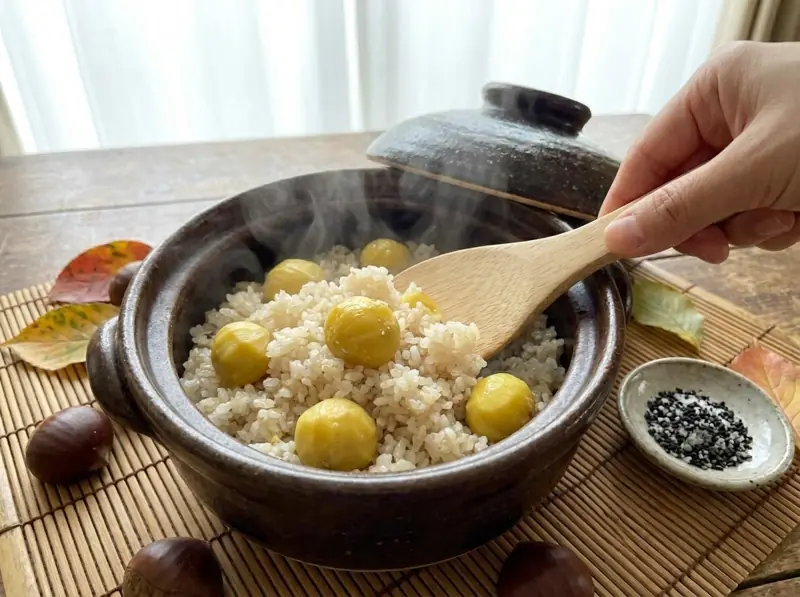
- Uncover and mix the rice gently: slide a rice paddle straight down to the bottom, turn a scoop up and over, and repeat around the pot in a light slicing motion rather than stirring. Rough stirring mashes the chestnuts into starchy lumps, so aim to fold the rice under and around them instead. Serve warm, scattered with the black sesame seeds, or with a small pinch of gomashio (sesame salt) instead if you have it.
FAQ
Mochigome brings more amylopectin starch than plain short-grain rice, and that starch is what keeps kuri gohan glossy and a little sticky even after it cools to room temperature, which matters if the rice is going into a bento box a few hours later. The usual ratio is about a quarter mochigome to three quarters regular rice, roughly 75 g to 225 g for a 2-gō batch; go much higher and the rice turns almost as chewy as okowa, the fully glutinous version. You can skip the mochigome entirely and use all short-grain rice instead. Just One Cookbook notes that the plain version is firmer right out of the pot, but it also does not turn as hard the next day, since there is less of the starch that stiffens on cooling, so it is worth trying if you plan to eat leftovers cold.
Soak the chestnuts in hot water around 50°C for at least 20 minutes first; a cold chestnut shell fights the knife, a warmed one gives way easily. Set each chestnut flat-side down, cut a thin disc off the pointed bottom where the two shell halves meet, and use that flat edge as your starting point instead of trying to stab into the rounded top. From there, wedge the knife tip under the cut edge and peel the hard outer shell off in one or two long strips, then do the same with the thinner, bitter inner skin. Twenty to twenty-five chestnuts take most people 20 to 25 minutes once they get into a rhythm, and working through a whole batch while watching something on a screen makes the time pass faster than you would think.
Yes, and it is the version most Japanese home cooks reach for on a weeknight. Frozen peeled chestnuts need nothing more than a quick thaw and a drain before they go on top of the rice; use about 250 to 300 g in place of the 400 g of fresh, unpeeled chestnuts in this recipe, since none of that weight is shell. Sweetened roasted chestnuts, amaguri, work too and skip the peeling step completely, though they push the finished rice toward a noticeably sweeter, almost dessert-like flavour, so many cooks cut the added salt by half when using them. Jarred chestnuts packed in syrup should be rinsed first, or the syrup will throw off the salt-to-liquid balance in the pot.
Peeled chestnut flesh oxidizes within minutes of contact with air, the same way a cut apple browns, and if the peeled chestnuts sit out instead of going straight into a bowl of cold water, that surface discoloration cooks into the rice as a dull grey-brown tint instead of the pale yellow you want. Change that soaking water two or three times over 30 minutes rather than once, since chestnut starch keeps leaching colour the whole time. A hard, chalky texture usually points to insufficient soaking of the rice itself before cooking; 30 minutes minimum, even in a rice cooker, is what lets the grains absorb enough water to cook through instead of staying dense at the centre. Rice made with no mochigome at all is naturally a bit firmer too, so if that texture bothers you, mix in the 75 g of glutinous rice the recipe calls for.
It is one of the better uses for leftovers, since the mochigome in the mix already gives the rice enough stickiness to hold a triangle shape without extra effort. Let the rice cool until it is just warm to the touch, wet your hands with lightly salted water the way you would for any onigiri, and pack it loosely so you do not crush the chestnut pieces inside. A few whole chestnut pieces pressed into the centre make each rice ball feel more substantial than a plain rice onigiri, and a strip of nori wrapped around the outside keeps your hands clean while you eat. Kuri gohan onigiri keep for a day at room temperature, wrapped, and are one of the more traditional cold lunchbox fillers during the fall harvest season.
Rate this
Recipes by email
One letter a week: a recipe picked for your taste, plus whatever is new on the site. Unsubscribe in one click.
Welcome gift: Sergei's cookbook (e-book).
By subscribing you agree to the privacy policy.
Tell us what you like to cook (30 seconds) →Keep browsing
More dishes from the Japanese archive — picked by overlap with what you're cooking now.
Join the conversation
Comments
No comments yet — be the first!