
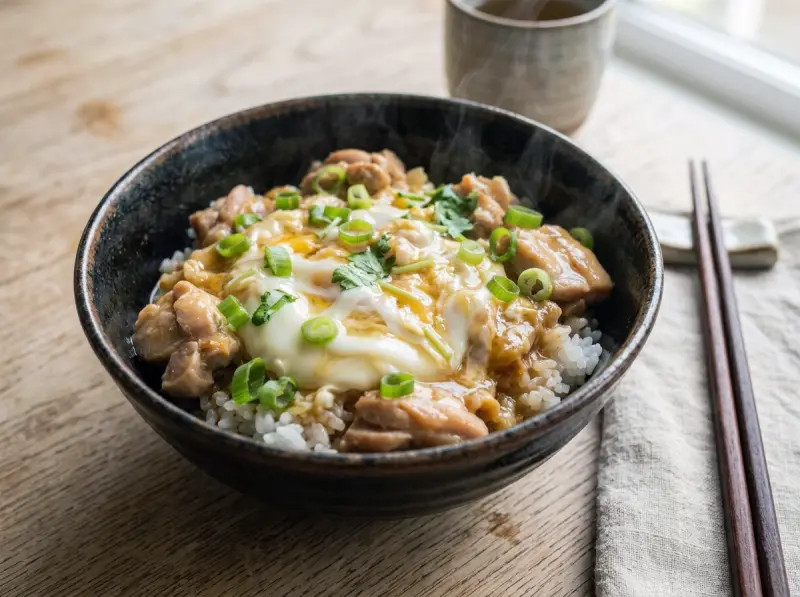
Oyakodon (Japanese Chicken and Egg Rice Bowl)
Oyakodon is a Japanese rice bowl (donburi) of chicken and onion simmered in sweet-savoury dashi broth, finished with softly set egg and served over rice. The name means "parent and child": chicken and egg in one bowl, which is either charming or a little dark depending on your mood. It's the easiest donburi to get right at home, and the one I make when there's nothing in the fridge but chicken thighs, eggs and rice. The egg goes in at the very end and sets into soft, barely cooked curds, and the whole thing takes about fifteen minutes.
Ingredients
- 400 gchicken, thigh
- 300 grice, cooked short-grain
- 3 pcseggs
- 1 pcsonion
- 150 mldashi
- 45 mlsoy sauce
- 30 mlmirin
- 20 mlsake
- 10 gsugar
- 2 pcsspring onion
Method
- Get the rice ready and keep it warm before you start, because oyakodon comes together fast and won't wait for you. Slice the chicken thigh into bite-sized pieces and cut the onion into thin wedges.
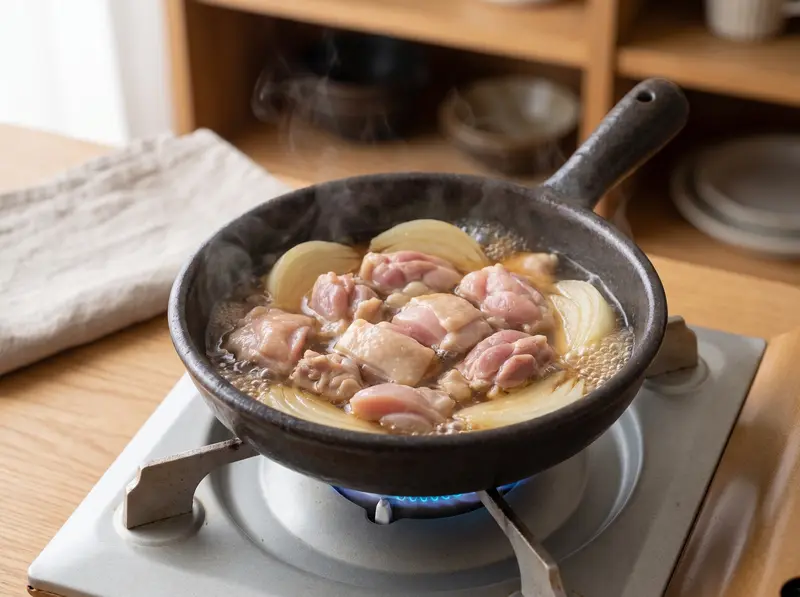
- In a small frying pan, ideally one that fits a single serving, mix the dashi, soy sauce, mirin, sake, and sugar. Bring it to a simmer and add the onion. Let it soften for a couple of minutes.
- Add the chicken in a single layer and simmer gently for about 5 minutes, until it's just cooked through. Don't rush this on high heat, or the chicken tightens and the broth boils away.
- Beat the eggs in a bowl, but only just — a few strokes, so there are still streaks of white running through the yolk. Overbeaten egg cooks into something uniform and rubbery, and you want the opposite here.
- Pour about two-thirds of the egg over the chicken in a slow circle and cover the pan. After roughly a minute the egg will start to set at the edges while the middle stays loose.
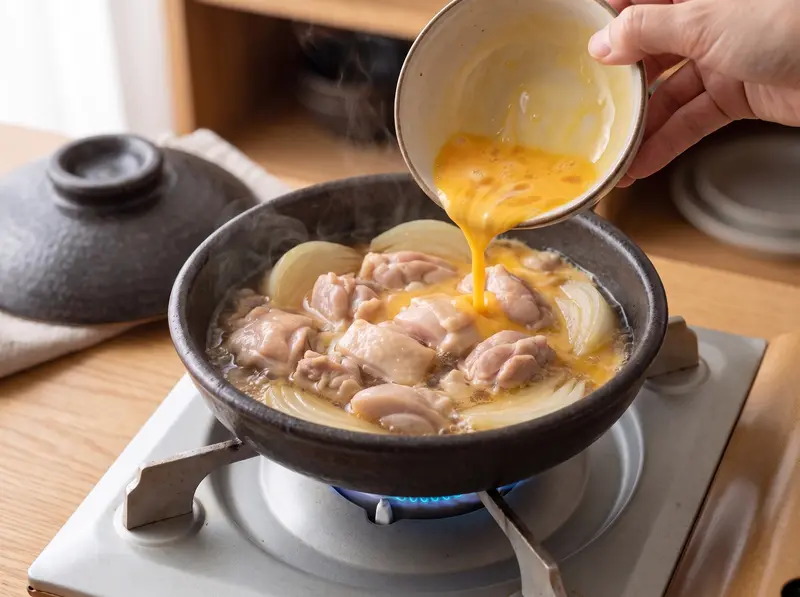
- Pour in the rest of the egg, cover again, and take the pan off the heat almost immediately. The residual warmth finishes it. Japanese cooks leave the centre properly soft and glossy, and that's the whole point of the dish.
- Slide the whole thing over a bowl of hot rice, letting the broth soak in. Scatter sliced spring onion on top and eat it straight away, while the egg is still trembling.
FAQ
Oyakodon is a Japanese rice bowl (donburi) of chicken and onion simmered in dashi with soy sauce and mirin, under softly set egg. "Oya" means parent, "ko" means child and "don" is short for donburi: the chicken and the egg end up in the same bowl. You need chicken thighs, eggs, onion, dashi, soy sauce, mirin, sake, sugar and short-grain rice. In Japan it's everyday home food and a regular on cheap canteen menus.
You can, but most of the flavour lives in the broth, so you'll taste the swap. The easiest route is instant dashi powder, dissolved as the packet says. If you don't have that either, use a light chicken stock with a little extra soy sauce and mirin: close, though not the same.
It stays on the heat too long and gets beaten too thoroughly. Break the eggs up with chopsticks in just a few strokes so streaks of white remain, and pour them in two additions. After the second, cover the pan and take it off the heat almost at once: the egg finishes from residual heat and the hot rice. If it already looks done in the pan, it will be overcooked by the time it's on the rice.
Boneless thigh, skin on or off as you like. It stays juicy as it simmers and has more flavour than breast, which dries out quickly in broth and turns stringy. If breast is all you have, slice it thinner and simmer it no longer than 3 minutes. Either way, cut bite-sized pieces so they cook through before the egg goes in.
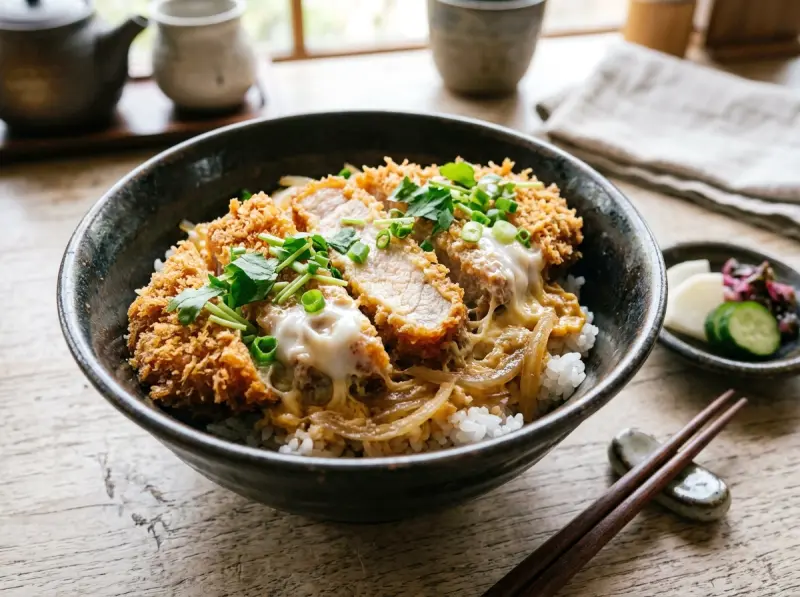
Both are egg-topped donburi simmered in dashi and cooked in the same small pan. In oyakodon the chicken simply simmers in the broth, while katsudon has a breaded, deep-fried pork cutlet instead. Oyakodon is noticeably quicker because there's no deep-frying, and katsudon is more filling and crunchy. The broth is almost identical, so once you've made one, you can cook the other without a recipe.
Rate this
Keep browsing
More dishes from the Japanese archive — picked by overlap with what you're cooking now.
Join the conversation
Comments
No comments yet — be the first!