
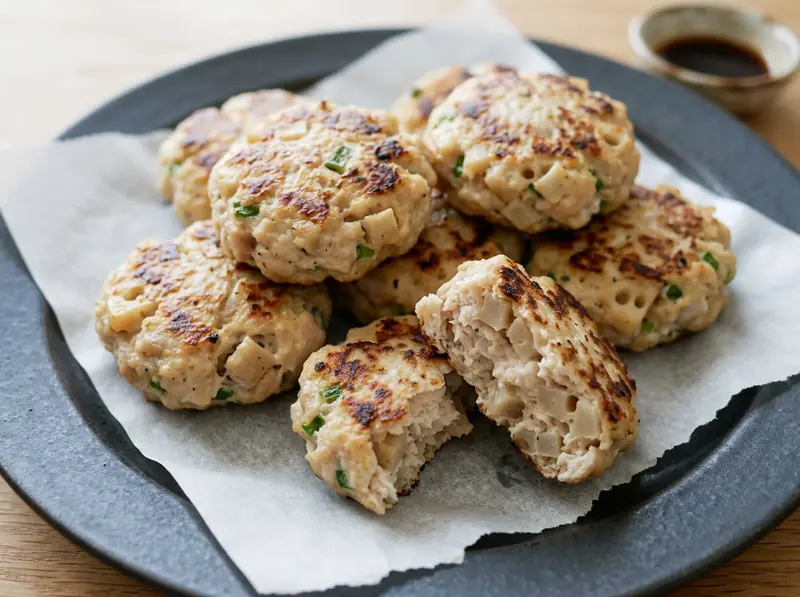
Chicken and Lotus Root Patties (Renkon Tsukune)
Chicken and lotus root patties, renkon tsukune (れんこんつくね) in Japanese, are small pan-fried patties from Japanese home cooking, made of ground or chopped chicken and lotus root held together with potato starch. They are one kind of tsukune, Japanese chicken patties. This version is 鶏むね肉とれんこんのつくね (torimune-niku to renkon no tsukune): the chicken is breast chopped with a knife, not bought ground chicken, and half of the lotus root goes in as 5 to 7 mm dice so it stays crunchy. Most Japanese recipes for renkon tsukune use ground chicken and finish the patties in a sweet soy glaze. These are fried plain until golden and served with a small dish of soy sauce and rice vinegar. The mixture is too loose to shape by hand, so it is spooned into the pan and pressed flat there, which is what the two Japanese chicken breast recipes we worked from do. Two things differ from the Japanese recipes we read. The other half of the lotus root is chopped fine where several of them grate it, and the patties get a last minute in the pan without the lid so the surface dries. The recipe makes 12 patties for 2 people and takes about 45 minutes.
What are chicken and lotus root patties (renkon tsukune)?
Renkon tsukune (れんこんつくね) are Japanese chicken patties with lotus root mixed in. Renkon is the Japanese word for lotus root, the underground stem of the lotus plant, and tsukune is the name these patties carry on Japanese recipe sites. The mixture is chicken, lotus root and potato starch (katakuriko), often with ginger, scallion and a spoonful of sake. It is shaped into small discs and cooked in a frying pan.
Japanese recipes handle the lotus root in different ways. Some chop all of it, some smash it in a bag, and several grate part of it and dice the rest. The pieces give the crunch the dish is known for, and Kikkoman's glossary says grated lotus root can work as a binder in minced meat dishes. In this recipe none of the lotus root is grated: half of the 150 g is cut into 5 to 7 mm dice for the crunch and half is chopped to 2 to 3 mm so it fills the spaces between them. The binding is left to the potato starch.
Renkon tsukune with chopped chicken breast vs ground chicken
Most renkon tsukune starts with ground chicken. The version with chicken breast cut by knife is less common. DELISH KITCHEN cuts the breast into 1 cm cubes, and the recipe site macaroni chops it coarsely. Our patties sit between the two: the breast is cut into 1 cm cubes and then chopped until about half of it is coarse mince. Both of those recipes spoon the mixture into the pan, and so does this one, because chopped breast makes a mixture that is hard to shape by hand.
The difference shows when you bite in. Ground chicken gives a soft, even patty. Chopped breast gives one with visible pieces of meat next to the pieces of lotus root. Breast is lean and dries out fast, which is why the patties spend 4 of their minutes in the pan under a lid, with 1 tbsp of water for steam. The cooking writer Yukari adds mayonnaise to her renkon tsukune for a fluffier patty. Lean breast needs that help more than ground chicken does, so 1 tbsp goes into this mixture.
How to serve renkon tsukune
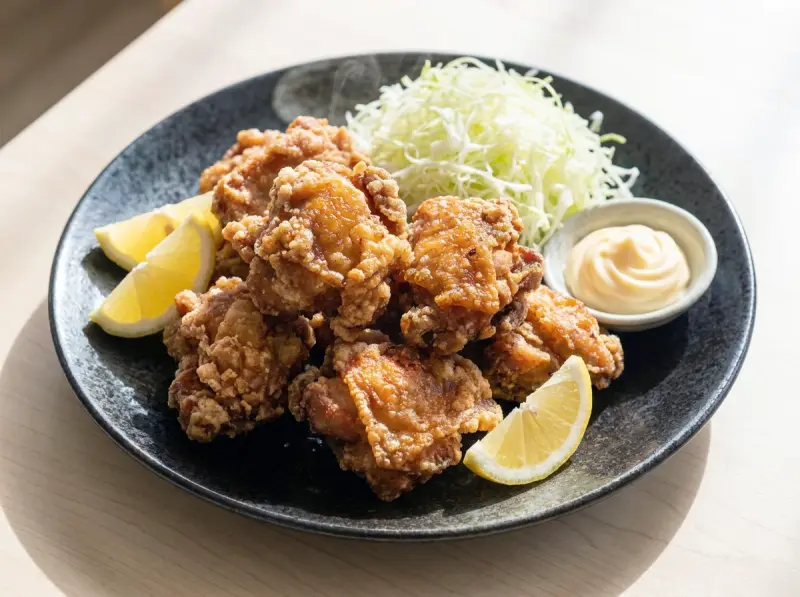
Serve the patties with the dip of 1 tbsp of soy sauce and 2 tsp of rice vinegar. DELISH KITCHEN serves its chicken breast version the same way and notes that the patties are good cold too. Macaroni seasons the mixture with aonori seaweed and suggests a little more aonori and salt on top once the patties are fried. For a full meal, add a bowl of rice and miso soup. If you like fried chicken with a ginger and soy marinade, try our chicken karaage next.
Ingredients
- 300 gchicken breast
- 150 glotus root
- 2 scallion stalks
- 5 gginger
- 18 gpotato starch
- 1 tbspmayonnaise
- 1 tbspsake
- 2 gsalt
- 1 tbspvegetable oil
- 3 tbspwater
- 1 tbspsoy sauce
- 2 tsprice vinegar
Method
- Cut and soak the lotus root. Peel the lotus root. You need 150 g after peeling, so buy about 200 g. Cut half of it (75 g) into dice of 5 to 7 mm and chop the other half finely, to 2 to 3 mm. The dice stay crunchy in the patties and the fine pieces fill the spaces between them. Put both into a small bowl of cold water and leave them for 5 minutes, which stops the cut lotus root from turning brown.
- Get the scallions, the ginger and the dip ready. While the lotus root soaks, thinly slice the 2 scallion stalks. You want about 2 tbsp. Finely grate the 5 g of ginger, which gives about 1 tsp. In a small dish, stir the 1 tbsp of soy sauce with the 2 tsp of rice vinegar for the dip and set it aside. When the 5 minutes are up, drain the lotus root in a sieve and leave it there to drip.
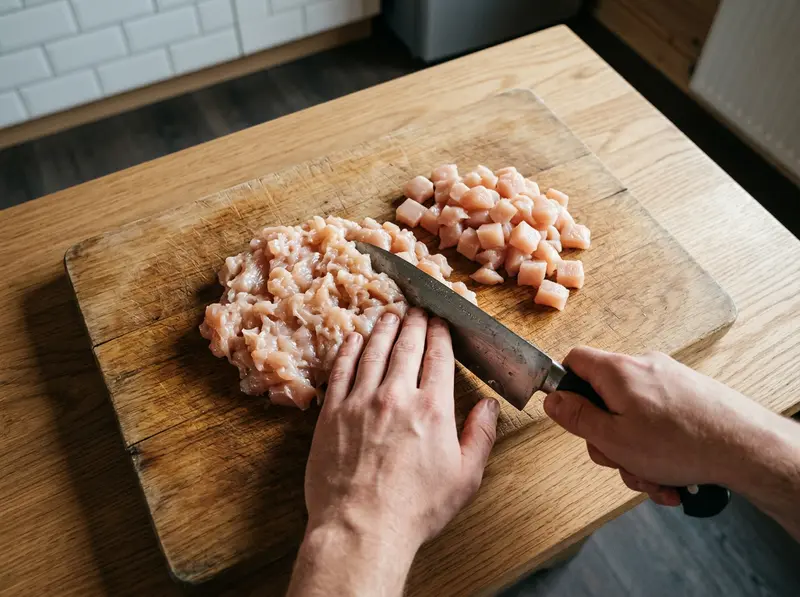
- Chop the chicken. Use skinless, boneless chicken breast. On the cutting board, cut the 300 g of chicken breast into slices 1 cm thick, the slices into strips 1 cm wide and the strips across into 1 cm cubes. Now chop through the pile with the knife until about half of the chicken has turned into a coarse, sticky mince that smears on the board, and the rest is still in separate pieces of up to 1 cm. The mince helps the patties hold together, and the pieces keep them juicy and give them bite. Scrape the chicken into a medium mixing bowl. Then wash the board, the knife and your hands with soap before you touch the dip or anything else that will not be cooked.
- Mix. Pat the drained lotus root dry with paper towels. The pieces should still be cream-white and the towel should come away only damp, because wet lotus root makes the mixture runny. Add the lotus root to the chicken with the scallions, the ginger, the 18 g of potato starch (2 level tbsp), the 1 tbsp of mayonnaise, the 1 tbsp of sake and the 2 g of salt (⅓ tsp). Mix with a spoon for about 1 minute. Stop when the mixture is sticky and you can see no dry starch. It will be loose, too soft to shape in your hands, and that is how it should be: the patties are shaped in the pan and hold together once the underside has set. The potato starch binds them, and the mayonnaise is there for a softer patty.
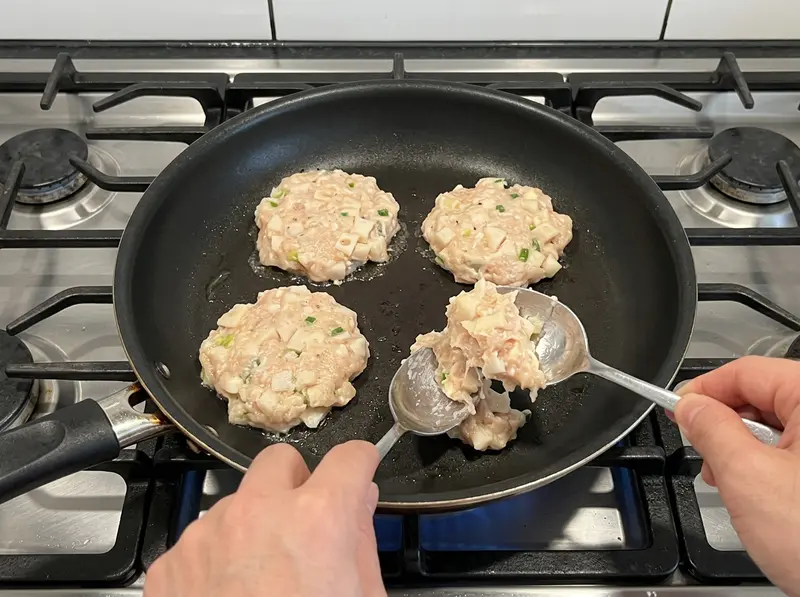
- Shape the first 4 patties in the pan. Use a 26 cm nonstick frying pan with a lid. With the spoon, mark the mixture in the bowl into 3 equal parts. Each part makes 4 patties of about 43 g, 12 in all. Heat 1 tsp of the vegetable oil, a third of the 1 tbsp, in the pan over medium heat for 1 minute, until the oil runs thin when you tilt the pan. Take up a quarter of one part with a spoon, push it off into the pan with a second spoon and press it flat with the back of the spoon into a disc about 6 cm across and 1.5 cm thick. Do the same with 3 more, about 2 cm apart, so there is room to get a spatula under each one. Fry for 3 minutes over medium heat, without the lid and without moving them. They are ready to turn when the underside is golden brown and a patty slides when you nudge it with the spatula. Before that the top is still raw and a patty breaks if you lift it.
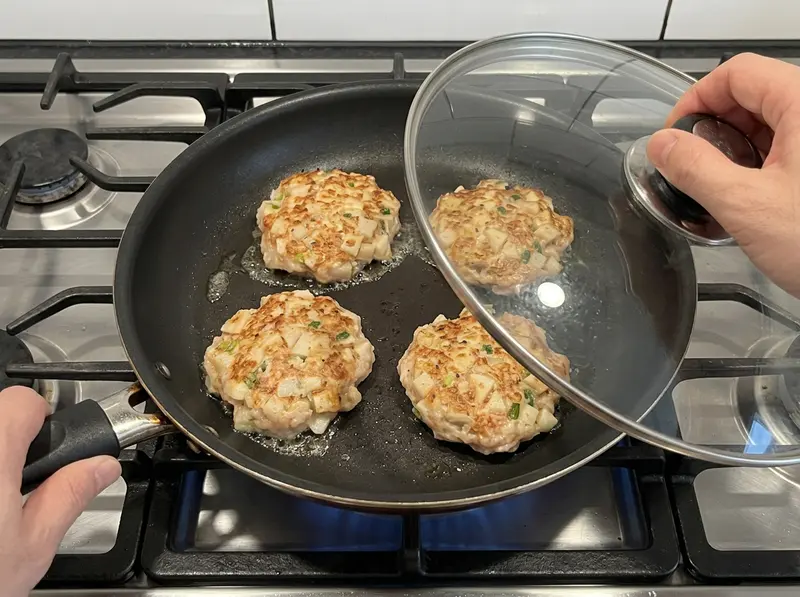
- Turn, steam and check. Turn the 4 patties over with the spatula. Pour 1 tbsp of the water into the pan at the edge, not over the patties, put the lid on at once and turn the heat down to low. The water spits when it hits the hot pan, so have the lid ready in your other hand. Cook for 4 minutes. The steam cooks the centre through before the lean breast dries out. Take the lid off, turn the heat back up to medium and fry for 1 minute more, until no water is left in the pan, the patties sizzle again and there are no beads of moisture on top. Lift one with the spatula: the underside should be golden too. The centre of a patty must reach 74 °C. Without a thermometer, break one open: the chicken should be white and opaque right through, with no pink, and the juices should run clear. If the centre is still pink or under 74 °C, put the lid back on and cook over low heat for 1 to 2 minutes more, then check again. Move the patties to a plate lined with paper towels.
- Fry the other 8 and serve. Fry the rest of the mixture in 2 more batches of 4, each with 1 tsp of the vegetable oil and 1 tbsp of the water: 3 minutes over medium heat without the lid, then 4 minutes over low heat under the lid with the water, then 1 minute over medium heat with the lid off. The pan is hotter now, so look at the underside after 2 minutes. Check one patty from each batch the same way, by thermometer or by breaking it open, and give the batch the extra 1 to 2 minutes under the lid if it needs them. Serve the patties when the last batch is done, 6 per person, with the dip on the side. The first ones will have cooled a little by then, which does them no harm.
FAQ
The mixture is loose on purpose, and a patty only holds once its underside has set, so leave it alone for the first 3 minutes and then turn it with a spatula in one go. If the patties still break, the usual cause is water: after its 5 minutes in cold water the lotus root has to be drained in a sieve and patted dry with paper towels. The chicken matters too. Chop the breast until about half of it is a coarse, sticky mince, then mix for about 1 minute, until you can see no dry starch. If the mixture still runs, add potato starch 1 tsp at a time.
No Japanese recipe we read tests a substitute in these patties and we have not tested one in this recipe either, so treat what follows as a fallback. Just One Cookbook compares the texture of lotus root to water chestnut, so start there: 150 g of water chestnuts, drained and patted dry if they come from a can, half cut into 5 to 7 mm dice and half chopped to 2 to 3 mm. The same site names burdock root and carrot as stand-ins for lotus root in some recipes. Both are harder, so chop all 150 g to 2 to 3 mm. Before you substitute, look in Asian and Japanese grocery stores for peeled, parboiled lotus root in packs, which needs no soak, only draining and patting dry.
Yes, and most Japanese recipes for renkon tsukune do just that. Use 300 g of ground chicken in place of the chicken breast, skip the chopping step and keep everything else the same. The patties come out softer and more even, without the larger pieces of meat you get from the knife. Fry them on the same schedule, 4 at a time, and check that the centre reaches 74 °C.
Put leftover patties in the fridge within 2 hours of cooking and eat them within 3 days, or freeze them for up to 1 month. If you reheat them, heat until the centre reaches 74 °C. They are also good cold, which is why Japanese recipe sites recommend them for bento, next to rice or onigiri. Keep the lunch box cold until you eat, and do not leave it at room temperature for more than 2 hours.
You can, and that is how most Japanese recipes for renkon tsukune finish them. Leave out the dip and stir together 1 tbsp each of soy sauce, mirin, sake and sugar. Glaze in the same batches of 4 and not all 12 at once, because 12 patties do not fit the pan in one layer: when a batch has had its last minute without the lid, pour a third of the mixture (4 tsp) in at the edge of the pan and turn the patties in it until they are coated and glossy. The glazed patties are darker and sweeter than the plain ones in this recipe. Our teriyaki sauce is a glaze of the same kind, thickened with cornstarch and flavoured with garlic and ginger.
Keep browsing
More dishes from the Japanese archive — picked by overlap with what you're cooking now.
Recipes by email
One letter a week: a recipe picked for your taste, plus whatever is new on the site. Unsubscribe in one click.
Welcome gift: Sergei's cookbook (e-book).
By subscribing you agree to the privacy policy.
Tell us what you like to cook (30 seconds) →
Join the conversation
Comments
No comments yet — be the first!