
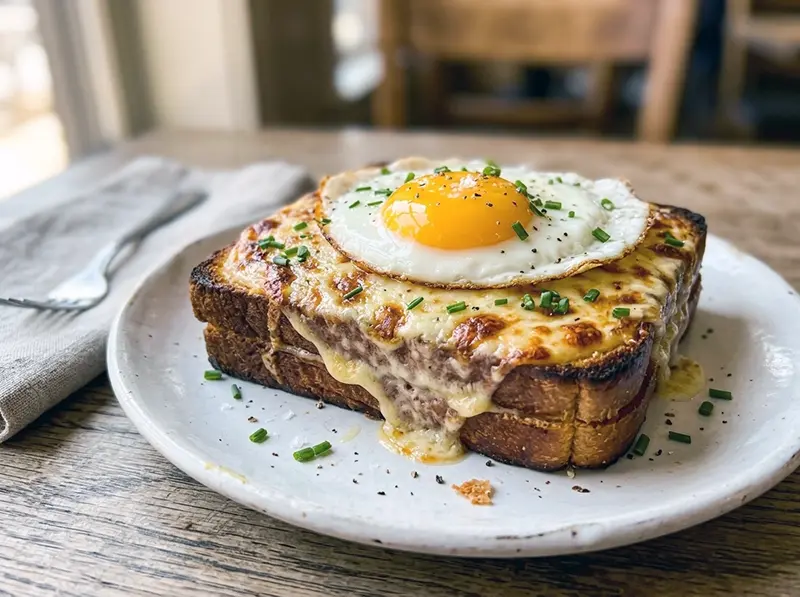
Croque Madame
Ein Croque Monsieur — Schinken, Gruyère und Béchamel auf getoastetem Weißbrot — mit einem Spiegelei obendrauf. Was ein gutes von einem mittelmäßigen unterscheidet ist die Béchamel: nicht nur als versteckte Schicht innen, sondern auch großzügig darüber gestrichen, wo sie unter dem Grill blubbert und bräunt und zu etwas wird das einer herzhaften Soufflékruste ähnelt. Das Eigelb, am Tisch gebrochen, tut den Rest.
Zutaten
- 4 ScheibenPain de mie oder dickes weißes Toastbrot
- 150 gGruyère oder Comté, fein
- 100 gQualitäts-Schinken, dünn
- 2 ELDijonsenf
- 2 große Eier
- 30 gungesalzene Butter
- 20 gungesalzene Butter
- 20 gWeizenmehl
- 250 mlVollmilch
- 1 Prisefrisch geriebene Muskatnuss
- 1 PriseSalz und weißer Pfeffer
- 10 gungesalzene Butter, zum Braten der Eier
Zubereitung
- Zuerst die Béchamel machen. 20 g Butter in einem kleinen Topf bei mittlerer-niedriger Hitze schmelzen. Mehl auf einmal hinzufügen und 2 Minuten ständig rühren. Vom Herd nehmen und Milch auf einmal hinzufügen und kräftig rühren. Auf mittlere Hitze zurückstellen und ständig rühren bis die Sauce eindickt, etwa 3-4 Minuten. Mit Muskatnuss, Salz und weißem Pfeffer würzen. Mit Frischhaltefolie direkt auf der Oberfläche bedecken.
- Brot in Butter toasten. Grill auf höchste Stufe vorheizen. 30 g Butter in einer großen Antihaftpfanne bei mittlerer Hitze schmelzen. Alle 4 Brotscheiben auf beiden Seiten in der Butter goldbraun und leicht knusprig anrösten, ca. 2 Minuten pro Seite. Auf ein mit Alufolie ausgelegtes Backblech übertragen.
- Sandwiches zusammenstellen. Eine dünne Schicht Dijonsenf auf einer Seite jeder Scheibe verteilen. 1-2 EL Béchamel über den Senf auf 2 Scheiben streichen. Schinken gleichmäßig verteilen und ein Drittel des geriebenen Gruyères darüberstreuen. Mit den anderen 2 Scheiben, Senf nach unten, abdecken. Jetzt eine dicke, großzügige Schicht Béchamel auf die Oberseite jedes Sandwiches bis zu den Rändern streichen. Restlichen Gruyère darüberstreuen.
- Gratinieren bis es blubbert und golden ist. Backblech unter den heißen Grill schieben und 3-5 Minuten under Beobachtung garen bis der Gruyère oben geschmolzen, blubbernde und dunkelgoldene Flecken hat. Währenddessen Eier in den dafür vorgesehenen 10 g Butter bei mittlerer-niedriger Hitze braten bis die Weißen vollständig gestockt und die Eigelbe komplett flüssig sind.
- Eier obendrauf legen und sofort servieren. Ein Spiegelei auf jedes gratinierte Sandwich legen. Das Eigelb muss flüssig sein. Sofort auf vorgewärmten Tellern servieren. Dies ist ein Messer-und-Gabel-Sandwich. Zuerst am Eigelb schneiden: das Eigelb fließt in die Béchamel und wird zu einer zusätzlichen Sauce.
Fragen
Genau eine Sache: das Ei. Ein Croque Monsieur ist ein Schinken-Gruyère-Sandwich mit Béchamel, getoastet oder gratiniert bis die Oberseite blubbert. Ein Croque Madame ist dasselbe Sandwich mit einem Spiegelei oben drauf. Das Eigelb, am Tisch aufgebrochen, fließt in die Béchamel und schafft eine zusätzliche Sauce.
Pain de mie — das klassische französische Weißtoastbrot — ist traditionell. Dickes weißes Toastbrot ist der praktischste Ersatz. Brioche funktioniert und gibt ein reichhaltigeres Ergebnis. Dünnes Toastbrot vermeiden: das Sandwich drückt zusammen und die Béchamel tränkt es durch.
Emmental ist der natürlichste Ersatz. Comté ist geschmacklich nah und ausgezeichnet. Gereifter Cheddar ist ein Notbehelf aber gibt einen schärferen und weniger französischen Geschmack. Weichkäse vermeiden — sie bräunen unter dem Grill nicht gleich.
Ja, komplett auf dem Herd. Nach dem Zusammenstellen mit einem Deckel bei niedriger Hitze abdecken — der Dampf lässt den Käse schmelzen. Man kann auch einen Küchenbrenner verwenden um die Béchamel und den Käse zu bräunen.
Teilweise. Die Béchamel kann 3 Tage im Voraus gemacht und im Kühlschrank mit Folie direkt auf der Oberfläche aufbewahrt werden. Die Sandwiches können (ohne Ei) einige Stunden vorher zusammengestellt und abgedeckt im Kühlschrank aufbewahrt werden, dann kurz vor dem Servieren gratinieren. Das Ei in letzter Minute braten.
Bewerten
Rezepte per E-Mail
Ein Brief pro Woche: ein Rezept nach Ihrem Geschmack und alles Neue auf der Seite. Abmelden mit einem Klick.
Als Geschenk: Sergeis Kochbuch (E-Book).
Mit der Anmeldung akzeptieren Sie die Datenschutzerklärung.
Verraten Sie uns, was Sie gern kochen (30 Sekunden) →Weiter stöbern
Weitere Gerichte aus dem Archiv — ausgewählt nach Überschneidung mit dem, was du gerade kochst.

An der Diskussion teilnehmen
Kommentare (2)
Room temperature eggs make a noticeable difference in this croque madame. Cold eggs don't incorporate as smoothly and can leave you with an uneven texture. Twenty minutes on the counter is all they need.
Частенько ем такое! Нормуль!