
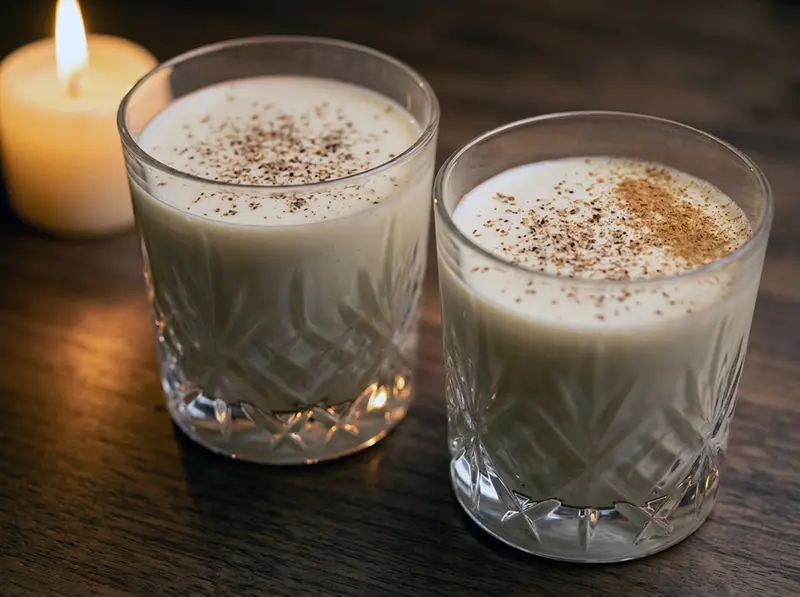
Hausgemachter Eggnog
Eigelb in eine dünne Creme mit Milch, Sahne, Muskatnuss und Vanille gekocht, dann gekühlt bis es andickt. Eggnog aus dem Laden ist süß und haltbar; dies ist etwas anderes — reichhaltig durch echte Eier, duftig durch frisch geriebene Muskatnuss, und dick genug um den Rücken eines Löffels zu überziehen. Die Technik ist genau dieselbe wie bei Crème anglaise.
Zutaten
- 6 Stückgroße Eigelbe
- 100 gZucker
- 480 mlVollmilch
- 240 mlSchlagsahne
- 0.5 TLfrisch geriebene Muskatnuss
- 1 TLVanilleextrakt
- 1 feines Salz
- 120 mlBourbon, dunkler Rum oder Brandy
Zubereitung
- Eigelb und Zucker aufschlagen. Eigelb und Zucker in eine mittelgroße Schüssel geben. 2-3 Minuten kräftig aufschlagen bis die Mischung blassgelb, glatt und dick genug ist, dass der Schneebesen eine sichtbare Spur hinterlässt. Nicht aufgelöster Zucker gibt körnige Textur, schlecht aufgeschlagene Eigelbe ein flaches, schweres Ergebnis.
- Milch und Sahne erwärmen. Milch, Sahne, Muskatnuss und Salz in einem Topf mit dickem Boden verbinden. Bei mittlerer Hitze erwärmen, gelegentlich rühren, bis die Mischung zu dampfen beginnt und kleine Blasen an den Rändern erscheinen — etwa 4-5 Minuten. Nicht kochen lassen. Bei aktivem Blubbern 30 Sekunden vom Herd nehmen bevor man weiterarbeitet.
- Eier temperieren. Dieser Schritt verhindert Rührei im Eggnog. Mit einer Kelle langsam etwa 120 ml heiße Milch in einem dünnen Strahl zu den Eigelben gießen und dabei ständig und schnell rühren. Noch eine Kelle zugeben und nochmals rühren. Wenn etwa die Hälfte der heißen Milch zugegeben wurde, die Eimasse zurück in den Topf gießen, dabei rühren.
- Auf 71°C kochen. Den Topf auf mittlere bis niedrige Hitze zurückstellen. Ständig mit Holzlöffel oder Spatel rühren, Boden und Seiten abkratzen. Kochen bis die Creme andickt und den Rücken des Löffels überzieht — eine saubere Linie wenn man den Finger durchzieht. Thermometer: 71-74°C. Nicht kochen lassen. Sofort vom Feuer nehmen sobald es andickt. Durch ein feines Sieb abseihen.
- Kühlen und servieren. Vanilleextrakt einrühren. Bei Raumtemperatur abkühlen lassen und gelegentlich rühren damit sich keine Haut bildet. Abdecken und mindestens 3 Stunden kühlen, am besten über Nacht. Vor dem Servieren gut umrühren, Alkohol zugeben falls gewünscht. In Gläser über Eis oder direkt aus dem Kühlschrank servieren. Frische Muskatnuss über jedes Glas reiben.
Fragen
Kochen wird dringend empfohlen. Temperieren und Kochen der Eigelbe auf 71°C eliminiert das Salmonellenrisiko und gibt auch ein besseres Ergebnis als roher Eggnog: die gekochte Creme ist seidiger und dicker. Wenn ohne Kochen, pasteurisierte Eier verwenden. Der Alkohol in gespüktem Eggnog ist kein zuverlässiger Schutz gegen Bakterien.
Gekaufter enthält Stärke, Carrageen und künstliche Aromen und hält monatelang. Selbstgemacht: Eier, Milch, Sahne, Zucker und Muskatnuss, fertig. Die Textur von selbstgemachtem ist leichter und trinkbarer; der Geschmack ist echtes Ei und echtes Gewürz. Der größte praktische Unterschied: frisch geriebene Muskatnuss. Die gemahlene aus dem Glas riecht fast nach nichts.
Bourbon, dunkler Rum und Brandy sind die traditionellen Optionen. Bourbon gibt Vanille- und Karamellnoten die gut zu den Gewürzen passen. Dunkler Rum ist süßer und runder. Brandy trockener und feiner. Nach vollständiger Kühlung zugeben, nicht in die heiße Creme. Mit 30 ml pro Portion beginnen und nach Geschmack anpassen. Mit Alkohol verbessert sich Eggnog nach ein bis zwei Tagen im Kühlschrank.
Dicker: mehr Eigelbe, höheres Sahne-zu-Milch-Verhältnis, etwas länger kochen. Leichter: Teil der Sahne durch Milch ersetzen, oder Eiweiß zu weichen Spitzen schlagen und vor dem Servieren unterheben — gibt schaumige Punsch-Textur. Die zuverlässigste Formel für klassisches dickes Ergebnis: 2 Teile Sahne zu 1 Teil Milch.
Ohne Alkohol: 3-4 Tage im Kühlschrank in einem verschlossenen Glas. Mit Alkohol: bis zu 1 Woche. Im Voraus machen ist nicht nur möglich sondern empfohlen: frisch gemachter Eggnog ist etwas rau, und eine Nacht im Kühlschrank lässt die Creme sich setzen, die Gewürze sich beruhigen und die Aromen sich vereinen. Wenn er sich beim Lagern trennt, kurz aufschlagen vor dem Servieren.
Bewerten
Rezepte per E-Mail
Ein Brief pro Woche: ein Rezept nach Ihrem Geschmack und alles Neue auf der Seite. Abmelden mit einem Klick.
Als Geschenk: Sergeis Kochbuch (E-Book).
Mit der Anmeldung akzeptieren Sie die Datenschutzerklärung.
Verraten Sie uns, was Sie gern kochen (30 Sekunden) →Weiter stöbern
Weitere Gerichte aus dem Archiv — ausgewählt nach Überschneidung mit dem, was du gerade kochst.
An der Diskussion teilnehmen
Kommentare (1)
I always chill the glasses for homemade eggnog — 15 minutes in the freezer transforms the drinking experience. The frost on the glass keeps everything at the perfect temperature through the last sip.