
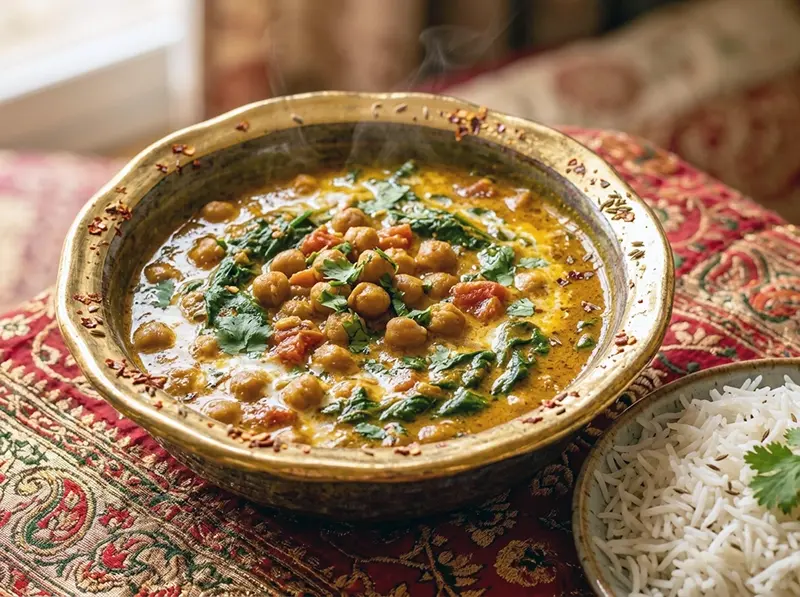
Curry de garbanzos y espinacas
Dos latas de garbanzos, una bolsa de espinacas, tomates, leche de coco y un puñado de especias. Una sola sartén, 35 minutos. El tipo de plato que cuesta casi nada, se recalienta perfectamente y sabe mejor al día siguiente.
Ingredientes
- 800 ggarbanzos en conserva
- 200 gespinacas frescas
- 1 ud.cebolla
- 4 ud.ajo
- 1 cdajengibre fresco
- 400 gtomates troceados en conserva
- 2 cdaconcentrado de tomate
- 200 mlleche de coco
- 150 mlcaldo de verduras
- 2 cdaaceite vegetal
- 1 cdtacomino molido
- 1 cdtacilantro molido
- 1 cdtacúrcuma
- 1 cdtagaram masala
- 0.5 cdtacayena
- 1 cdtasal
Preparación
- Pica la cebolla en daditos, pica el ajo fino y ralla el jengibre. Enjuaga los garbanzos bajo agua fría.
- Calienta el aceite en una sartén grande a fuego medio. Cocina la cebolla 5 a 6 minutos hasta que esté blanda y empiece a dorarse por los bordes. Añade el ajo y el jengibre, remueve 1 minuto.
- Añade el comino, el cilantro, la cúrcuma y la cayena. Remueve constantemente 2 minutos — las especias tienen que freírse en el aceite, no limitarse a flotar en líquido. Aquí es donde nace el sabor.
- Añade el concentrado de tomate y remueve otros 2 minutos hasta que oscurezca ligeramente. Luego añade los tomates, los garbanzos, el caldo y la leche de coco. Mezcla bien.
- Lleva a ebullición, baja el fuego y cuece sin tapa durante 15 minutos, removiendo de vez en cuando. La salsa debe reducir y espesar. Si sigue líquida, aplasta unos cuantos garbanzos contra el borde de la sartén con una cuchara — el almidón espesa sin harina.
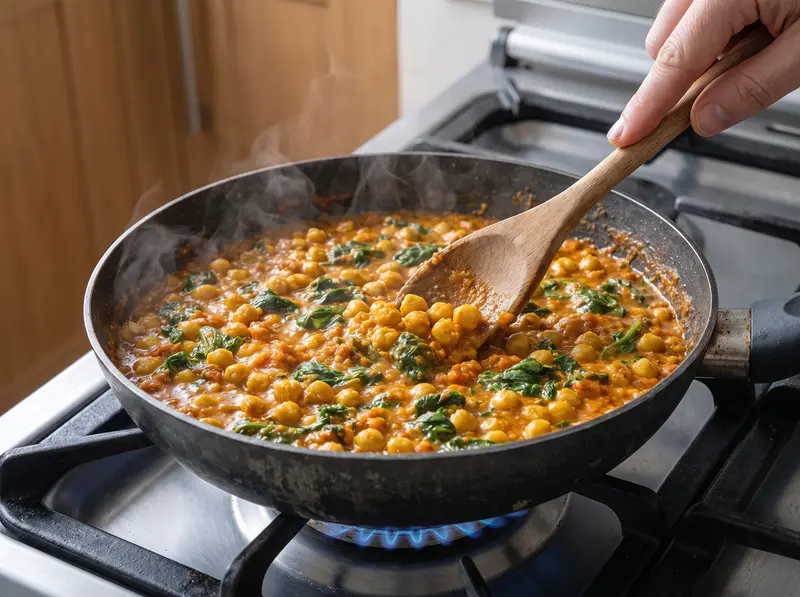
- Añade las espinacas a puñados, removiendo entre cada adición hasta que se marchiten. Incorpora el garam masala. Prueba y rectifica de sal. Sirve con arroz basmati o pan plano.
Preguntas
El curry aguado casi siempre viene de pasos saltados. Las especias tienen que freírse en aceite con la cebolla — 2 o 3 minutos al fuego activan la aromaticidad mucho mejor que añadirlas al líquido. El concentrado de tomate debe oscurecer en la sartén antes de añadir líquido — 2 o 3 minutos solo eliminan el sabor metálico crudo y añaden profundidad. El hervor final debe ser sin tapa, 10 a 15 minutos, para que se evapore el exceso de humedad. Si sigue líquido: aplasta unos cuantos garbanzos con una cuchara directamente en la salsa. El almidón espesa sin harina.
Para curry, no. Los cocidos en casa son algo más firmes y neutros, pero absorben las especias y la salsa igual durante la cocción y la diferencia en el plato terminado es mínima. Lo único importante con los de conserva: enjuágalos bien bajo agua fría — elimina el líquido de la lata y el sodio extra. Si quieres un sabor más tostado y mejor textura, cuécelos tú. Para un curry de entre semana los de conserva son completamente equivalentes.
El curry en polvo funciona. Pero las mezclas suelen tener demasiada cúrcuma y poco de todo lo demás, así que el sabor será menos complejo. Una buena base para este plato: comino, cilantro molido, cúrcuma, garam masala y cayena si quieres picante. El ajo y el jengibre son imprescindibles de todas formas. Si usas mezcla, añade una pizca extra de garam masala al final — afina todo el sabor. La regla clave para cualquier especia: fríelas en aceite antes de añadir los tomates. Sin ese paso el curry quedará plano.
La leche de coco da cremosidad y suaviza el picante de las especias. Sin ella el curry quedará más ácido y cortante. El sustituto más cercano es la crema de anacardos: un puñado de anacardos remojados en agua hirviendo 20 minutos, luego triturados con agua hasta obtener una consistencia láctea. La nata de soja o avena del supermercado es la opción más fácil. Solo más tomates y caldo sin componente cremoso también funciona — obtienes un curry más tomate, plato diferente pero rico. Si eliminas la leche de coco, añade una pizca de azúcar al final para suavizar la acidez de los tomates.
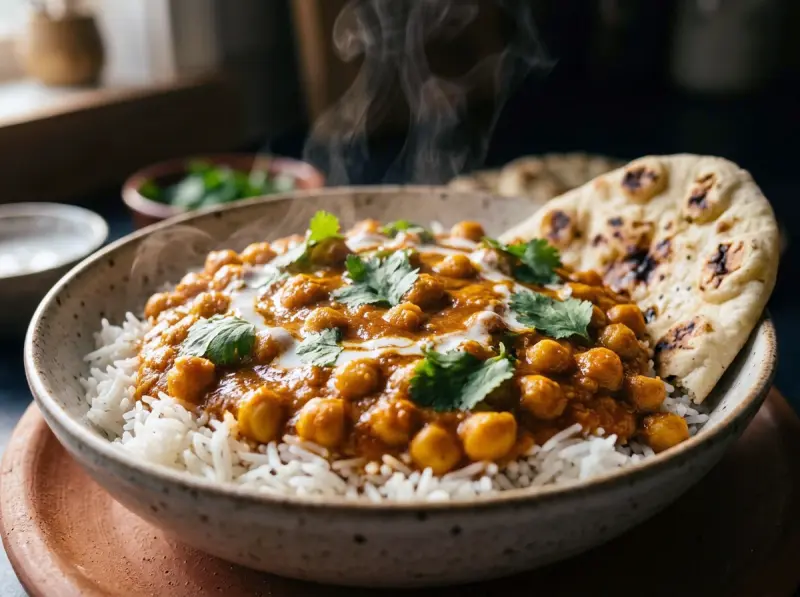
El arroz basmati es el clásico: absorbe la salsa y queda suelto. El arroz largo normal también funciona, solo con diferente textura. El naan o el pan pita van bien si quieres mojar la salsa con pan. El chapati (pan plano sin levadura) es una opción más ligera. Quinoa o coliflor si quieres sin carbohidratos. Yo siempre pongo una cucharada de yogur natural encima justo antes de comer — enfría y equilibra el picante. Pequeño detalle que cambia cómo se siente todo el plato.
Valora
Recetas en tu correo
Un correo a la semana: una receta elegida a tu gusto y lo nuevo del sitio. Puedes dejar de recibirlo con un clic.
De regalo: el libro de recetas de Sergei (e-book).
Al pulsar el botón aceptas la política de privacidad.
Cuéntanos qué te gusta cocinar (30 segundos) →Sigue explorando
Más platos del archivo — elegidos por su solapamiento con lo que estás cocinando ahora.
Únete a la conversación
Comentarios (1)
Cook the canned chickpeas until it just barely yields to a knife for chickpea and spinach curry. It continues softening from residual heat for 2-3 minutes. Cooking until fully soft in the pan means mush on the plate.