
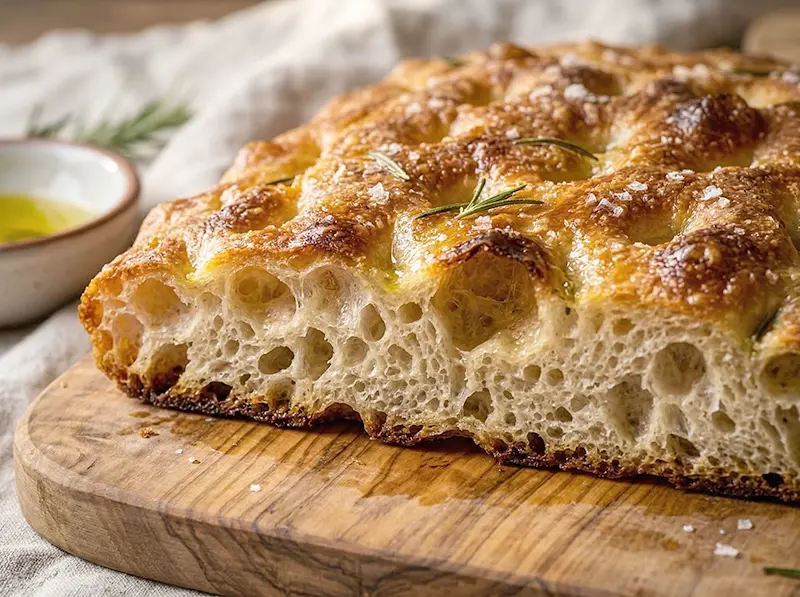
Focaccia
Una masa muy hidratada estirada en una bandeja generosamente aceitada, hundida profundamente con los dedos para crear bolsillos que retengan la salmuera y el aceite de oliva, luego horneada a alta temperatura hasta que la base quede frita y crujiente y la superficie se dore profundamente. La focaccia de Liguria — con sal marina y romero — es la versión que todos copian y que casi nadie hace correctamente en casa. La salmuera es la técnica que casi todos se saltan.
Ingredientes
- 500 gharina de fuerza o harina fuerte
- 7 glevadura instantánea
- 10 gsal fina
- 400 mlagua tibia
- 80 mlaceite de oliva virgen extra
- 60 mlaceite de oliva virgen extra
- 120 mlagua
- 5 gsal fina
- sal marina en escamas
- ramas de romero fresco
Preparación
- En un bol grande mezcla harina, levadura y sal. Añade el agua tibia y 80 ml de aceite de oliva. Mezcla hasta que no quede harina seca. La masa será muy pegajosa y húmeda. No añadas más harina. Tapa y deja levar a temperatura ambiente 2–3 horas hasta que doble y esté burbujante, o toda la noche en nevera (8–16 horas) para más sabor.
- Vierte 30 ml de aceite en una bandeja metálica de 23×33 cm. Vuelca la masa y estírala con manos engrasadas hacia los bordes. Si se retrae, cúbrela 10 minutos y vuelve a intentarlo. Déjala reposar 30–45 minutos hasta que infle.
- Prepara la salmuera: disuelve 5 g de sal en 120 ml de agua. Reserva. Precalienta el horno a 230°C.
- Haz los hoyos: rocía los 30 ml restantes de aceite sobre la masa. Engrasa bien las yemas. Presiona firmemente hacia el fondo de la bandeja por toda la superficie creando bolsillos profundos. No seas tímido — los hoyos deben ser profundos.
- Vierte la salmuera uniformemente para que se acumule en los hoyos. Distribuye el romero. La superficie quedará húmeda y encharcada — así está bien. Espolvorea con sal en escamas.
- Hornea en la rejilla inferior 20–25 minutos hasta que la superficie sea dorado profundo. Levanta una esquina para revisar la base — debe ser dorada y ligeramente crujiente, no blanca. Saca a una rejilla inmediatamente. Rocía con una cucharada más de aceite en caliente.
Preguntas
La salmuera mantiene húmeda la parte superior durante la primera fase. Al evaporarse, frena el dorado de la superficie — la parte superior se escalfa en agua salada mientras el aceite fríe la base. Una vez evaporada el agua, el aceite toma el control y la superficie adquiere color profundo. Sin salmuera, la parte superior se seca antes de que la base se haya crujido.
Normalmente una de tres causas: la masa no levó suficiente (debe estar visiblemente burbujante y suave); se añadió demasiada harina al manipularla (usa manos engrasadas, no enharinadas); la masa se desgasificó al estirarla. Estira con suavidad, no presiones hacia abajo.
La versión del mismo día (2–3 horas a temperatura ambiente) está buena pero es menos sabrosa. Para acelerarla: aumenta la levadura a 10 g, usa agua más caliente (40°C) y coloca la masa en un lugar cálido. No igualará la versión overnight.
Cuatro factores: bandeja metálica (no vidrio ni cerámica); suficiente aceite (3–4 cdas — la base debe estar en aceite); hornear en la rejilla inferior; hornear suficiente tiempo. Levanta una esquina y comprueba que la base es dorada. El metal oscuro da mejores resultados.
La clásica ligur solo lleva romero, sal en escamas y aceite. Para otros ingredientes: añádelos al hacer los hoyos, antes de la salmuera. Funcionan bien tomates cherry, aceitunas kalamata, cebolla roja, ajo, tomillo. Patata fina con romero es un clásico ligur. El queso solo en los últimos 5 minutos. Nunca albahaca fresca antes de hornear — ponla en caliente al sacar.
Valora
Recetas en tu correo
Un correo a la semana: una receta elegida a tu gusto y lo nuevo del sitio. Puedes dejar de recibirlo con un clic.
De regalo: el libro de recetas de Sergei (e-book).
Al pulsar el botón aceptas la política de privacidad.
Cuéntanos qué te gusta cocinar (30 segundos) →Sigue explorando
Más platos del archivo — elegidos por su solapamiento con lo que estás cocinando ahora.
Únete a la conversación
Comentarios (3)
Facilissima! L'olio d'oliva dev'essere abbondante sia nell'impasto che sopra. Il sale grosso in superficie è fondamentale non dimenticatelo
Фокачча — это не пицца без начинки, хватит так к ней относиться. Тесто должно быть влажным почти до неприличия, и его не надо месить — достаточно складывать в миске. Оливковое масло лейте щедро, прямо в форму, не жалейте. Пальцами делайте глубокие ямки — именно в них собирается масло и соль.
Don't open the oven door during the first two-thirds of baking focaccia. The sudden temperature drop can cause sinking, cracking, or uneven rising. Trust the timer and check only in the final stretch.