
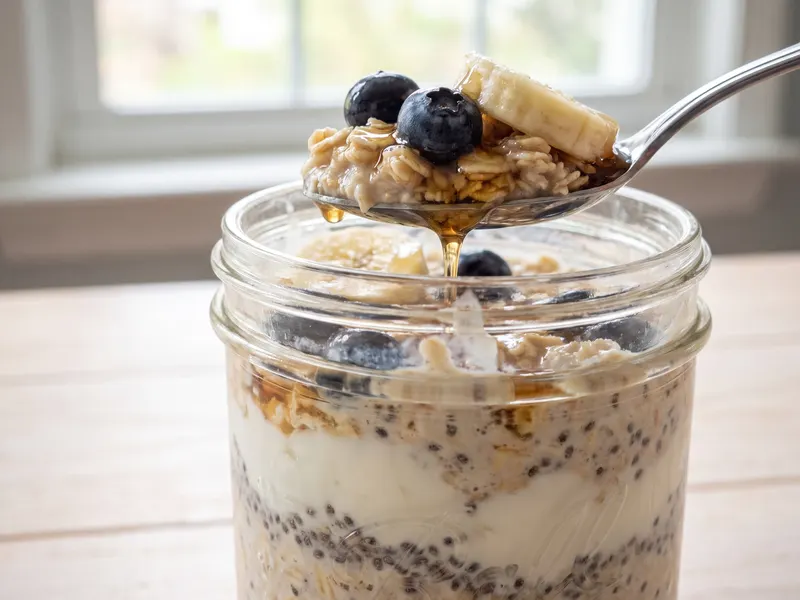
Avena fría con yogur
Cinco minutos la noche anterior y el desayuno ya espera en la nevera. Los copos de avena se remojan en leche y yogur durante la noche. Por la mañana las semillas de chía han espesado todo hasta volverse cremoso y denso.
Ingredientes
- 50 gcopos de avena
- 120 mlleche
- 60 gyogur griego
- 1 cdasemillas de chía
- 1 cdajarabe de arce
- 0.25 cdtaextracto de vainilla
- 1 pizcasal
Preparación
- Pon los copos de avena y las semillas de chía en un tarro con tapa. Añade una pizca de sal.
- Vierte la leche, agrega el yogur, el jarabe de arce y el extracto de vainilla. Mezcla bien.
- Cierra y mete en la nevera al menos 6 horas. Toda la noche es mejor — 8 horas dan la textura más cremosa.
- Por la mañana, remueve bien. ¿Demasiado espeso? Añade un chorrito de leche. Agrega los toppings y come del tarro.
Preguntas
Los copos instantáneos absorben el líquido demasiado rápido y al amanecer son una papilla sin textura. Los copos tradicionales absorben lentamente y conservan cremosidad con cuerpo. Solo los copos tradicionales dan el equilibrio justo.
Un tarro con yogur griego y semillas de chía aporta unos 14–16 g de proteína. Agrega mantequilla de cacahuete y llegas a 20–25 g. Para un desayuno sin cocción, es un número serio.
Hasta 5 días en un tarro cerrado. Los primeros tres días son los mejores. El plátano y las fresas, mejor añadirlos justo antes de comer.
Sí. Microondas 60–90 segundos, remover a la mitad. El recalentado no arruina la textura.
Sí, pero el resultado será más líquido. Aumenta las semillas de chía a 1,5 cucharadas y usa leche vegetal con grasa.
Valora
Recetas en tu correo
Un correo a la semana: una receta elegida a tu gusto y lo nuevo del sitio. Puedes dejar de recibirlo con un clic.
De regalo: el libro de recetas de Sergei (e-book).
Al pulsar el botón aceptas la política de privacidad.
Cuéntanos qué te gusta cocinar (30 segundos) →Sigue explorando
Más platos del archivo — elegidos por su solapamiento con lo que estás cocinando ahora.
Únete a la conversación
Comentarios (1)
Timing is everything with cold-brew oats. I have the plate warming in the oven while I cook, so everything goes from pan to table at peak temperature. This is not a dish that waits well.