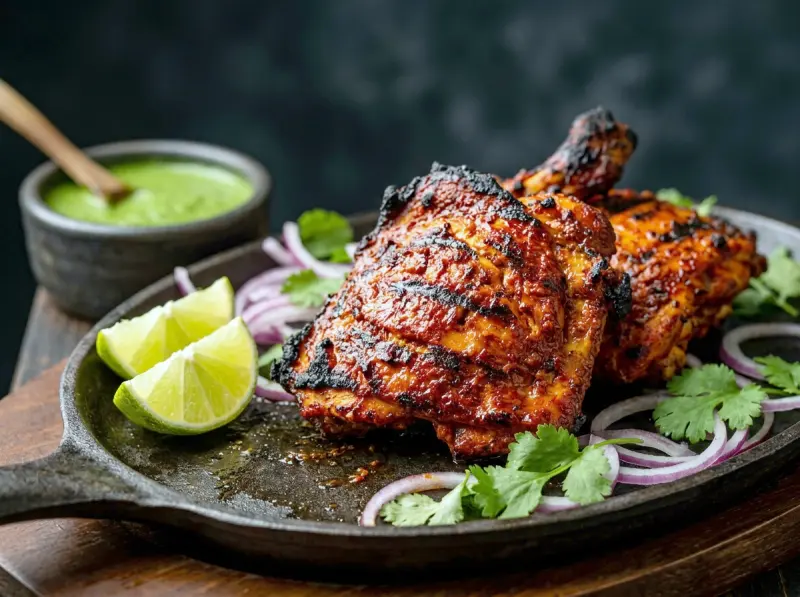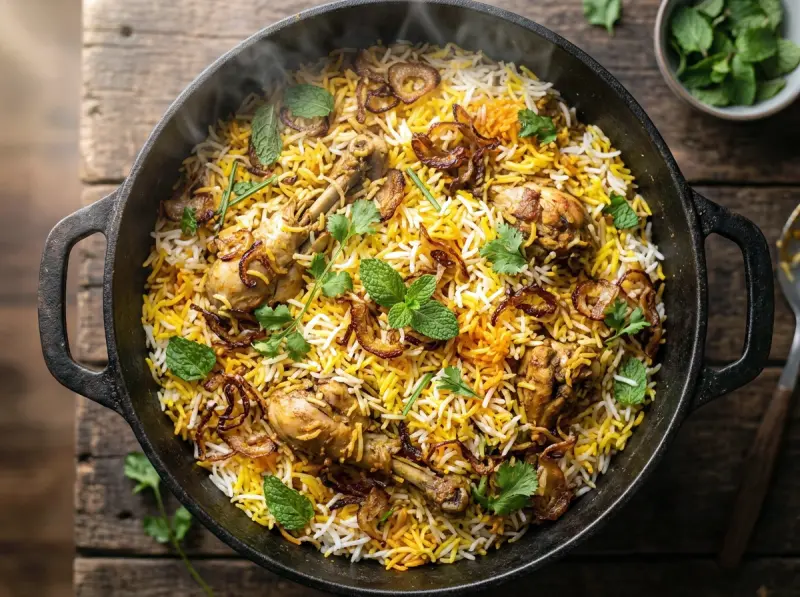
Three things determine whether a biryani is good or merely decent. First: the rice at exactly 75% done before layering. Overcooked rice going into the dum will turn mushy. Undercooked rice may not finish properly. Bite a grain at the 5-minute mark — you want soft outside, chalky in the middle. Second: the birista onions cooked to genuinely dark gold, not pale gold. Pale onions mean a pale, flat-tasting biryani. Third: the sealed pot and the full 25 minutes on low heat. Every minute of that steam is doing work — infusing the rice with the chicken juices, saffron, and spice aromatics from below.
To seal the pot properly without dough: press a sheet of foil over the top of the pot, then press the lid down hard onto it. The foil creates the seal; the lid holds it. Place the pot on a tawa (flat griddle) or thick baking sheet on the lowest burner if your stove runs hot at 'low' — this diffuses the heat and prevents the bottom from burning. The biryani is done when you can smell saffron and spice coming out around the edges of the lid.
Chicken Biryani
By Sergei Martynov
Marinated chicken layered with par-cooked basmati rice, fried onions, saffron milk, and whole spices, then sealed and slow-cooked on low heat so the steam does the work. This is Hyderabadi-style pakki dum biryani — the chicken is cooked first, then layered with rice and finished in a sealed pot. It takes effort. Not complicated effort, but deliberate effort: the rice must be 75% done before layering, the onions must be genuinely dark gold, and the pot must stay sealed for the full 25 minutes. Each of those things matters more than the spice list.
What you'll need
Ingredients
- 700 g
See recipes with bone-in chicken thighs and drumsticksbone-in chicken thighs and drumsticks, skin removed, scored
i - 150 g
See recipes with full-fat plain yogurtfull-fat plain yogurt
i - 1.5 tsp
See recipes with kashmiri chilli powderKashmiri chilli powder
i - 1 tsp
See recipes with garam masalagaram masala (for marinade)
i - 1 tsp
See recipes with ground corianderground coriander
i - 0.5 tsp
See recipes with turmericturmeric
i - 1 tbsp
See recipes with ginger-garlic pasteginger-garlic paste
i - 1 tsp
See recipes with saltsalt (for marinade)
i - 350 g
See recipes with aged long-grain basmati riceaged long-grain basmati rice, rinsed until clear, soaked 30 min
i - 2
See recipes with large onionslarge onions, thinly sliced (for the fried onions / birista)
i - 1 pinch
See recipes with saffron strandssaffron strands, steeped in 3 tbsp warm milk
i - 3 tbsp
See recipes with ghee or neutral oilghee or neutral oil
i - 2
See recipes with bay leavesbay leaves
i - 4
See recipes with green cardamom podsgreen cardamom pods, lightly crushed
i - 1
See recipes with cinnamon stickcinnamon stick (5 cm)
i - 4
See recipes with clovescloves
i - 1 tsp
See recipes with shahi jeera or regular cuminshahi jeera (black cumin) or regular cumin
i - 1 tbsp
See recipes with fresh mint leaves + 1 tbsp fresh coriander — for layeringfresh mint leaves + 1 tbsp fresh coriander — for layering
i - 1 tsp
See recipes with garam masalagaram masala (for layering, sprinkled over rice)
i
How to make it
Instructions
- 1
Marinate the chicken. Combine yogurt, Kashmiri chilli powder, garam masala, ground coriander, turmeric, ginger-garlic paste, and salt. Score each chicken piece two or three times to let the marinade penetrate. Add chicken, coat thoroughly, cover and refrigerate for at least 2 hours — overnight is better. The scoring and the yogurt acid together mean the spices reach the bone, not just the surface.
- 2
Fry the onions (birista). Heat 3 tablespoons of ghee or oil in a wide heavy pan over medium heat. Add the sliced onions. Fry, stirring every few minutes, for 20 to 25 minutes until deep golden-brown and beginning to crisp. They will look too dark before they're done — this is correct. Drain on paper towels immediately; they crisp as they cool. Reserve the flavoured oil in the pan. Divide the fried onions in half: one half goes into the chicken, one half is used for layering.
- 3
Cook the chicken masala. Return the onion-oil pan to medium heat. Add the marinated chicken and all its marinade. Cook uncovered, stirring occasionally, for 8 minutes until the chicken firms up. Cover and cook for another 15 minutes until the chicken is almost fully cooked and the masala is thick and saucy. Stir in half the fried onions. The masala should cling to the chicken rather than pool under it.
- 4
Par-cook the rice. Bring a large pot of salted water to a rolling boil — use at least 2 litres of water and 1 tablespoon of salt. Add the bay leaves, cardamom, cinnamon, cloves, and cumin. Drain the soaked rice and add to the boiling water. Cook on high heat, stirring gently once or twice, for 5 to 6 minutes until the rice is 75% cooked: a grain should be soft outside but have clear resistance in the centre. Drain immediately. Do not let the rice sit in the hot pot — it will keep cooking.
- 5
Layer and dum cook. In a large heavy-bottomed Dutch oven or pot, spread the chicken masala in an even base. Spoon half the par-cooked rice over the chicken in an even layer. Scatter half the remaining fried onions, half the mint and coriander, and half the saffron milk. Add the rest of the rice, then the remaining onions, herbs, and saffron milk. Sprinkle garam masala over the top. Drizzle 1 tablespoon of ghee. Cover the pot tightly with foil first, then the lid. Cook on high heat for 3 minutes, then reduce to the lowest possible heat and cook for 25 minutes. Turn off the heat and rest for 10 minutes without opening. Open, gently fold the layers together using a wide spatula, and serve with raita.
Frequently Asked Questions
What is the dum method and why does it matter for biryani?
Dum means 'breath' or 'steam' in Urdu. The technique involves sealing the assembled biryani in a heavy pot and cooking it over very low heat so the steam circulates through all the layers rather than escaping. That trapped steam carries the flavours of the chicken masala, saffron, whole spices, and fried onions up through the rice, infusing every grain. Without dum, rice and chicken cook separately and taste like it. The seal is traditionally made with a strip of dough pressed around the lid — foil pressed under the lid achieves the same result at home.
How cooked should the rice be before layering — why can't you fully cook it first?
Par-cook to 75%: the grain should be soft and yielding on the outside but have a firm, chalky centre when you bite it — similar to pasta al dente. Fully cooked rice going into the dum pot will turn mushy under 25 minutes of steam. The rice finishes cooking during the dum stage. Bite a grain at the 5 to 6-minute mark of boiling and pull it the moment the outside is soft. Salt the cooking water generously — under-salted rice will make the whole biryani taste flat, regardless of the spices in the chicken. After draining, layer immediately; do not let rice sit in the drained pot.
Why are fried onions (birista) so important in biryani — can you skip them?
Birista — thinly sliced onions fried to deep golden-brown — contribute a bitter-sweet caramelised depth that no other ingredient replicates. They also add textural contrast: crunchy pieces in soft rice. Some go into the chicken masala, some layer between the rice. The key is colour: dark gold is correct, black means burnt and bitter. Remove from the oil while still a shade lighter than you want — they continue darkening as they cool. They can be made 1 to 2 days ahead and stored in a sealed container. Skipping them produces a technically correct biryani that will taste noticeably flatter.
What rice should you use for biryani — does the variety matter, should you soak it?
Aged long-grain basmati is the only appropriate choice. Aged basmati has lower moisture content, meaning the grains absorb water more evenly and stay separate after cooking rather than clumping. Fresh basmati works but the grains are softer and more prone to sticking. Soaking for 30 minutes is essential: it allows even hydration and prevents the grains from snapping during the boil. Rinse the rice 3 to 4 times until the water runs clear — this removes surface starch and reduces stickiness. Short-grain, jasmine, or regular rice will turn mushy and should not be used.
Is biryani best eaten fresh or can you make it ahead — how to store and reheat?
Fresh biryani at its best: the saffron is vivid, the fried onions still have crunch, the rice is perfectly separate. The next day, the flavours are deeper and better integrated, but the rice softens slightly. Both are good. What you can prepare ahead: the marinade overnight, the birista 1 to 2 days ahead, the chicken masala base a day before. The assembled finished biryani keeps for 2 to 3 days in the fridge. To reheat: add 2 to 3 tablespoons of water, cover tightly with foil, and warm in the oven at 160°C for 15 to 20 minutes, or reheat on the stovetop over low heat with a lid, stirring very gently to avoid breaking the rice.


Join the conversation
Comments
Loading comments…