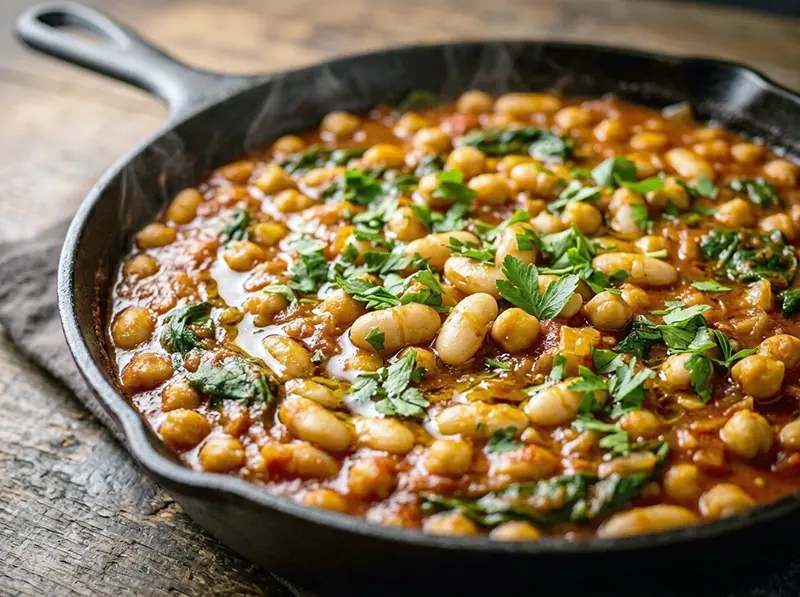
White beans and chickpeas are not interchangeable here — they do different things. The white beans (cannellini work best, butter beans are a close second) are soft and creamy and dissolve slightly at the edges, thickening the sauce. The chickpeas hold their shape and give you something to bite into. Using both is the point. If you only have one type, use it, but the texture will be more one-dimensional.
Rinsing canned beans is not optional when gut health is the goal. A thorough rinse removes a significant portion of the oligosaccharides responsible for gas and bloating — the same compounds that make raw beans hard to digest. For people new to eating legumes regularly, start with half a portion for the first week and let the gut microbiome adapt.
High-Fiber White Bean & Chickpea Skillet
By Sergei Martynov
White beans and chickpeas in a garlicky tomato base with smoked paprika and wilted spinach — one skillet, 25 minutes, around 18 g of fiber per serving. This is the kind of dinner that looks simple and then keeps you full for four hours. No meat, no gluten, and genuinely good enough to make on a weeknight without thinking of it as a compromise. Serve with crusty bread or flatbread to drag through the sauce.
What you'll need
Ingredients
- 400 g
See recipes with canned white beanscanned white beans, drained and rinsed
i - 400 g
See recipes with canned chickpeascanned chickpeas, drained and rinsed
i - 400 g
See recipes with canned crushed tomatoescanned crushed tomatoes
i - 100 g
See recipes with baby spinachbaby spinach
i - 1
See recipes with yellow onionyellow onion
i - 5
See recipes with garlic clovesgarlic cloves
i - 3 tbsp
See recipes with olive oilolive oil
i - 2 tsp
See recipes with smoked paprikasmoked paprika
i - 1 tsp
See recipes with ground cuminground cumin
i - 0.5 tsp
See recipes with chili flakeschili flakes
i - 1 tbsp
See recipes with lemon juicelemon juice
i - 1 tsp
- 0.5 tsp
See recipes with black pepperblack pepper
i - 30 g
See recipes with fresh parsleyfresh parsley
i - 2 tbsp
See recipes with extra virgin olive oilextra virgin olive oil
i
How to make it
Instructions
- 1
Drain and rinse the white beans and chickpeas thoroughly under cold running water — this removes the starchy liquid that causes bloating and gives canned beans a metallic edge. Shake off as much water as possible and set aside. Dice the onion. Mince the garlic.
- 2
Heat olive oil in a large skillet over medium heat. Add the onion and cook for 5–6 minutes, stirring occasionally, until soft and beginning to turn golden at the edges. Do not rush this — the sweetness that develops here is the backbone of the sauce.
- 3
Add the garlic, smoked paprika, cumin, and chili flakes. Stir constantly for about 1 minute until the spices bloom and the garlic smells fragrant. The mix will look dry and almost paste-like — that is exactly right.
- 4
Pour in the crushed tomatoes and stir everything together. Add the white beans and chickpeas. Season with salt and pepper. Bring to a gentle simmer, then reduce heat to medium-low and cook uncovered for 10 minutes, stirring occasionally. The sauce will thicken and the beans will absorb the tomato flavor.
- 5
Add the baby spinach in two or three handfuls, stirring each addition until just wilted before adding more — about 1 minute total. The spinach will lose about two-thirds of its volume. Take the pan off the heat.
- 6
Squeeze the lemon juice over the skillet and stir once. Drizzle with extra virgin olive oil, scatter the chopped parsley on top, and serve straight from the pan. Flatbread or sourdough alongside for scooping.
Frequently Asked Questions
How much fiber is in a serving of white bean and chickpea skillet — is this really one of the best high-fiber dinners?
One serving contains roughly 17–19 g of dietary fiber — more than half the recommended daily intake of 28–38 g according to FDA guidelines. For comparison, a bowl of oatmeal has about 4 g, a serving of broccoli around 5 g. White beans contribute approximately 7 g of fiber per 100 g, chickpeas around 6 g, and the spinach and tomatoes add another 2–3 g. Research published in the American Journal of Clinical Nutrition consistently shows that regular legume consumption lowers LDL cholesterol and supports microbiome diversity — two of the most evidence-backed benefits of a high-fiber diet.
Why do beans cause bloating — and how do I cook this white bean skillet to avoid it?
Bloating comes from oligosaccharides — complex carbohydrates that human digestive enzymes cannot break down. They reach the colon intact, where gut bacteria ferment them and produce gas. Three things reduce this significantly: first, rinse canned beans thoroughly under cold water, which removes up to 40% of the problematic compounds; second, add a pinch of ground cumin or asafoetida to the pan — both are traditional digestive aids that inhibit the enzymes responsible for fermentation; third, eat smaller portions at first and increase gradually over two to three weeks. The gut microbiome adapts, and the bloating tends to decrease markedly once legumes become a regular part of the diet.
Can I substitute butter beans or lentils for chickpeas in this skillet — what works best?
Butter beans are the best swap — same creamy texture, slightly milder flavor, identical fiber content. Red lentils will break down entirely and thicken the sauce into something closer to a dal, which is good in its own right but a different dish. Green or brown lentils hold their shape better and work well, though they need 5 extra minutes of cooking time. Black beans shift the flavor profile toward something more earthy and smoky — good with extra cumin and a squeeze of lime instead of lemon. Edamame, added frozen in the last 3 minutes, brings extra protein and a pop of sweetness.
Can I make this chickpea skillet ahead of time — how do I store it without the beans going mushy?
The skillet actually improves the next day — the beans absorb more of the tomato and spice flavor overnight and the sauce becomes richer. Store in an airtight container for up to 4 days. When reheating, add 2–3 tablespoons of water or vegetable broth because the beans continue to absorb liquid in the fridge. The spinach will lose its bright color by day two, which is fine for flavor but less visually appealing — if that matters, stir fresh spinach in when reheating rather than adding it to the batch you plan to store.
Is white bean skillet a good high-fiber dinner for people with IBS — are legumes safe on a low-FODMAP diet?
White beans contain fewer FODMAPs than chickpeas, which is why this recipe uses both rather than chickpeas alone — the ratio matters. Canned and well-rinsed legumes are generally better tolerated than home-cooked dried ones because rinsing removes water-soluble FODMAPs. Portion size is the main lever: a 100 g serving of canned, rinsed white beans falls within low-FODMAP guidelines according to Monash University data, while a full 200 g serving exceeds the threshold. If you have diagnosed IBS and are in the elimination phase of a low-FODMAP protocol, start with a half portion and monitor your response. Consult a registered dietitian before drawing conclusions — individual tolerance varies considerably.


Join the conversation
Comments
Loading comments…