Let me clear up the single biggest confusion I see with this recipe: curry leaves are NOT curry powder. They're completely different things. Curry leaves are fresh, glossy, aromatic leaves that look like small bay leaves — you'll find them in Indian grocery stores, usually sold as sprigs with 15–20 leaves attached. They have a citrusy, slightly nutty fragrance that's absolutely irreplaceable in South Indian cooking. Curry powder, on the other hand, is a British-invented spice blend that no Indian cook actually uses. If you can't find fresh curry leaves, the closest approximation is a combination of a bay leaf plus the zest of half a lime — it won't be the same, but it'll get you in the neighborhood. As for the tamarind paste: it's a concentrated sour-sweet paste made from tamarind fruit, sold in jars in most Asian stores. If you can't find it, mix 2 tablespoons of lime juice with 1 teaspoon of brown sugar.
For the best Kerala fish curry, use firm white fish like cod, sea bass, or halibut — they hold their shape during simmering. Avoid tilapia or sole, which fall apart too easily. And always let the curry rest for 5–10 minutes after cooking before serving — the fish absorbs the sauce and the flavors deepen dramatically.
Keralan Fish Curry
By Sergei Martynov
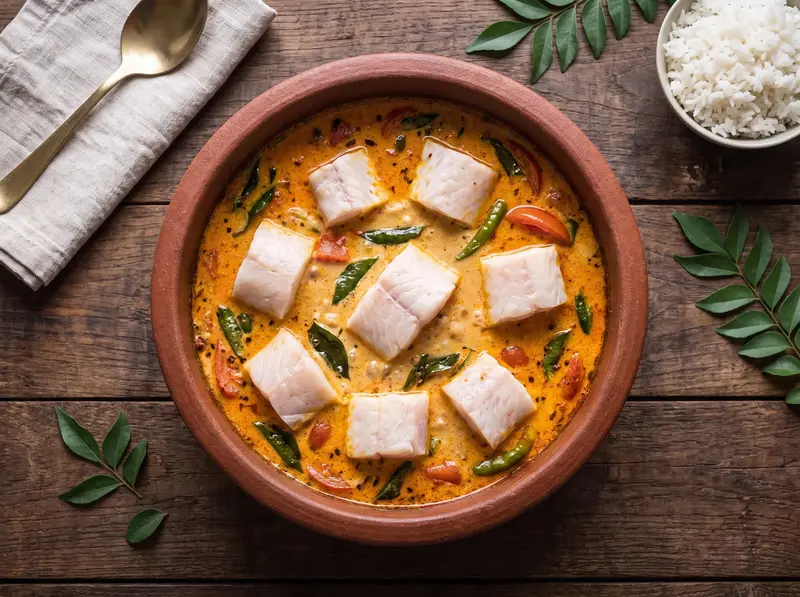
Authentic South Indian fish curry from Kerala — tender white fish fillets simmered in a coconut milk sauce with curry leaves, mustard seeds, and tamarind. This isn't your typical creamy curry — it's lighter, tangier, and deeply aromatic from the tempered spices and fresh curry leaves. The tamarind gives it that signature sour note that balances the richness of coconut milk. The golden rule: never stir the fish, just shake the pan gently to keep the fillets intact.
Key Ingredients
What you'll need
Ingredients
- 500 g
See recipes with white fish filletswhite fish fillets
i - 400 ml
See recipes with coconut milkcoconut milk
i - 1 large
- 2
See recipes with tomatoestomatoes
i - 4 cloves
See recipes with garlicgarlic
i - 1 inch
See recipes with gingerginger
i - 2
See recipes with green chiligreen chili
i - 10-12
See recipes with curry leavescurry leaves
i - 1 tsp
See recipes with mustard seedsmustard seeds
i - 1 tsp
See recipes with turmericturmeric
i - 1 tsp
See recipes with chili powderchili powder
i - 1 tbsp
See recipes with tamarind pastetamarind paste
i - 2 tbsp
See recipes with coconut oilcoconut oil
i - to taste
How to make it
Instructions
- 1
Cut the fish fillets into large pieces — about 7–8 cm each. Don't go smaller or they'll fall apart during cooking. Pat them dry with paper towels and season lightly with salt and a pinch of turmeric. Set aside.
- 2
Heat coconut oil in a wide, heavy-bottomed pan over medium heat. Add the mustard seeds and wait for them to pop — this takes about 30 seconds. The popping means the oil is at the right temperature for tempering.
- 3
Add the curry leaves (careful — they'll splatter), sliced onion, slit green chilies, minced garlic, and grated ginger. Sauté for 4–5 minutes until the onions turn soft and translucent. Don't brown them — you want a gentle golden color.
- 4
Add the chopped tomatoes, turmeric, and chili powder. Cook for 3–4 minutes, pressing the tomatoes with the back of a spoon until they break down into a chunky sauce.
- 5
Pour in the coconut milk and tamarind paste. Stir well to combine, bring to a gentle simmer, and cook for 8–10 minutes until the sauce thickens slightly and the raw coconut milk taste mellows out.
- 6
Gently slide the fish pieces into the sauce. Don't stack them — arrange them in a single layer so each piece is partially submerged. Here's the crucial rule: DO NOT stir. Instead, shake the pan gently side to side every couple of minutes. This keeps the fish intact while letting the flavors penetrate.
- 7
Cover and cook on low heat for 8–10 minutes until the fish is opaque and flakes easily when pressed. Let the curry rest for 5 minutes off heat — the flavors intensify as it sits. Serve with steamed rice.
Frequently Asked Questions
Why does my fish curry fall apart when I cook it — how to keep fish fillets whole in curry sauce?
Three things cause fish to disintegrate in curry: cutting pieces too small, using soft-fleshed fish, and stirring with a spoon. Cut fillets into large 7–8 cm chunks — small pieces have more surface area and break apart faster. Choose firm white fish like cod, sea bass, or halibut instead of tilapia or sole. The most critical rule: never stir the curry after adding fish. Instead, hold the pan handles and shake the pan gently side to side — this moves the sauce around the fish without breaking it. Also, don't cook on high heat — a gentle simmer is all you need. The fish is done in 8–10 minutes.
What are curry leaves and where can I buy them — can I use curry powder instead in fish curry?
Curry leaves and curry powder are completely different things — this is the most common confusion in Indian cooking. Curry leaves are fresh, aromatic leaves from the Murraya koenigii tree. They look like small, glossy bay leaves and have a unique citrusy, slightly smoky fragrance. You can find them at Indian grocery stores, usually sold as fresh sprigs. Some Asian supermarkets carry them in the produce section. Curry powder is a British-invented blend of ground spices like coriander, cumin, and turmeric — no Indian cook uses it for fish curry. If you absolutely cannot find curry leaves, use 2 bay leaves plus the zest of half a lime, but the flavor won't be identical.
Can I make Keralan fish curry without tamarind paste — what's a good substitute for tamarind?
Tamarind paste provides the signature sour note that balances the coconut milk's richness. The best substitute is a mixture of 2 tablespoons fresh lime juice with 1 teaspoon of brown sugar — the acidity comes from the lime while the sugar mimics tamarind's slight sweetness. Another option is 1 tablespoon of dried mango powder (amchur), which gives a similar fruity sourness. White wine vinegar (1 tablespoon) works in a pinch but lacks the depth. Kokum, if you can find it, is what Kerala cooks traditionally use — soak 3–4 pieces in warm water for 10 minutes and add the liquid to your curry.
What kind of fish is best for South Indian fish curry — can I use salmon or shrimp instead?
Firm white fish works best for Keralan fish curry because it holds its shape during the 8–10 minutes of simmering. Cod, sea bass, halibut, and kingfish are ideal choices. Red snapper and swordfish also work beautifully. Salmon is not traditional and its strong flavor competes with the spices, but it can work — just reduce cooking time to 6–7 minutes since salmon cooks faster. Shrimp is a fantastic alternative — add them in the last 4–5 minutes of cooking. Traditional Kerala cooks use seer fish (king mackerel) or pearl spot, but any firm-fleshed fish from your local market will produce excellent results.
How do I store leftover fish curry and can I reheat it without the fish getting rubbery?
Fish curry keeps well in the refrigerator for 2 days in an airtight container. The flavors actually improve overnight as the spices meld together — it's one of those dishes that tastes better the next day. To reheat without making the fish rubbery, warm it gently over low heat on the stovetop. Never microwave fish curry on high — use 50% power in 30-second intervals, stirring the sauce (not the fish) between rounds. If the sauce has thickened too much in the fridge, add 2–3 tablespoons of water or coconut milk before reheating. Don't freeze fish curry — the fish texture changes dramatically when frozen and thawed.


Join the conversation
Comments
Loading comments…