Skip to content
GetCookMatch
No-Knead Bread with flour and yeast — USA recipeUSAUSA
📝Useful tips
S
Sergei Martynov

The tiny amount of yeast is not a typo. Standard bread recipes use 7 g of yeast. This one uses 1 g — barely anything. With so little yeast, fermentation happens very slowly, and that's the whole point. Slow fermentation produces lactic and acetic acids that give the bread its flavor, and it gives the gluten time to develop without any kneading at all. More yeast would speed things up but the bread would taste flat and bready rather than complex. Trust the small amount.

💡

The dough should look worryingly wet and sticky at every stage. If it seems manageable to knead, you've added too much flour. Sticky dough is correct dough. Flour your hands generously when handling, use a scraper to shape it, and don't fight the stickiness — it's what makes the crumb open and airy.

Flour and Confectionery Products

No-Knead Bread

By Sergei Martynov

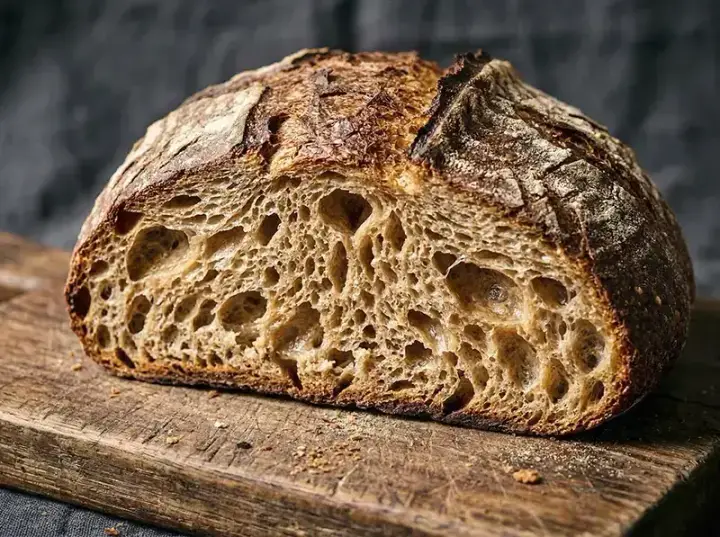
Four ingredients, five minutes of actual work, twelve to eighteen hours of waiting, and a screaming-hot Dutch oven. Jim Lahey published this method in the New York Times in 2006 and it changed home baking permanently. A very wet dough and a long slow fermentation do everything that kneading normally does — they develop the gluten structure and build the flavor. The result is a crackly crust, an open airy crumb, and depth of flavor that shorter methods can't produce.

⏱️
780
Minutes
👥
10
Servings
🔥
180
kcal
Rate this recipe

Key Ingredients

What you'll need

Ingredients

How to make it

Instructions

  1. 1

    Evening, day before: In a large bowl combine flour, salt, and yeast. Add the water. Stir with a wooden spoon or your hand until no dry flour remains — about 30 seconds. The dough will be shaggy, sticky, and wet. That's exactly right. Do not add more flour. Cover the bowl tightly with plastic wrap or a lid.

  2. 2

    Let the dough ferment at room temperature for 12–18 hours. You'll know it's ready when the surface is covered in bubbles and the dough has more than doubled. It should smell pleasantly tangy and yeasty. If your kitchen is cold it may need the full 18 hours; if warm, 12 may be enough.

  3. 3

    When the dough is ready, generously flour a clean work surface. Scrape the dough out — it will be sticky and stretch in long threads. Don't fight this. Gently fold the dough over itself a few times using a scraper or your hands. Shape it loosely into a ball. Place it seam-side down on a large piece of lightly floured parchment paper. Dust the top with flour, drape a clean kitchen towel over it, and let rest 1.5–2 hours. It should puff noticeably.

  4. 4

    About 30 minutes before the dough is ready, place a Dutch oven or heavy pot with a lid into the oven and preheat to 245°C (475°F). The pot must be screaming hot when the bread goes in — this is the oven within an oven that creates the crust.

  5. 5

    When the dough has proofed, carefully take the Dutch oven out. Lower the dough in using the parchment paper as a sling. Score the top with a sharp knife or scissors if desired. Cover and bake for 30 minutes. Then remove the lid and bake another 12–15 minutes until the crust is deeply golden-brown.

  6. 6

    Remove the bread and let it cool on a wire rack for at least 45 minutes before cutting. Cutting it hot seems tempting, but the crumb is still setting inside — slice too early and it compresses and becomes gummy.

Join the conversation

Comments

Leave a comment

Loading comments…

Frequently Asked Questions

Can you bake no-knead bread without a Dutch oven — what can you use instead?

The Dutch oven serves two functions: it traps steam released by the dough in the first 30 minutes of baking (creating the crackling crust) and transfers intense heat evenly from all sides. Without a Dutch oven, use any oven-safe pot with a lid that can handle 245°C — a cast iron casserole, a ceramic cocotte, or even a large stainless pot. The lid is the critical part. If you have no lidded pot, place a deep baking tray inverted over a heavy baking sheet with the bread on it to trap some steam.

Why did my no-knead bread come out flat and dense instead of airy — what went wrong?

Four common causes: the dough was underproofed (the surface should be covered in bubbles, not just a few); the oven or pot wasn't hot enough (preheat both for at least 30 minutes at full temperature); too much flour was added during shaping (the dough needs to stay wet); or the dough was overhandled during shaping and the gas pockets were knocked out. Handle it gently — fold, don't press.

How long can no-knead bread dough ferment — can you leave it longer than 18 hours?

Yes, up to about 24 hours at room temperature is generally safe. Beyond that the yeast runs out of food, the gluten begins to break down, and the dough becomes too slack to hold its shape. If you want to extend past 24 hours, put the dough in the refrigerator after the initial 12 hours. Cold fermentation can continue for up to 3 days and develops even more flavor. Take it out 1–2 hours before shaping to let it warm up.

Can you make no-knead bread with whole wheat flour — what proportion works best?

Yes. Substituting up to 30% with whole wheat (about 130 g whole wheat to 300 g white) gives a nuttier flavor and slightly denser crumb without major changes to technique. Beyond 30% add an extra 30–50 ml of water because whole wheat absorbs more. The fermentation time may need to extend slightly as whole wheat slows the yeast.

How do you know when no-knead bread dough has risen enough and is ready to bake?

Two visual cues: the dough should have at least doubled in volume, and the surface should be dotted with bubbles. If you poke the shaped dough lightly with a floured finger, it should spring back slowly, not immediately (underproofed) and not stay as a dent (overproofed). The dough also becomes much softer and more jiggly when correctly proofed. Smell is reliable too — correctly fermented dough has a pleasant tangy-yeasty aroma.