
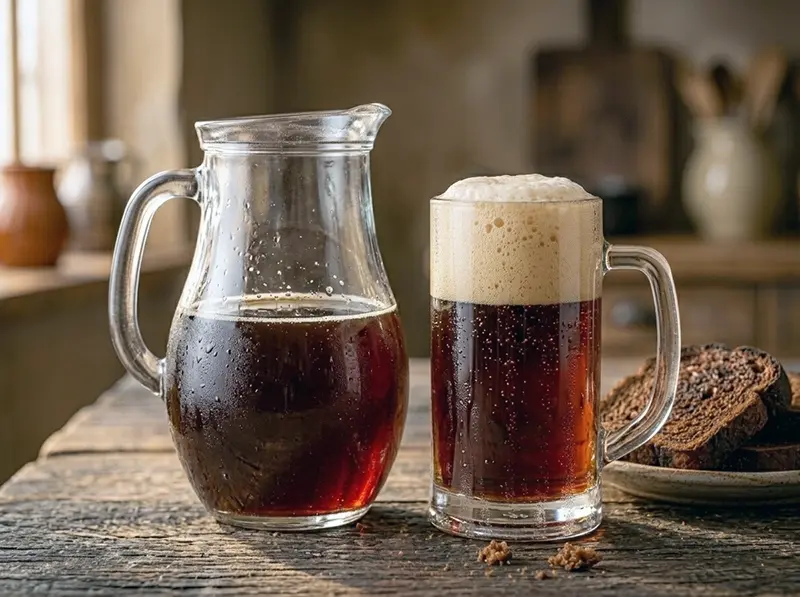
Kvass de Pan Casero
Pan de centeno oscuro tostado casi hasta quemarse, en infusión en agua hirviendo, endulzado y dejado fermentar uno o dos días con una pequeña cantidad de levadura. El kvass es una de las bebidas fermentadas más antiguas de la cocina de Europa del Este — ligeramente ácido, apenas dulce, con una profundidad de pan tostado que ninguna otra bebida tiene.
Ingredientes
- 300 gpan de centeno oscuro, de uno o dos días
- 3 lagua hirviendo
- 100 gazúcar granulada
- 5 glevadura seca instantánea
- 30 gpasas
- 1 puñadomenta fresca o rodajas de limón
Preparación
- Tostar el pan casi hasta quemarlo. Cortar el pan de centeno en rebanadas de 1 cm y extender en una bandeja. Hornear a 200°C durante 15-20 minutos dando la vuelta una vez, hasta que el pan esté profundamente marrón oscuro con bordes casi negros — no quemado, pero muy bien tostado. Este es el paso más importante.
- Hacer la infusión de pan. Poner los trozos de pan tostado en una olla grande. Verter 3 litros de agua hirviendo. Cubrir con un paño limpio y dejar a temperatura ambiente 3-4 horas hasta que el líquido se enfríe por debajo de 30°C. Colar por un tamiz fino en un recipiente limpio para la fermentación, presionando el pan para extraer todo el líquido.
- Añadir azúcar y levadura. Disolver el azúcar en el líquido tibio. Comprobar la temperatura — debe estar por debajo de 30°C antes de añadir la levadura. Añadir la levadura y remover suavemente. Añadir las pasas — llevan levaduras silvestres que contribuyen a la carbonatación.
- Fermentar a temperatura ambiente. Verter el líquido en un frasco limpio dejando 20% de espacio. Cubrir sin sellar herméticamente las primeras 8-12 horas. Tiempo total de fermentación a 20-22°C: 18-36 horas. Probar periódicamente: cuando esté agradablemente ácido con carbonatación visible, está listo.
- Colar, embotellar y refrigerar. Cuando el kvass tenga el nivel correcto de acidez y burbujas, colar otra vez eliminando pasas y sedimento. Envasar en botellas cerradas limpias. Refrigerar inmediatamente. Servir muy frío. Consumir en 3-4 días.
Preguntas
Tres causas comunes. Primera: el líquido estaba demasiado caliente al añadir la levadura — por encima de 35°C la mata; enfriar siempre por debajo de 30°C. Segunda: levadura muerta — probar en agua tibia con azúcar, debe espumar en 10 minutos. Tercera: entorno demasiado frío — la fermentación se ralentiza drásticamente por debajo de 18°C.
Tostar el pan más intensamente con bordes casi negros. Usar pan Borodino en lugar de centeno más claro. Aumentar la proporción pan-agua. Algunos añaden 1-2 cucharadas de malta tostada. Un remojo más largo (6-8 horas) extrae más color y sabor.
Sí, con fermentación más larga. Usar solo pasas como fuente de levadura silvestre — añadir 50 g en lugar de 30, fermentar 48-72 horas. El resultado es más láctico y ácido. También se puede usar una masa madre de centeno: 2 cucharadas de starter activo.
En botellas cerradas en la nevera 3-4 días. Después la acidez aumenta notablemente y el sabor se deteriora. La carbonatación también se acumula — abrir las botellas con cuidado después del 2º día.
El amargor viene de dos fuentes. Primera: el pan se quemó en lugar de tostarse profundamente. Segunda: fermentación excesiva. Probarlo cada 6-8 horas y refrigerar en el momento en que el equilibrio de sabores sea correcto.
Valora
Recetas en tu correo
Un correo a la semana: una receta elegida a tu gusto y lo nuevo del sitio. Puedes dejar de recibirlo con un clic.
De regalo: el libro de recetas de Sergei (e-book).
Al pulsar el botón aceptas la política de privacidad.
Cuéntanos qué te gusta cocinar (30 segundos) →Sigue explorando
Más platos del archivo — elegidos por su solapamiento con lo que estás cocinando ahora.
Únete a la conversación
Comentarios (1)
My grandmother made kvass every summer in a 10-litre jar on the kitchen windowsill. She never used commercial yeast — just the sediment from the previous batch, which she kept in a small jar in the fridge between batches. After 3-4 cycles, the starter becomes remarkably active and produces a more complex, slightly more sour kvass than any dry yeast can.